FAUST
Faust is a surname of German origin, historically derived from the Middle High German words vust or fust meaning “fist.” The name literally identified a person noted for a powerful hand, sometimes linked to the physical strength required of a blacksmith or the metaphorical strength of character of a resolute individual.
In medieval usage, the same surname also appears as a nickname for someone described as having a strong or even angry disposition – a “strong‑willed” figure whose fists carried the symbolic weight of determination. The name has occasionally been viewed as a metonymic occupational surname, referring to a craftsperson who employed their hands most prominently in their trade.
A second possible origin comes from the Latinised personal name Faustus, meaning “fortunate” or “lucky.” Early Christian martyrs bore this name, and it entered German naming traditions during the medieval period. While the application of the name to a surname is rare, the association with “good fortune” could have served as a sobriquet for a notably successful individual, later transmitted hereditarily.
The surname has notable cultural resonance through the legend of Doctor Faustus, the scholar who, according to German folklore, entered a pact with the devil in quest of knowledge and power. Although this story has shaped popular perceptions of the name, the historical etymology continues to trace back to the German words for “fist” or to the Latin for “lucky.”
In the British Isles, early records show the name among parish registers. The marriage of Mary Magdalen Faust to John Balthaser Hasloch on 5 March 1764 at St. James’s, Westminster, and the union of John Henry Faust with Mary Craft on 13 April 1762, also at St. James’s, represent the first instances in London. A further early spelling appears as Hellen Fost, who married Edmond Masse on 9 June 1584 at Harrow‑on‑the‑Hill, recorded during the reign of Queen Elizabeth I (1558‑1603). This suggests that the name arrived in England in the late sixteenth century with at least one early variant of the spelling.
The surname attains several orthographic variants that have surfaced as families migrated and assimilated into new linguistic environments: Faustt, Fauste, Faustus, Foust, Fust, Fausti, Faustini, and Faustinus. Other unrelated names sharing a phonetic resemblance include Fausnaught, Fausnacht, Fausnaugh, Fausnight, Haus, Hausen, Housen, House, and Housel, which evolved independently in various locales. In North America, the surname has occasionally transformed to Fawcett or Fosdick as settlers adjusted to English orthography.
Today the name persists predominantly in Germany and the United States, but it is also found in France, Canada, and Brazil. Migration has altered its distribution over time, so contemporary statistics may differ from those of earlier centuries. However, the name remains recognisable within numerous cultures and retains its association with the themes of ambition, knowledge, and the moral implications of pursuing power, owing largely to the lasting influence of the Doctor Faust legend.
Although the name has Hebrew linguistic ties and Jewish religious associations in its early usage, as indicated by the first source, modern bearers of the surname are typically descended from the Germanic lineages described above. The original meanings of “fist” and “lucky” have not been applied to individuals in contemporary contexts, as surname meanings seldom influence personal characteristics today.
Typical given names associated with the Faust surname
Male
- Christopher
- Daniel
- David
- Jason
- Jeffrey
- Jeremy
- Leon
- Michael
- Neil
- Nicholas
- Peter
- Richard
- Robert
Female
- Angela
- Claire
- Emma
- Emmeline
- Hannah
- Jane
- Karen
- Michele
- Michelle
- Nina
- Pamela
- Rebecca
- Sarah
Similar and related surnames
Related and similar names are generated algorithmically based on the spelling, and may not necessarily share an etymology.
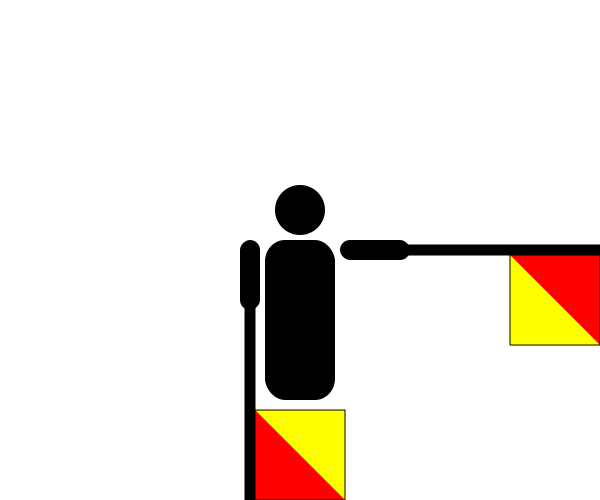
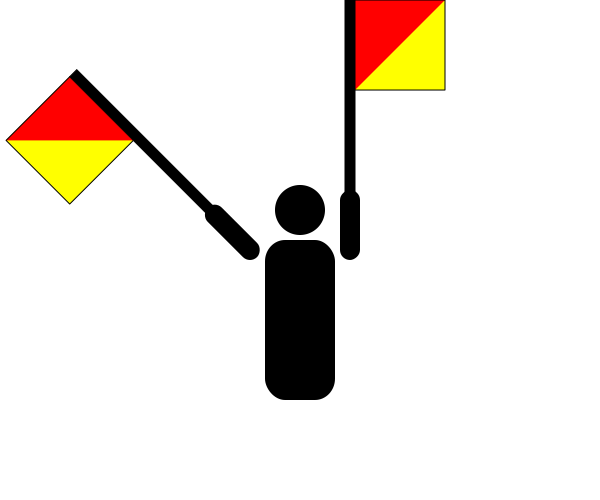
How to communicate the surname Faust in...
Braille
⠋⠁⠥⠎⠞
Morse
..-..-..-...-
Semaphore


There are approximately 212 people named Faust in the UK. That makes it one of Britain's least common surnames. Only around three in a million people in Britain are named Faust.
Religion of origin: Jewish
Language of origin: Hebrew
