FORST
Forst is a surname of German provenance, deriving from the Middle High German term forst, which denotes a forest. The name was traditionally given to persons whose livelihoods were connected with woodland, either as foresters or woodsmen, or to those who resided within or owned forested land.
The etymological root of the surname also appears in Old High German as forst, a word that has survived with little alteration into modern German. In medieval usage the surname functioned both as a topographical identifier for those living near a forest and as an occupational marker for those employed within one.
Historical evidence attests to an exceptionally long existence of the name. The earliest recorded instance is that of William Forst, listed in the Domesday Book of 1086 in Hampshire. This entry confirms that the surname was already in use during the reign of King William the Conqueror and that it has retained its original orthographic form for many centuries.
In England the surname entered the record early and remained in a number of its original spellings. Documents mention individuals such as Lefstan Frost in the feudal records of Bury St. Edmunds (1095) and Gilbert Frost in the pipe rolls of Warwick (1195). These early Anglo‑Saxon formants illustrate the surname’s endurance beyond the Norman conquest.
There are several orthographic variants that have evolved over time. In addition to Forst itself, forms such as Forster, Frost, Foerst, and Vorst are recorded, reflecting differences in regional pronunciation, spelling conventions, and, at times, clerical transcription errors. The variation Forster is a longer English adaptation that still recognises the connection to woodland.
In contemporary geography the surname remains most common within German-speaking areas, particularly in the state of Rhineland‑Palatinate. Migration during the nineteenth and early twentieth centuries spread the name to the United States, Canada and other parts of Europe, where it is now less frequent but still identifiable.
Notable historical bearers of the name include John Frost of Cambridge, a Puritan divine who lived from 1626 to 1667 and was a contemporary of Oliver Cromwell, and Thomas Frost, aged 28, a pioneer who relocated from London on the ship “John” in 1635 to St. Christopher in the West Indies. Though recorded under the variant Frost, these individuals demonstrate the surname’s longstanding presence within English historical records.
In sum, the surname Forst exemplifies a durable link between human settlement and natural landscape, preserving a linguistic heritage that bridges Germanic roots and Anglo‑Saxon history.
Typical given names associated with the Forst surname
Male
- Francis
- Mark
Female
- Eva
- Patricia
Similar and related surnames
Related and similar names are generated algorithmically based on the spelling, and may not necessarily share an etymology.
How to communicate the surname Forst in...
Braille
⠋⠕⠗⠎⠞
Morse
..-.---.-....-
Semaphore

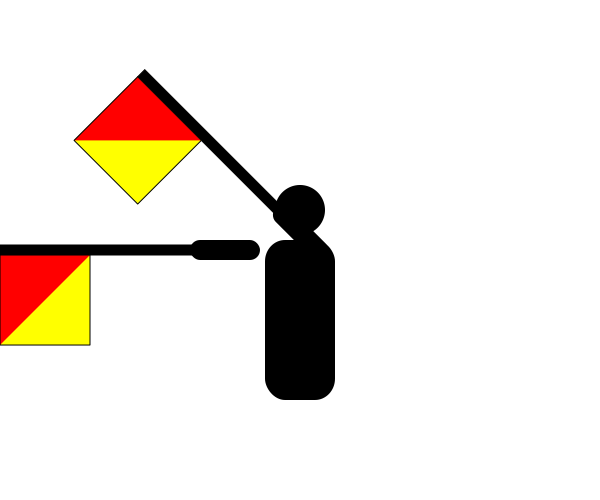
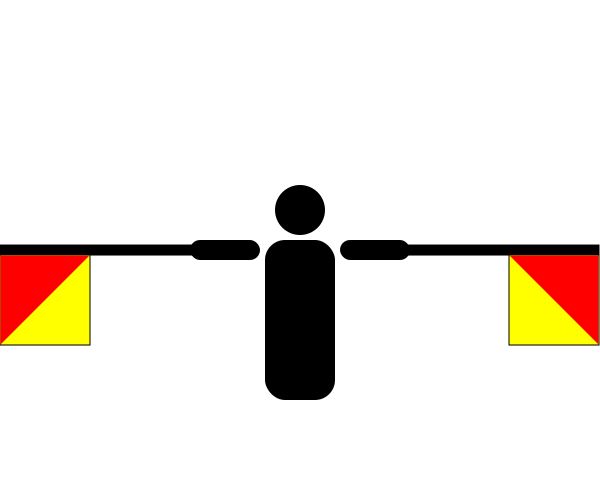

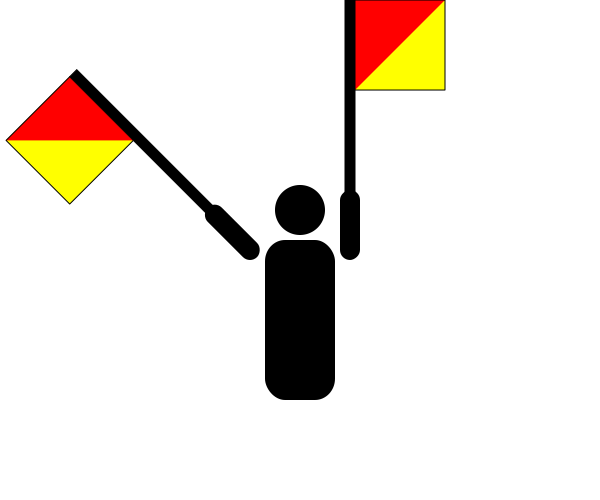
There are approximately 26 people named Forst in the UK. That makes it one of Britain's least common surnames. Fewer than one in a million people in Britain are named Forst.
Origin: English
Region of origin: British Isles
Country of origin: England
Religion of origin: Christian
Language of origin: English