FANN
Fann is an English surname of Germanic origin, first recorded in the late twelfth century in the British Isles. The earliest surviving instance is that of John del Fan, dated 1199 in the Memoranda Roll of Essex, a document from the reign of King Richard I.
The name was originally a patronymic form, meaning “son of Fan.” Fan itself is a medieval given name, a short form of various Germanic names beginning with the element fani, which translates as “peace.” In this sense, Fann denotes a person connected to a lineage that values tranquillity or was identified with a forebear named Fan.
There is another line of English etymology relating Fann to the Middle English word fan, meaning a flag or a winnowing fan. This association suggests that an early bearer of the surname might have been a flag bearer, a maker of fans, or an agricultural worker who used a winnowing fan to sift grain. The occupation-based origin fits with the medieval practice of naming individuals after their trade or dwelling.
Additionally, Fann is sometimes considered a topographic or locational surname. It may have been applied to people who lived in low-lying marshes or the Fen Country of East Anglia. The derivation is from the Old English pre-7th-century word foenn, an East Saxon form meaning a marsh, lake, or boggy region. The earliest known cases of this use appear in Norfolk church registers, such as Alice Fann, who married Thomas Preston in 1593, and Robert Fenn, christened in 1705; these records show that the surname was in use in various spellings, including Fenn and Venn.
Over the centuries the surname has undergone several orthographic variations:
Fenn, Venn, Vaun, Vaune, Vance, Vanns, Van, Fenning, and Fanning. These forms appear to be the result of regional spellings and the interchange of F and V in Germanic languages.
The heraldic representation most commonly associated with the family is a silver shield with a blue fesse bearing three silver escallops, all within a blue bordure engrailed; the crest depicts a dragon’s head erased.
In contemporary usage, the surname is relatively rare. Census and parish records show that it is most frequently found in England, the United States, and Australia, although it is not concentrated in any particular region of these countries. Migration has spread the name globally, but it remains uncommon compared with more prominent English surnames.
While the name Fann also occurs in Chinese contexts, derived from a different origin and meaning, the British lineage discussed here is distinct. Its history reflects the complex interplay of patronymic naming, occupational designation, and geographical features that characterised medieval English onomastics.
Typical given names associated with the Fann surname
Male
- David
- Michael
- Simon
- Terence
Female
- Ce
- Julie
- Katherine
- Margaret
- Philippa
Similar and related surnames
- Fan
- Fain
- Fahn
- Faine
- Faina
- Faines
- Fains
- Faini
- Fana
- Fanna
- Fanai
- Fane
- Fanes
- Fani
- Fannah
- Fanney
- Fannie
- Fannis
- Fanns
- Fanny
- Fano
- Fanou
- Fans
- Fanu
- Fany
- Fayne
- Fean
- Feane
- Feannie
- Feanny
- Fehn
- Fein
- Fenna
- Fenne
- Fenns
- Pfan
- Pfann
- Phann
- Van
- Vann
- Vanne
- Vanns
- Fand
- Fanea
- Faney
- Fang
- Fanow
- Fant
- Fanx
- Feihn
- Feine
- Fennie
- Fenny
- Fiehn
- Fiennes
- Phan
- Vaan
- Vain
- Vane
- Vanna
- Vannes
- Vanni
- Vean
- Fine
- Foan
- Phinn
- Vian
Related and similar names are generated algorithmically based on the spelling, and may not necessarily share an etymology.
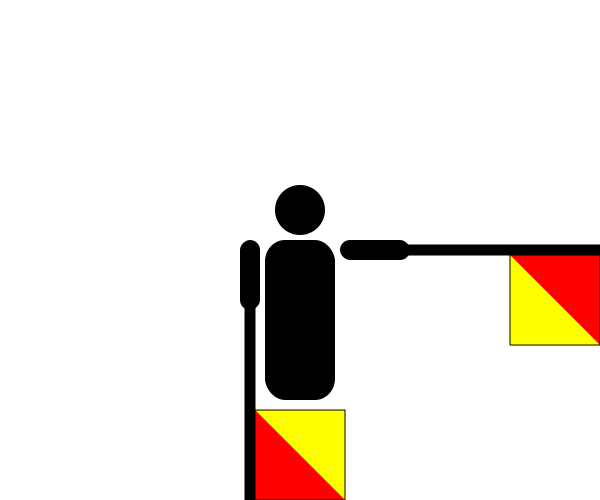
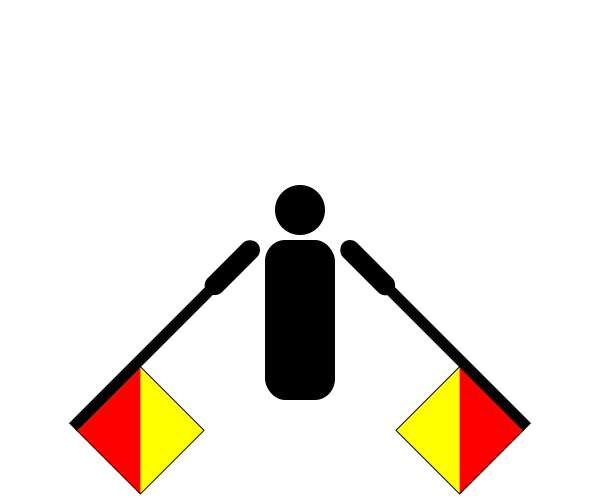
How to communicate the surname Fann in...
Braille
⠋⠁⠝⠝
Morse
..-..--.-.
Semaphore

There are approximately 45 people named Fann in the UK. That makes it one of Britain's least common surnames. Only around one in a million people in Britain are named Fann.
Origin: English
Region of origin: British Isles
Country of origin: England
Religion of origin: Christian
Language of origin: English
