CRUMB
From its earliest records the surname Crumb is firmly rooted in the English Isles, with particular concentration in England. The name derives from the Old English word crumb, a term that originally denoted a small piece or fragment, and later came to mean a bent or crooked shape. The metaphorical extension of the term is reflected in its use as a nickname for those of small stature or slight build, and in medieval contexts it may also have been applied to someone perceived as insignificant or unimportant.
Three main hypotheses have been proposed to explain the emergence of the name. One suggests a metonymic occupational origin, describing a maker or seller of hooks and hangers, a trade for which the Old English adjective for “bent” was apt. A second hypothesis regards the name as a descriptive nickname, given to an individual with some physical deformity or curvature of the spine, a characteristic that would have set him apart in a tight-knit community. The third possibility points to a locational origin, linking bearers of the name with places such as Croom in East Yorkshire, derived from Old English crohum meaning a narrow valley, or with Croome in Worcestershire, taken from the Welsh crwm meaning crooked, but here referring to a river bend.
The surname has appeared in a range of medieval spellings, including Crum, Crome, Croom, Crume, Cromett and the variant Crombe. Early documentary references date back to the late 12th and early 13th centuries: the Assize Court Rolls of Staffordshire record a Robert le Crumbe in 1199; Simon de Crombe is listed in the Hundred Rolls of Worcestershire in 1275; Luke Croom appears in the 1309 Essex Subsidy Rolls; and William Cromett is noted in a 1697 marriage register in Stepney, London. These records establish the name’s long historical presence in England.
While the surname remains uncommon in present-day Britain, it has acquired visibility in the United States, where census data indicate several thousand bearers. Notable individuals bearing the name span a variety of fields, most famously the underground comic artist Robert Crumb, the composer George Crumb, and the blues musician Frank Stokes, who sometimes performed under the name Frank Crumb. Such modern associations demonstrate the continued relevance of the surname beyond its medieval origins.
In summary, the surname Crumb exemplifies the manner in which early English nicknames, occupational labels, or geographical markers were adopted as hereditary family names. Its etymology, extensive historical record, and variation in spelling illustrate the fluid nature of surname formation in early medieval Britain.
Similar and related surnames
Related and similar names are generated algorithmically based on the spelling, and may not necessarily share an etymology.
How to communicate the surname Crumb in...
Braille
⠉⠗⠥⠍⠃
Morse
-.-..-...----...
Semaphore

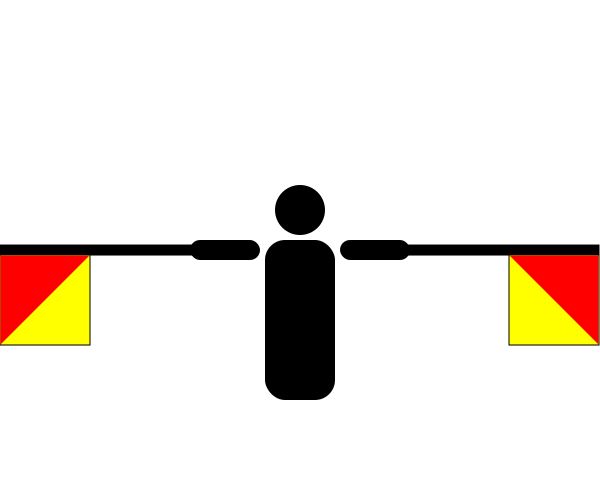

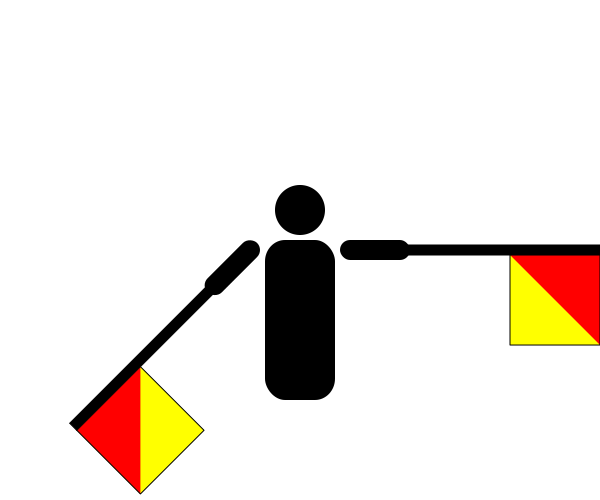
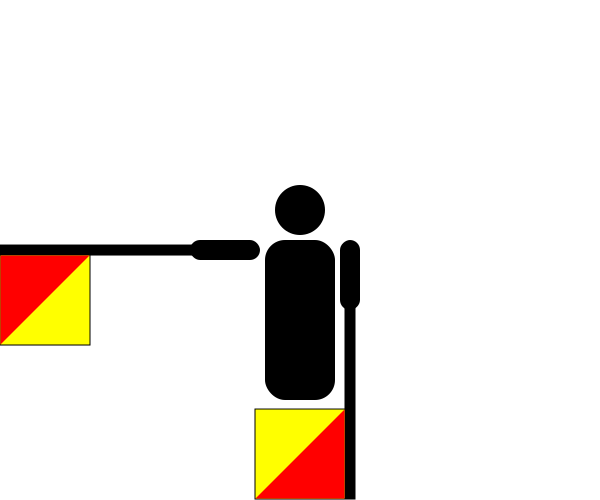
There are approximately 107 people named Crumb in the UK. That makes it one of Britain's least common surnames. Only around two in a million people in Britain are named Crumb.
Origin: English
Region of origin: British Isles
Country of origin: England
Religion of origin: Christian
Language of origin: English
