CRUM
Crum is a surname of both English and Scottish provenance, appearing in the medieval records of the British Isles under a range of spellings. It is linked to common Anglo‑Saxon and Gaelic lexemes that describe physical form or place.
The earliest English derivation is from the Old English word crumb, meaning a small piece or fragment. In medieval usage this term also conveyed the notion of something bent or crooked, a nuance that is reflected in later occupational and descriptive forms. Within Scottish tradition, the name is seen as stemming from the Gaelic crom, which translates as bent or crooked and may describe a physical deformity or a noteworthy bend in the landscape.
Through time Crum acquired a number of orthographic variations, including Crumb, Crome, Croom, Croome, and the diminutives Cromett and Crommett, all of which appear in Legal and tax records dating back to the fourteenth century. These variants illustrate the fluidity of spelling in a period when standardised orthography had not yet been established.
Place‑based origins are also documented. In England, the name may refer to inhabitants of Croom in East Yorkshire, a valley once termed crohum, or to those from Croome in Worcestershire, a site named after the Welsh word crwm meaning a crooked river. In Scotland and Northern Ireland, the surname is linked to habitational sites such as Crimond in Aberdeenshire, formerly called Crombie, or a locality near Uddington. Such geographic connections suggest that the name was adopted by families who lived near a distinctive bend or hill.
Early documentary evidence of the surname includes Simon de Crombe recorded in the Hundred Rolls of Worcestershire in 1275, Luke Croom documented in the Essex Subsidy Rolls of 1309, and William Cromett who married Sophia Tute in East Stepney, London, in 1697. The first recorded spelling in the legal record is believed to be that of Robert le Crumbe in the Staffordshire Assize Court Rolls of 1199, during the reign of King Richard the Lionheart.
Descriptive use of the surname is supported by its application to individuals of small stature or slight build, as suggested by the fragmentary sense of the word. It may also have served as an occupational marker for makers or sellers of hooks and hangers, for whom the Old English term for bent or crooked objects would have been appropriate. The persistence of the nickname in medieval Britain indicates that it was used to identify people within relatively small communities.
In later centuries, Crum has been carried across the Atlantic, becoming most common in the United States, particularly in West Virginia, Kentucky and Indiana. Retention of the surname in the United Kingdom remains primarily within Scotland, with notable numbers also found in northern Ireland. Migration has also spread the name to Canada, Australia, Germany and Chile.
Cross‑lingual parallels exist. The German counterpart Krumm and its Middle High German root krum share the same meaning of bent or crooked, indicating a possible independent yet etymologically related emergence. Similarly, the Dutch surname Krom shares this heritage, while the Newfoundland variant Crummey illustrates the surname’s adaptation to local linguistic contexts.
Typical given names associated with the Crum surname
Male
- Alexander
- Andrew
- David
- Ian
- James
- John
- Kevin
- Mark
- Martin
- Matthew
- Stephen
- Timothy
Female
- Ailsa
- Catherine
- Christine
- Emma
- Janet
- Joanne
- Julie
- Laura
- Lyn
- Margaret
- Nicola
- Penelope
- Vanessa
- Yvonne
Similar and related surnames
Related and similar names are generated algorithmically based on the spelling, and may not necessarily share an etymology.
How to communicate the surname Crum in...
Braille
⠉⠗⠥⠍
Morse
-.-..-...---
Semaphore

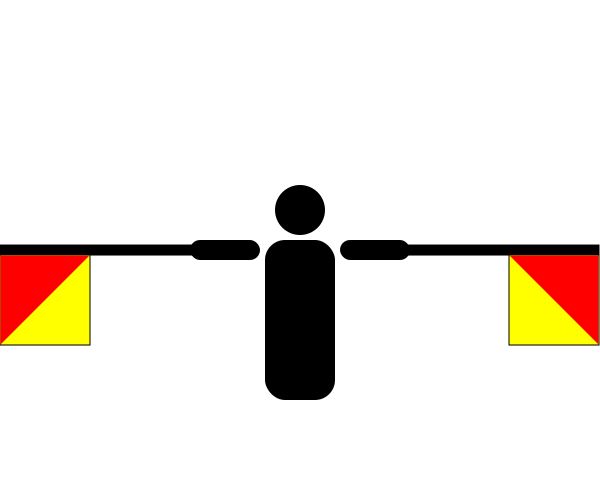

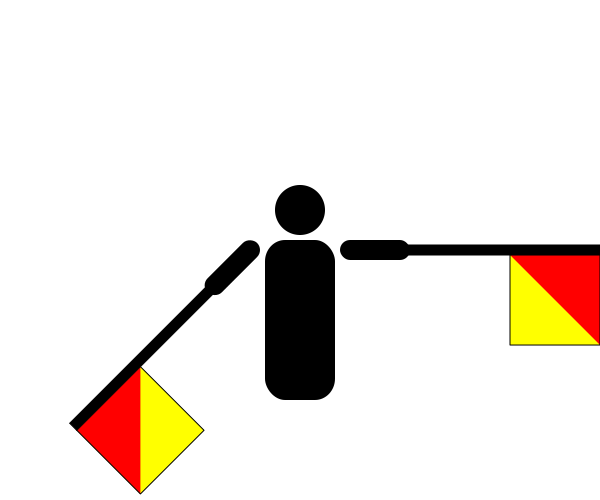
There are approximately 349 people named Crum in the UK. That makes it one of Britain's least common surnames. Only around five in a million people in Britain are named Crum.
Surname type: From given name or forename
Origin: Celtic
Region of origin: British Isles
Country of origin: Scotland
Religion of origin: Christian
Language of origin: Gaelic

Famous people named Crum
- Walter Ewing Crum - Scottish coptologist (1865 to 1944)
- Alison Crum - Viola da gamba player
- Johnny Crum - Football player (1912 to 1969)
Names and descriptions courtesy of Wikipedia, and may contain errors. This is not intended to be an exhaustive list of every famous person with this name.