COGGIN
Coggin is a surname of English origin. It first appears in recorded history in the late twelfth century, with the earliest surviving mention being that of Milo de Cogan in the Records of County Cork dated 1171. Other early attestations include William de Cogan in the Pipe Rolls of Glamorgan in 1185 and John de Cogan in the Somerset Hundred Rolls of 1273.
The name is traditionally considered a diminutive. It is derived from the medieval given name Coggan, which itself is a diminutive of the Old English personal name Cuthbert. The latter name originates from the Old English cuð meaning “famous” and beorht meaning “bright”; thus Coggin may be interpreted as “descendant of Coggan” or “son of Cuthbert.” This etymology explains the surname’s frequent placement among Christian families in England.
Some scholars recognise a second possible origin for the surname, as a dialectal variant of Cogan, a Welsh locational name taken from a place called Cotgan in Llandaff near Cardiff. The Welsh word cotg translates as “bowl” or “depression.” Other accounts suggest that Coggin may be the Anglicised form of the Gaelic patronymic MacCogadhain, comprising the prefix mac (son of) and the personal name Cuchogaidh meaning “hound of war.” This Gaelic connection is reflected in the various Irish renderings of the name such as Cogan, Coggan, Coggen, Cogin and Coggon.
In the maritime context, Coggin has also been linked to the Old English word cogg, a reference to a type of small ship. The surname may have arisen as an occupational name for an individual who built or sailed such vessels, or as a locational name for someone residing near a dock or shipyard. An alternative occupational explanation considers the name as derived from a maker of cogs – the toothed wheels used in machinery – further emphasising the didactic nature of medieval surnames.
The spelling of the surname has evolved over time, resulting in a number of accepted variants. These include Coggins, Coggan, Coggon, Coggen, Cogan, Goggin and Cogin. The divergent spellings are largely attributable to regional accents, the limited literacy of the period and the inconsistent phonetic transcription employed by clerks and officials. Consequently, different branches of the family may have adopted distinct forms, reflecting both geographical dispersion and personal preference.
While no longer a common surname, Coggin remains concentrated in the south of England and in several English‑speaking countries, most notably the United States. In the United States, the surname is rare but can be found in states such as North Carolina, Texas and Georgia, reflecting historical migration patterns from the British Isles.
Typical given names associated with the Coggin surname
Male
- David
- Frederick
- Graham
- James
- Jason
- John
- Mark
- Michael
- Paul
- Peter
- Richard
- Stephen
Female
- Anne
- Gina
- Heather
- Jean
- Joanne
- Karen
- Linda
- Lisa
- Marie
- Patricia
- Rachel
- Sarah
- Susan
- Tracey
Similar and related surnames
Related and similar names are generated algorithmically based on the spelling, and may not necessarily share an etymology.
How to communicate the surname Coggin in...
Braille
⠉⠕⠛⠛⠊⠝
Morse
-.-.-----.--...-.
Semaphore

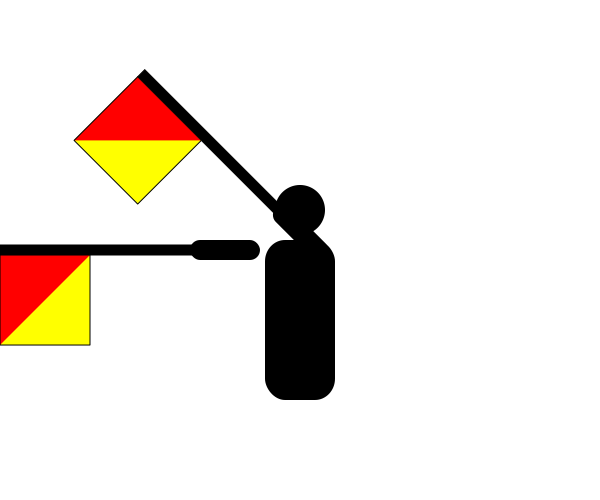

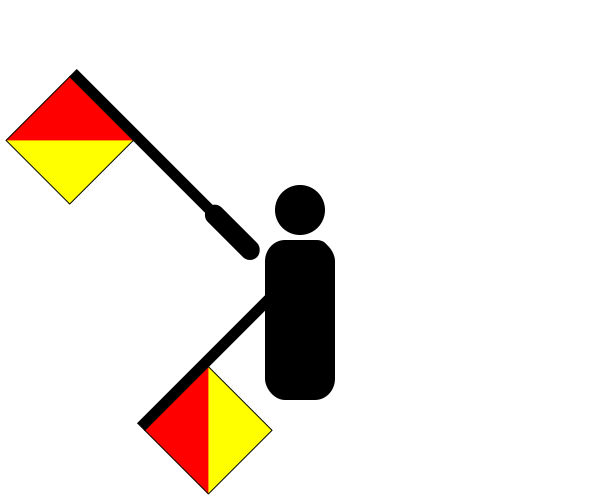
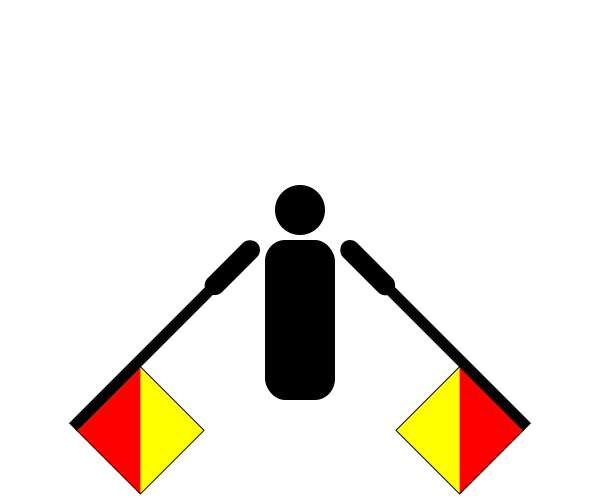
There are approximately 547 people named Coggin in the UK. That makes it one of Britain's least common surnames. Only around eight in a million people in Britain are named Coggin.
Surname type: Diminutive
Origin: English
Region of origin: British Isles
Country of origin: England
Religion of origin: Christian
Language of origin: English
