COGAN
Cogan is a surname of predominantly Irish origin, the form traced back to the Gaelic Ó Cogáin or MacCogadhain. The element Cogáin is usually interpreted as “young warrior” and the derivative MacCogadhain literally means “son of the little spear” or “son of Cogadhain”, with cogadh signifying war. These etymological connotations suggest that the earliest bearers of the name were associated with martial prowess or a family of fighters.
The surname is most commonly found in Munster, particularly County Cork, where it appears in medieval records such as the Records of County Cork where a person named Milo de Cogan is recorded in 1171. Later entries in English documents, for example the Pipe Rolls of Glamorgan, mention a William de Cogan in 1185, and the Somerset Hundred Rolls record a John de Cogan in 1273. These early instances display the surname’s presence both on the continent and within the English-speaking world during the medieval period.
In England the surname appears to have a locational aspect, linked to a place named Cotgan in Llandaff near Cardiff. The Welsh word for bowl or depression is the origin of the place name, and the surname may have been adopted by inhabitants of that area. The place-based theory is complemented by the observation that the first London Church Register entry for a person with a related spelling—Jane Coggins—was recorded on 3 July 1616. That same year a woman named Sara Coggin, aged 20, sailed aboard the *Assurance* from London to Virginia, illustrating the surname’s early migration to the New World.
Over time the surname has acquired a number of spelling variants that are often used interchangeably. The principal English forms include Coogan, Coggan, Coggin, Coggins, and Goggin. In addition, the Jewish surname Kogan, sometimes rendered as Cohen in Eastern Europe, is considered a separate ethnogenesis, though it shares phonetic similarity. It should be noted that not every individual bearing the surname Kogan or Cohen is a priest, a misconception that has arisen during the historical period when surnames were assigned.
Despite its relatively small geographical concentration compared to other Irish surnames, Cogan has been widely disseminated through emigration, particularly during the 19th and 20th centuries. Today it is found in the United Kingdom, the United States, Canada, Australia, and New Zealand, especially in areas with large Irish diasporas such as Massachusetts, New York, and parts of Ontario and Victoria. The distribution of the name remains a testament to the patterns of Irish migration and the lasting impact of medieval Gaelic nomenclature on contemporary society.
Typical given names associated with the Cogan surname
Male
- Andrew
- Christopher
- David
- James
- John
- Mark
- Michael
- Paul
- Peter
- Richard
Female
- Barbara
- Elizabeth
- Helen
- Jane
- Janet
- Jennifer
- Karen
- Linda
- Margaret
- Mary
- Nicola
- Rosemary
- Sandra
- Sarah
- Susan
Similar and related surnames
Related and similar names are generated algorithmically based on the spelling, and may not necessarily share an etymology.
How to communicate the surname Cogan in...
Braille
⠉⠕⠛⠁⠝
Morse
-.-.-----..--.
Semaphore

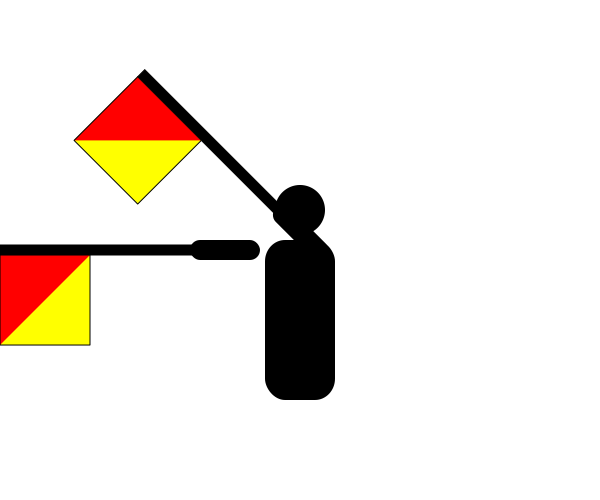


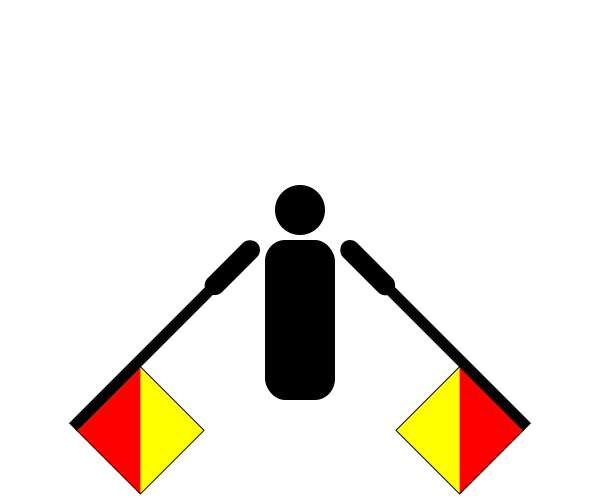
Did you know?
According to a survey carried out by Democracy Club, politicians and candidates with the surname Cogan are most likely to say that their favourite biscuit is a Shortbread.
There are approximately 1,263 people named Cogan in the UK. That makes it roughly the 6,159th most common surname in Britain. Around 19 in a million people in Britain are named Cogan.
Surname type: Location or geographical feature
Origin: English
Region of origin: British Isles
Country of origin: England
Religion of origin: Christian
Language of origin: English
