BERGIN
Bergin is a surname associated primarily with Ireland, having its roots in the Gaelic naming tradition. The earliest references to the name are found in the linguistic heritage of the Scottish Gaelic and Irish Gaelic tongues, where it is derived from the patronymic form Ó Beirgin, meaning “descendant of Beirgin.” The personal element Beirgin is believed to stem from the Gaelic word beirg, which translates to “spear,” thus suggesting a warrior lineage for the bearers of the name.
Historically, the surname Bergin has been most commonly recorded in the counties of Tipperary and Offaly. In these areas, individuals bearing the name were noted as members of clans that played roles in local leadership and landed estates. Earlier records also indicate that the clan O’Beirgin held positions of authority in County Galway, further emphasising the name’s association with Gaelic society. In contemporary times, the name remains instantly recognisable throughout the province of Leinster and retains a strong prevalence in Ireland.
Variations of the surname appear in historical documents as a result of regional pronunciation and orthographic adaptation. These include forms such as Bergen, Bleinan, Beregan, Berrigan, Birgin, Burgoin, Burgoyne, Burgin, Burgwin and others. Such diversity demonstrates a common pattern in the transmission of Gaelic surnames, where the initial consonant and suffixes were altered to align with English spellings. In certain cases, the suffix -in has been applied to create a locative sense, indicating a household or family dwelling in a specific area.
Other theories regarding the surname arise from sources that connect it to continental Europe. According to an alternative account, forms resembling Bergin and its cognates were used as locational surnames in Dutch, French, and Norwegian contexts; for example, the French region of Burgundy and the towns called Bergen in both the Netherlands and Norway. These claims suggest that some bearers of the name may have migrated from these areas during periods of diaspora or commercial expansion. However, such associations are comparatively less documented in the Irish context and should be regarded as supplementary rather than primary.
In the medieval period, a form of the name appeared in the Domesday Book of 1086 when a Walter Burgoin was recorded as holding lands in Devonshire. Later, in 1128, a Scottish bearer known as Robert Burgonensis was noted in the rolls of St. Serf's island, Loch Leven, and was mentioned for alleged misdeeds. These early references illustrate the broader European presence of the name and highlight the frequent variation in spelling across documents of the era.
Other historical mentions include a 13th‑century tax register in London where an Adam de Burgoine appears, a 1784 christening witness named Cornelius Berregone, and a 19th‑century entry citing John Berrygun as a petitioner at St George in the East, Stepney. In the realm of military history, Admiral John Burgoyne, known for his involvement in the American Revolutionary War, demonstrates the name’s reach beyond Ireland and into broader geopolitical narratives.
From a semantic standpoint, the Gaelic component beirg dates back to a root meaning “plunder, loot or pillage,” while the suffix -gin could be interpreted in a patronymic sense, denoting “birth.” Consequently, one might understand the name as indicating “born of plunder” or, more broadly, as signifying the strength of a lineage born through conflict and resilience. In correspondence, some scholars propose a Germanic reading in which berg means “mountain” and the suffix -in designates a residence or habit. The “mountain dweller” interpretation highlights a contrast between martial prowess and the stoic steadiness associated with a highland environment.
In the contemporary diaspora, concentrations of the surname can be found in the United States, the United Kingdom, Australia, and Canada, reflecting the migration patterns of Irish families across the globe. Genealogical research remains the most reliable method for confirming the specific branch and historical context of individual family lines, particularly given the multiplicity of orthographic forms the name has adopted across centuries.
Typical given names associated with the Bergin surname
Male
- Anthony
- Christopher
- David
- James
- John
- Joseph
- Martin
- Michael
- Patrick
- Paul
- William
Female
- Catherine
- Ellen
- Emma
- Gillian
- Hazel
- Katherine
- Margaret
- Mary
- Michelle
- Patricia
- Sarah
- Sharon
- Susan
Similar and related surnames
- Bargen
- Bargent
- Bargin
- Bargioni
- Bergain
- Bergan
- Berge
- Bergen
- Bergene
- Bergeon
- Berger
- Bergher
- Bergins
- Bergis
- Berjani
- Berjean
- Birgen
- Birgi
- Birgin
- Birgini
- Borgen
- Borgi
- Borgins
- Bourgein
- Bourgeon
- Bourgine
- Bragen
- Bragin
- Bragina
- Bridgen
- Bridgeon
- Bridgin
- Brodgen
- Brogen
- Brogin
- Brougean
- Browjohn
- Brugioni
- Burgar
- Burgen
- Burgeny
- Burgeon
- Burger
- Burgher
- Burgi
- Burgin
- Burgine
- Burgins
- Burgyne
- Burjan
- Burjin
Related and similar names are generated algorithmically based on the spelling, and may not necessarily share an etymology.
How to communicate the surname Bergin in...
Braille
⠃⠑⠗⠛⠊⠝
Morse
-.....-.--...-.
Semaphore
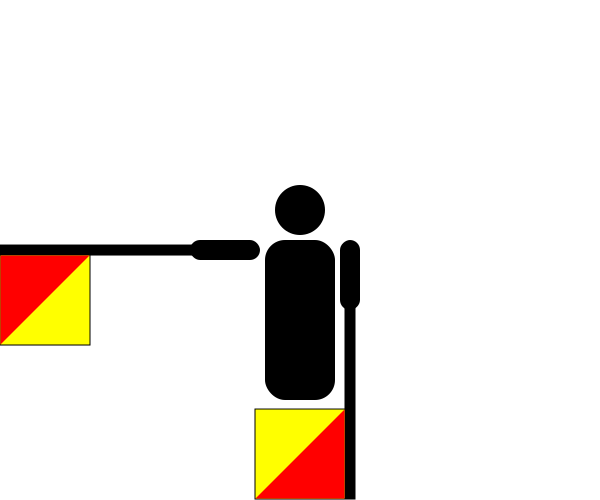

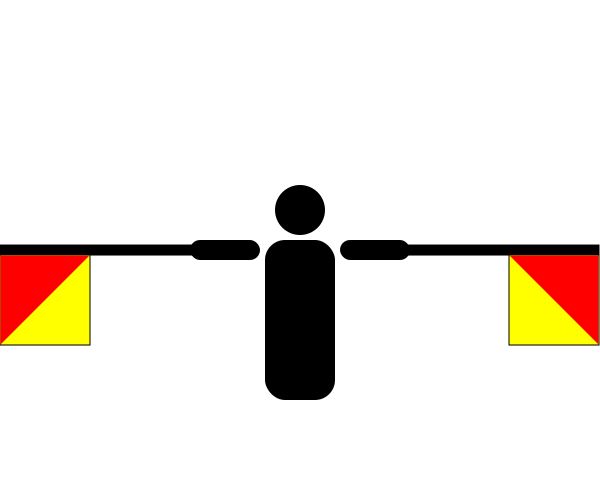

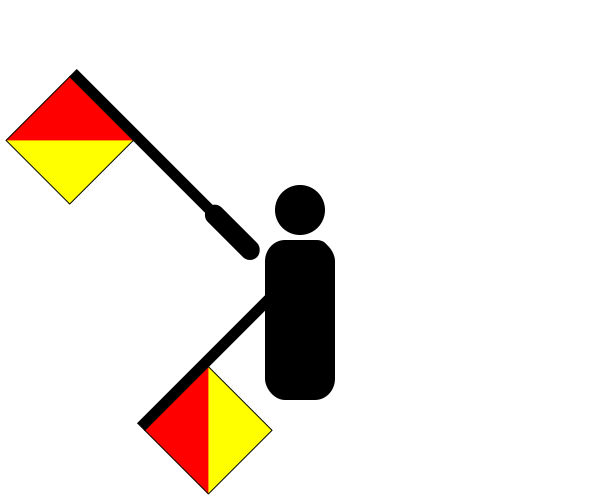
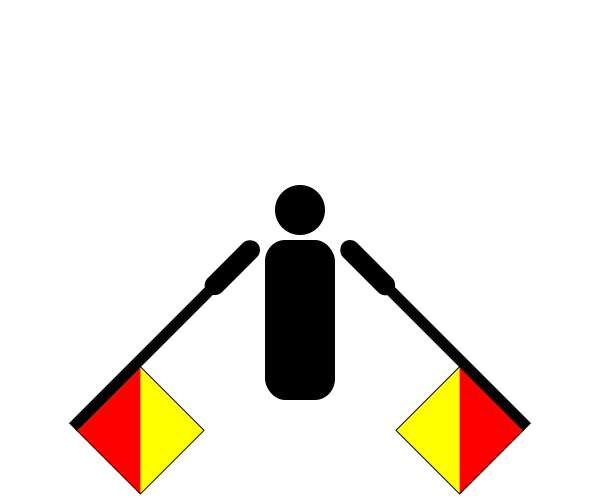
There are approximately 1,929 people named Bergin in the UK. That makes it roughly the 4,343rd most common surname in Britain. Around 30 in a million people in Britain are named Bergin.
Origin: Celtic
Region of origin: British Isles
Country of origin: Ireland
Religion of origin: Christian
Language of origin: Gaelic

Famous people named Bergin
- Liam Bergin - Actor
- Avilla Bergin - Northern Ireland football player
Names and descriptions courtesy of Wikipedia, and may contain errors. This is not intended to be an exhaustive list of every famous person with this name.