BURGEN
Burgen is a surname primarily of German origin, its etymology rooted in Middle High German. The word burc or burg translates to "castle" or "fortress". Consequently, the surname is often considered an occupational name, originally applied to individuals who dwelt near, worked for, or were otherwise associated with a castle or fortress. The name may also have been adopted for persons who displayed characteristics of strength or fortitude, thereby reinforcing the link to fortified structures.
In addition to its Germanic roots, the surname appears in records of pre‑medieval French provenance. Variants such as Burgoin, Burgoyne, Burgan, Burgen, Burgin and Burgyn are well documented in the United Kingdom. These forms emerged following the Norman conquest of England in 1066, when followers of Duke William, later known as “The Conqueror”, brought the name from the region of Burgundy in Eastern France. The original source of the cluster is the Germanic tribal group Burgundii, whose early incursion into Gaul dates to around 480 AD. The Domesday Book of England (1086) records Walter Burgoin, who was granted lands in Devonshire, marking the earliest English entry for the surname.
In Scotland the earliest recorded bearer of the name was Robert Burgonensis, cited in the medieval roll Cartarum prioratus Sancti Andrew of 1128. He was accused of rapacity by monks at St. Serf’s Island, Loch Leven. Later attestations include Adam de Burgoine in the London Subsidy Tax register of 1319, Elizabeth de Burgon in the Yorkshire Poll Tax Rolls of 1379, Thomas Burgane holding lands in Innerkethin in 1500, and Edward Burgen christened at All Hallows church, London Wall, on 8 January 1665. These records illustrate the spread and continuity of the surname across the British Isles over several centuries.
The notable figure General John Burgoyne, an author and soldier, is recorded as having capitulated to George Washington at the Battle of Saratoga in 1777. This defeat played a decisive role in the American Revolutionary War, ultimately leading to the independence of the United States. Although his name is commonly rendered as Burgoyne, the roots of the surname remain consistent with the meanings described above.
Another tradition attributes an Old Norse origin to Burgen, deriving from the word Borg, meaning “fortification” or “castle”. The suffix -en in Old Norse denotes a locative sense, thus indicating a person coming from or living by a fortification. This perspective highlights the surname’s potential presence within Viking societies, particularly in Norway, and its diffusion to other countries through migration. The Old Norse interpretation, however, aligns closely with the Germanic meaning, reinforcing a common theme of strength, security and association with fortified places.
Typical given names associated with the Burgen surname
Male
- Andrew
- Charles
- Chas
Female
Similar and related surnames
Related and similar names are generated algorithmically based on the spelling, and may not necessarily share an etymology.
How to communicate the surname Burgen in...
Braille
⠃⠥⠗⠛⠑⠝
Morse
-.....-.-.--..-.
Semaphore
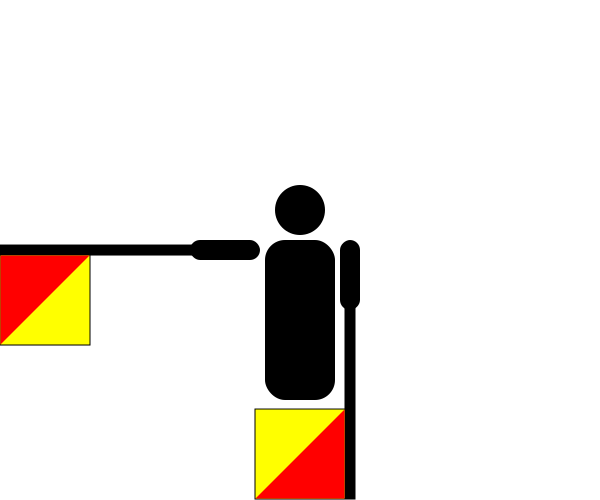

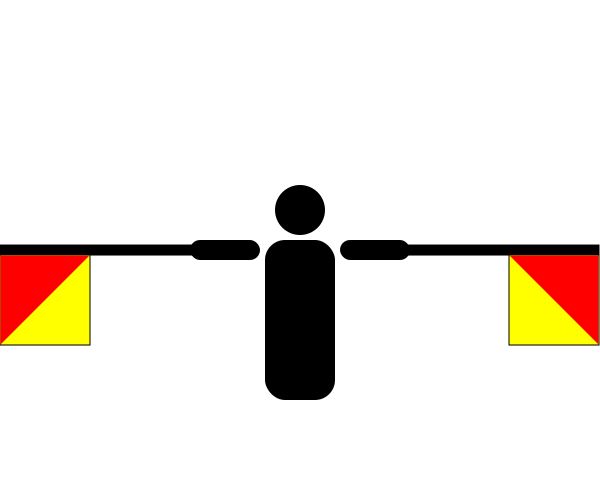


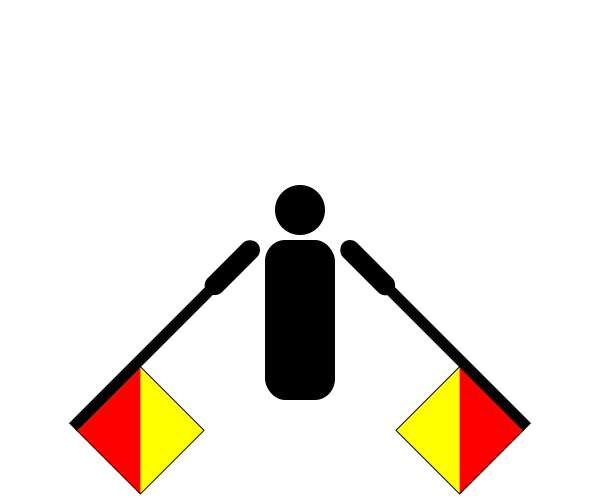
There are approximately 76 people named Burgen in the UK. That makes it one of Britain's least common surnames. Only around one in a million people in Britain are named Burgen.

Famous people named Burgen
- Arnold Burgen - Academic
Names and descriptions courtesy of Wikipedia, and may contain errors. This is not intended to be an exhaustive list of every famous person with this name.