BURGER
Origins of the surname Burger can be traced to Germany, where it is an occupational name derived from the Middle High German word burger, meaning a citizen or village dweller. This appellation was originally applied to individuals who resided within the fortified walls of a town or city, distinguishing them from those living in rural surroundings.
The term burg in Old German translates to a castle or fortified town, and consequently a burger was understood to be an inhabitant of such a borough. The name was commonly adopted for people who lived in or near a fortified settlement, or who performed work for a town’s property or castle. Consequently the surname conveys a status of freeman and membership in a town’s governing body in medieval usage.
Within Germany, the surname is widespread, with notable concentrations in German‑speaking regions. Variants exist in pronunciation and spelling, including Berger and Bergmann, which share the same roots and meaning. Other recorded spellings across Northern Europe include Bourger, Burgher, Burgar, Burker, Borger, Borgar, Bürger, Bürgers, Burgers, Buerger, and Burgerman. These variations arise from regional dialects and linguistic influences of nearby countries such as the Netherlands, Belgium, Austria and Switzerland.
In England the name appears in documentary records from the thirteenth century onwards. The earliest known spelling is that of Henry le Burger, dated 1275 in the London Hundred Rolls, during the reign of King Edward I. Subsequent English spellings include Burgher, Burker and Borger. The name’s meaning in Middle English derived from burg, and it denoted a freeman or citizen of a fortified town.
In the United States, the surname is found among descendants of German emigrants and retains its association with its German origins. The name is also present in Dutch and Fennish communities, where it appears as van den Burger, indicating “from the citizen.” In some cases, families anglicised the name to Townsend, a surname that also signifies a connection to a town. Jewish Ashkenazi families have occasionally adopted Burger as an English form of surnames such as Berg or Berger, although these names have distinct etymological meanings relating to mountains.
Through migration and population movements, the surname now occurs in countries beyond its Germanic heartlands, including the United States, South Africa and the Netherlands. Despite geographical dispersion, the surname preserves a clear link to the concept of a citizen belonging to a fortified borough, a meaning that has endured from medieval times to the present day.
Typical given names associated with the Burger surname
Male
- Albert
- Christopher
- Daniel
- David
- John
- Michael
- Miles
- Nicholas
- Paul
- Peter
- Richard
Female
- Adriana
- Amanda
- Amy
- Angela
- Catherine
- Claudia
- Elizabeth
- Helen
- Janet
- Katherine
- Lisa
- Martina
- Susan
Similar and related surnames
- Barger
- Bargar
- Bargers
- Bargor
- Bruger
- Burge
- Barruger
- Berger
- Bergers
- Bergier
- Birger
- Borgars
- Borger
- Borgers
- Bourger
- Buerger
- Burgar
- Burgard
- Burgers
- Burghard
- Burghardt
- Burghart
- Burgher
- Burgner
- Burguera
- Burguiere
- Bargary
- Bergan
- Bergara
- Berge
- Bergen
- Bergher
- Bergin
- Berguer
- Brager
- Breger
- Burer
- Burga
- Burgel
- Burges
- Burgress
- Burner
- Brieger
- Burgert
Related and similar names are generated algorithmically based on the spelling, and may not necessarily share an etymology.
How to communicate the surname Burger in...
Braille
⠃⠥⠗⠛⠑⠗
Morse
-.....-.-.--...-.
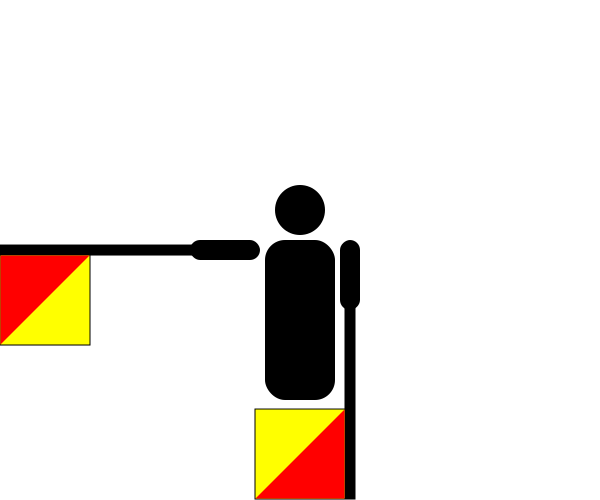
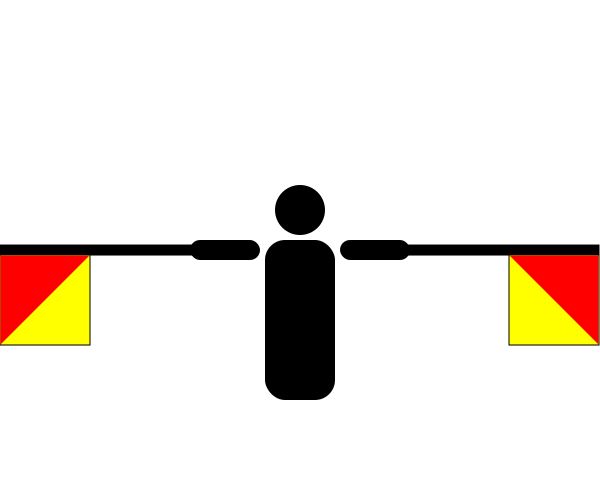
Semaphore



There are approximately 802 people named Burger in the UK. That makes it roughly the 8,747th most common surname in Britain. Around 12 in a million people in Britain are named Burger.
Surname type: Occupational name
Region of origin: Europe
Country of origin: Germany
Language of origin: German