WOOLARD
The surname Woolard has its roots firmly planted in the English landscape, tracing back to the early medieval period when the wool trade formed the backbone of the national economy. It is primarily an occupational name, derived from the Old English word wullweard, literally meaning “guardian of the wool”. The term combines wull, referring to wool, and weard, meaning guard or protector, thereby identifying those who oversaw the production, processing and commerce of wool.
Historical records demonstrate that the name first appeared in written form in the late twelfth century. A citation in the Cambriagshire Fines Court Records records the spelling Wlward for a certain Martin in the year 1199, during the reign of King Richard I, the Lionheart. Further evidence of the name’s antiquity is found in the Domesday Book of 1086, where a personal name recorded as Wluuard or Vluuard is noted and later evolved into Wol(f)ward by the thirteenth century. These entries corroborate the name’s existence under a form very close to the modern spelling, indicating a continuity of usage across the centuries.
Two distinct linguistic sources have been identified for the modern surname. The first originates from the pre‑seventeenth‑century personal name Wulfweard, composed of the elements wulf (wolf) and weard (guardian). In this construction, the surname was originally a patronymic, granting the bearer the identity of a “wolf guardian.” The second source is locational, derived from the place name “Wolwarde” recorded in the Domesday Book, itself composed of wulf and weard and signifying an “enclosure to protect flocks from wolves.” The settlement was situated in Warwickshire, and inhabitants of the area later adopted the locative surname in its various spellings.
Over time, these two origins have merged linguistically, giving rise to a range of variant spellings. The most common forms include Woolward, Wolward, Woolwerd, Wolwerd, Wollard, and Wollward. Less frequent but still recognised variants are Olard, Ollard, Ollward, and Ooard, which result from the omission of the initial W in some dialects. Further orthographic experiments have produced spellings such as Woollard, Woolardre, Wollardre, Wollerd, and Wolard. Surnames of the very same origin, often confused in contemporary registers, include Wooler, Woolert, Wullard, Woolgar, Wallard, Worrall, and Wolferd. The variety of spellings reflects the differing accents across England and the changing conventions of spelling through the centuries.
Despite its English provenance, the Woolard name also possesses a noted presence at the northern frontier, where it is centred on the English–Scottish border. In that region, the term “woolward” appears to have been applied to shepherds or merchants involved with the wool trade, emphasising a direct connection to the handling of wool or wool‑related goods. Records indicate that, in the seventeenth and eighteenth centuries, members of families bearing this surname frequently migrated southwards, particularly to the Southern United States, seeking opportunities in farming, trade or seafaring. A case in point is that of Anne Woolard, who married Thomas Gourlay on 1 April 1690 at St. James, Dukes Place, London, a marriage that underlines the surname’s activity within the English capital during that era.
In the New World, the Woolard name experienced both dispersion and permanence. By the nineteenth century, it was well established across the American Midwest, South, and Southern regions. Census data from 2000 show that the surname remains among the top one thousand most common in the United States, with the highest concentrations found in Mississippi, South Carolina, and Georgia, followed by Indiana, Alabama, North Carolina, Tennessee and Kentucky. Many of these American Woolards trace their lineage back to immigrants from England or Scotland, and, in some cases, to British seamen who settled in the Caribbean before moving to the mainland. The surname’s continued prevalence reflects a durable familial lineage that has preserved its identity across transatlantic migrations and sociocultural changes.
In contemporary Britain, the Woolard surname persists primarily in its English homeland, where it continues to be associated with a proud heritage of farmers, merchants and, historically, shepherds. The name’s etymology—rooted in the guardianship of wool—mirrors the significance of the wool industry to medieval England, and its survival into the modern era attests to the resilience of occupational identities in shaping family histories. The array of spellings preserved in historical documents demonstrates the fluidity of personal nomenclature in an age before standardised spelling, while the name’s migration narrative connects the old world to the new, illustrating the broader pattern of English surnames that traversed the Atlantic to become part of North American society.
Typical given names associated with the Woolard surname
Male
- Christopher
- Danny
- Darren
- David
- George
- Glenn
- James
- John
- Kevin
- Michael
- Paul
- Stephen
Female
- Agnes
- Ann
- Carol
- Caroline
- Catherine
- Claire
- Corinna
- Gillian
- Helen
- Jean
- Margaret
- Mary
- Sarah
- Winifred
- Zoe
Similar and related surnames
Related and similar names are generated algorithmically based on the spelling, and may not necessarily share an etymology.
How to communicate the surname Woolard in...
Braille
⠺⠕⠕⠇⠁⠗⠙
Morse
.--------.-...-.-.-..
Semaphore
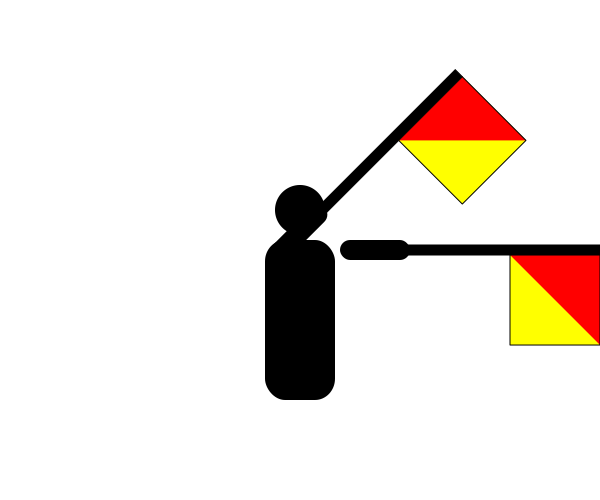
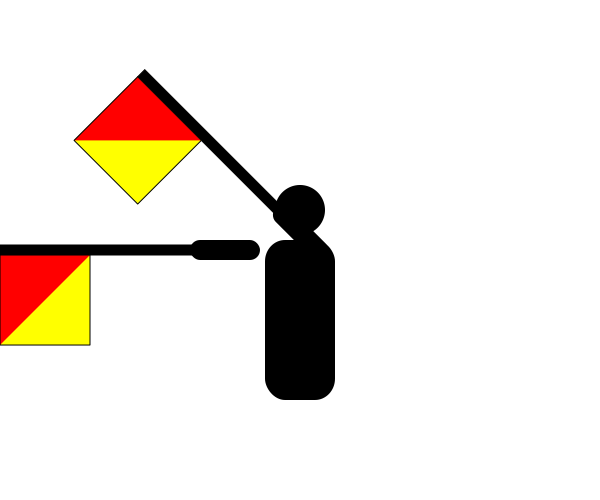


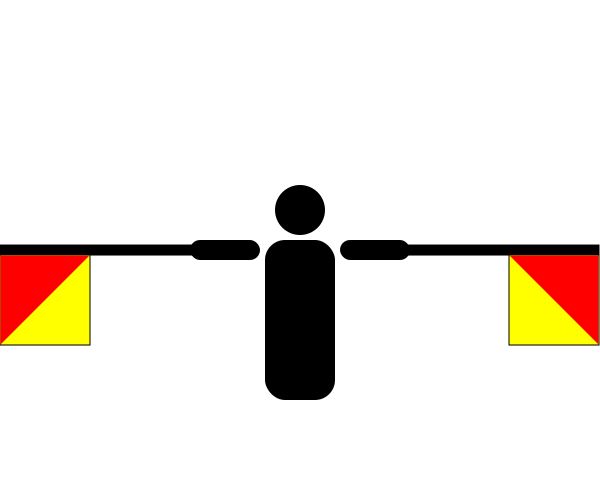

There are approximately 341 people named Woolard in the UK. That makes it one of Britain's least common surnames. Only around five in a million people in Britain are named Woolard.
Origin: English
Region of origin: British Isles
Country of origin: England
Religion of origin: Christian
Language of origin: English