WOLLARD
The surname Wollard is a traditional English family name that can be traced back to the early medieval period of the British Isles.
Its earliest documented appearance occurs in the Domesday Book of 1086, where it is recorded in slightly altered spellings such as Wluuard and Vluuard, and later as Wolwarde. Subsequent official records show the name as Wlward in a Fines Court document from Cambridgeshire in 1199 and as Woolard in the marriage register of 1690, when Anne Woolard married Thomas Gourlay at St. James, Dukes Place, Westminster.
The surname is thought to derive from one or more pre‑7th century personal names that began with the Old English word wulf meaning “wolf”. One proposed source is the name Wulfweard, combining wulf with weard, a guardian. Another possibility is a locational origin from a manor called Wolford in Warwickshire, first described in the Domesday Book as Wolwarde and meaning “defended against the wolves”. In addition to these Anglo‑Saxon roots, scholarly references suggest that the name may also reflect the Anglo‑Norman word wolward, meaning “guard”, and there are hints of Welsh influences such as the personal name Gwallt, meaning “mane”. A further external possibility is a Norman‑French derivation from waulard or wollard, elements that would translate to “wild” or “wild‑hearted”. Finally, a Germanic variant in the Middle English period, Wolhard, is often equated with the Germanic Wolfhard, meaning “brave-hearted and strong in spirit”. All of these sources coexist in the historical record, illustrating the complex evolution of the name.
When the elements are combined, the name typically conveys a sense of leadership or protection associated with a wolf. Thus the primary traditional interpretation is “wolf leader” or “leader of the wolves”, though variations such as “wolf guardian” and “wild-hearted man” are also noted in the source material.
The family’s heraldic device consists of a silver lion rampant upon a blue field, flanked by two red gauntlets. The lion, a common symbol of bravery and dominion over the wild, aligns with the animalistic theme of the name, while the gauntlets suggest martial prowess and a protective role.
Over the centuries the spelling of Wollard has fluctuated markedly, reflecting differences in spelling conventions, regional accents, and the influence of other languages. Variants found in historical documents include Woolard, Woolward, Woulard, Wepward, Woppard, Wollerd, Wallard, Wallerd, Wollord, Willard, Willert, Wilyard, Willyarn, Wilard, Weillargh, and Wooler. These variants appear in records from the Middle Ages up through the 18th and 19th centuries, and they persisted into modern times in various English‑speaking countries.
In contemporary Ireland and the British Isles, the name remains predominantly English in character. Across the Atlantic, the Wollard surname reached the United States in the late seventeenth century, with early settlers establishing themselves in Maryland as farmers and planters. By the nineteenth century the name had spread south and west, and today there are over eight thousand individuals bearing the name in the United States, with the highest concentrations in Pennsylvania, Maryland, North Carolina, Tennessee, and central regions such as Philadelphia, Baltimore, Charlotte, Nashville, and Dallas.
Immigration to Canada and Australia in the nineteenth and early twentieth centuries introduced variants such as Wooler, Woolers, and Woolward into those countries. These forms are often found in regional census records and land ownership documents, indicating the name’s continued use and adaptation in the diaspora.
Thus, the surname Wollard exemplifies a family name that has survived through diverse linguistic traditions, evolving from its earliest Anglo‑Saxon roots to its present-day global distribution, while maintaining a core motif of strength, guardianship, and the symbolic presence of the wolf.
Typical given names associated with the Wollard surname
Male
- Pete
Female
Similar and related surnames
Related and similar names are generated algorithmically based on the spelling, and may not necessarily share an etymology.
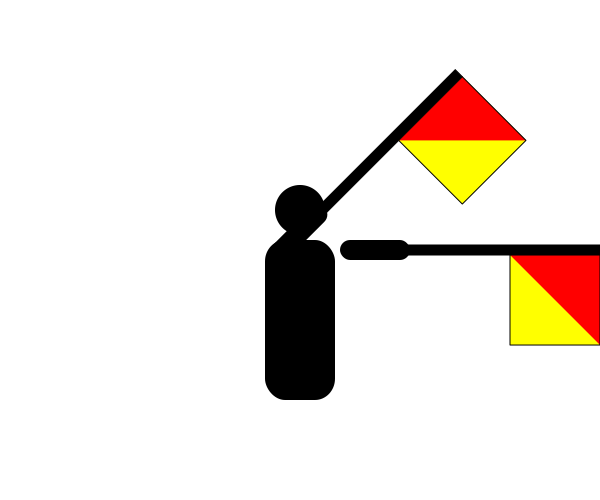
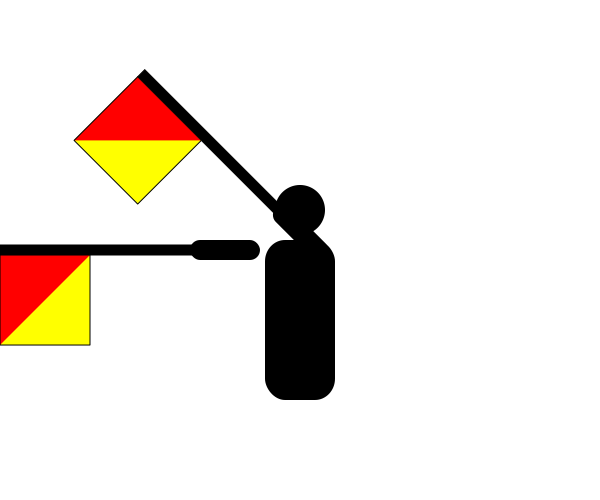
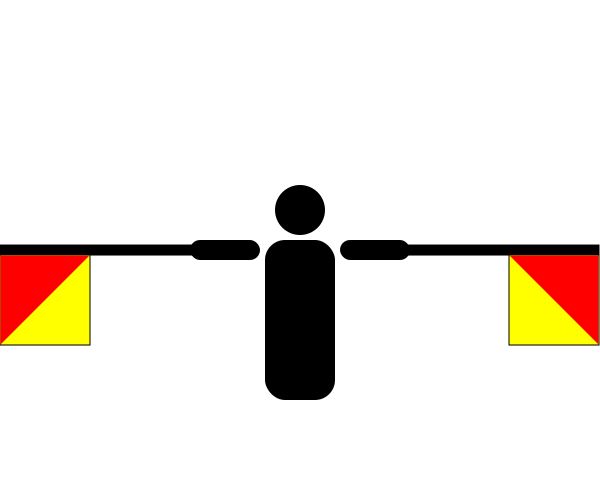
How to communicate the surname Wollard in...
Braille
⠺⠕⠇⠇⠁⠗⠙
Morse
.-----.-...-...-.-.-..
Semaphore



There are approximately 25 people named Wollard in the UK. That makes it one of Britain's least common surnames. Fewer than one in a million people in Britain are named Wollard.
