WILEY
Wiley is a surname of English provenance, common within the British Isles and particularly in England. Its linguistic roots can be traced to old native words, and its earliest attestations appear in a variety of medieval documents.
The name derives in part from the Old English personal name wilig, a term meaning “willow tree,” which may also serve as a descriptive nickname for a person living near such trees. Another possibility is a shortening of the Old English word wilig itself, again related to a willow. In certain contexts, Wiley is considered a variant spelling of Wylie, a name that stems from the personal name Wigheard, which translates to “war‑hardy” or “war‑rior.” Consequently, the surname carries implications of strength, resilience and determination.
As a locational surname, Wiley is associated with several villages in England whose names are recorded as Willey, Wyley, Wylie, and Wyly. Five of these settlements—located in Cheshire, Herefordshire, Shropshire, Warwickshire and Devonshire—share a common etymology: the Old English word wilig for “willow” combined with leah, a term that may denote a fenced clearing in a wood or, in some circumstances, a water meadow. The Surrey village of Willey has a distinct origin, from the Old English weoh meaning a pagan temple, coupled with leah for a clearing within a woodland. The earliest recorded mention of this place dates back to 909 AD in the Anglo‑Saxon Chronicles, where it appears as Weoleage.
Locational surnames were typically adopted by the original lords of a manor or by individuals who migrated from their homeland in search of employment. The practice of using the name of one’s former homestead was both convenient and easily identifiable, though it often led to varied spellings over time. Early documentary examples include William de Wylly of Sussex (1296) and Richard de Wyleye of Essex (1390). Further attestations are found in the name of Edmund Willie of Somerset (1595) and Francis Willey in London (1621). The earliest known spelling of the family name is John de Wylegh, recorded in 1201 in the Pipe Rolls of Wiltshire during the reign of King John (1199‑1216).
Throughout English history the Wiley surname has been borne by individuals who often exhibited notable resilience and fortitude. Its etymological links to willow trees—a species valued for flexible yet robust timber—underscore this association. Whether through the lens of locational heritage or personal attribute, the Wiley name continues to reflect a legacy rooted in both landscape and character.
Typical given names associated with the Wiley surname
Male
- Andrew
- Anthony
- Christopher
- David
- Gary
- James
- John
- Mark
- Michael
- Paul
- Peter
- Robert
- Stephen
Female
- Angela
- Catherine
- Claire
- Jill
- Joanne
- Margaret
- Nicola
- Patricia
- Rebecca
- Samantha
- Sarah
- Sharon
- Susan
- Suzanne
Similar and related surnames
Related and similar names are generated algorithmically based on the spelling, and may not necessarily share an etymology.
How to communicate the surname Wiley in...
Braille
⠺⠊⠇⠑⠽
Morse
.--...-...-.--
Semaphore
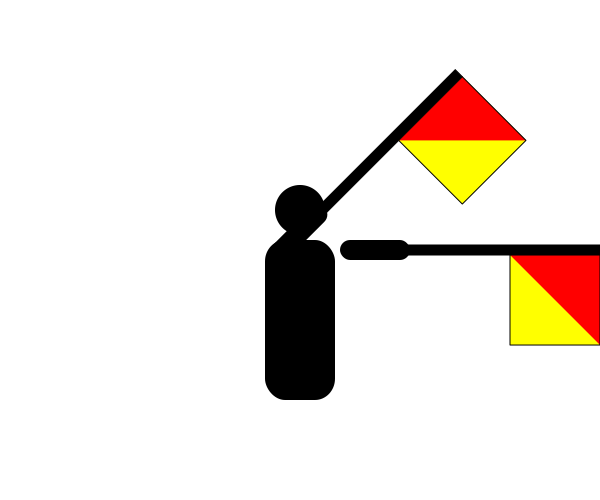
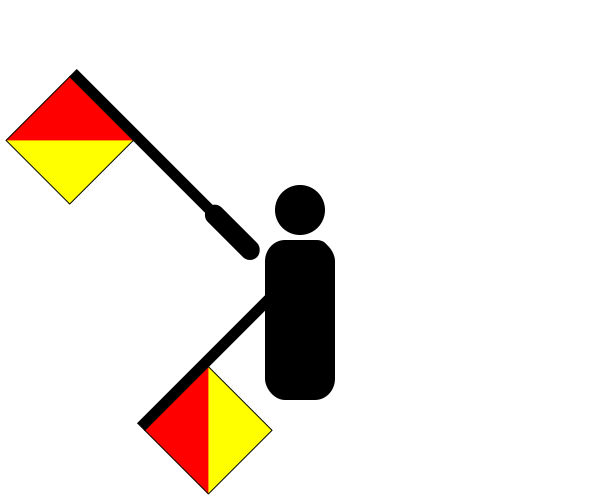


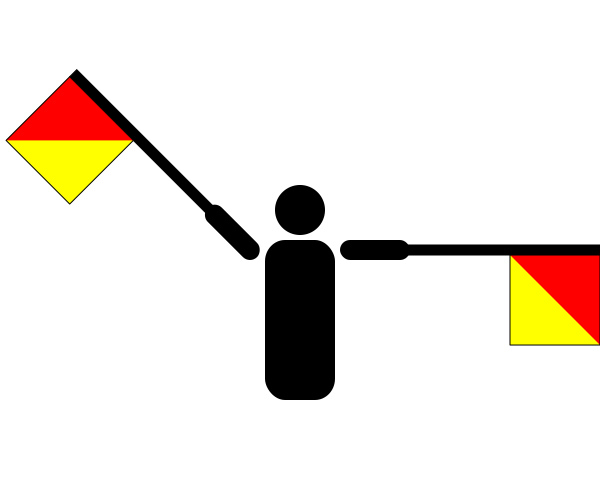
There are approximately 1,310 people named Wiley in the UK. That makes it roughly the 5,980th most common surname in Britain. Around 20 in a million people in Britain are named Wiley.
Origin: English
Region of origin: British Isles
Country of origin: England
Religion of origin: Christian
Language of origin: English

Famous people named Wiley
- Samira Wiley - American actor and model
- Alan Wiley - Football referee
Names and descriptions courtesy of Wikipedia, and may contain errors. This is not intended to be an exhaustive list of every famous person with this name.