WHITEHAIR
Whitehair is a surname of English origin, tracing back to the Anglo‑Saxon period before the eighth century. The name has been recorded in a variety of spellings, including Whitcher, Whittier, Whiter, Whitter, Whityer, and Whicher.
The most widely accepted derivation comes from the Old English words hwit meaning “white” and haer meaning “hair.” It was originally used as a descriptive nickname for someone with white or light‑haired hair, and the nickname subsequently evolved into a family surname.
Other sources note a second possible origin for the name. One theory connects it to the Old English word hwicce, meaning “chest.” With the agent suffix -er, this would describe a man who made or dealt with chests. An alternative view links the name to the Middle English wic (a farm or settlement). In this case the suffix -er would signify a dweller at such a place. Both occupational and topographical meanings would have become hereditary only when a son accompanied his father into the same vocation or residence.
The earliest extant record of a person bearing a related form of the surname appears in the Pipe Rolls of Berkshire, dated 1176, where a William Wicher is listed. This document is one of the primary sources for early English surnames and confirms the antiquity of the Whitehair family name.
Variants of the surname are numerous and indicative of regional spelling differences. Known variants include Whitehay, Whithey, Whitheir, Whitheire, Whitehey, Whitehouse, Whitehoe, Whitenair, Whitenaer, Whitenay, Whiteney, Whitson, Whittson, and Whittesen. These forms have been preserved in parish registers, legal documents and later census records.
The Whitehair family coat of arms, believed to be dated to the thirteenth century, was granted to a bearer of the name during that period. The crest features two horses with white manes rearing atop a shield. Heraldic commentators interpret the motif as a symbol of protection and vigilance.
In contemporary times the surname remains relatively uncommon but is dispersed worldwide. In the United States it is most frequent in the mid‑Atlantic, northeast and southern states such as Mississippi, South Carolina and Georgia, where the name appears in census records from the eighteenth and nineteenth centuries. According to the 2010 U.S. Census, the surname ranked 7 592nd in popularity, with approximately 3 700 individuals enumerated. In Canada it ranked 10 535th in the 2011 Census, with around 500 bearers. In Australia it was the 27 272nd most frequent name in the 2016 Census, with about 50 individuals. In the United Kingdom the name appeared 12 561st in the 2011 Census, with roughly 300 occurrences, and in New Zealand it was 18 268th, with around 10 individuals.
Internationally, the surname has cognates in several languages. In German it appears as Weissehaar, Weißhaar, Weishar, Weisshaar, Weisshae and Weisshaer. Dutch forms include Wijthae and Wijthaeres. Portuguese variants are Brancopelo and Brancoapel. Spanish examples are Brancopelo.
The persistence of the Whitehair surname, with its clear descriptive origin and rich historical documentation, offers a window into the linguistic and social developments of medieval England. Its spread across continents in recent centuries reflects broader patterns of migration and settlement, while the continued use of the name preserves a tangible link to an early ancestor’s distinctive appearance.
Similar and related surnames
Related and similar names are generated algorithmically based on the spelling, and may not necessarily share an etymology.
How to communicate the surname Whitehair in...
Braille
⠺⠓⠊⠞⠑⠓⠁⠊⠗
Morse
.--......-......-...-.
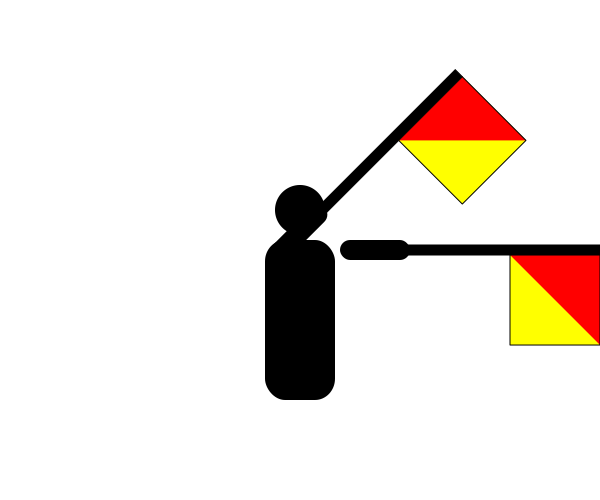
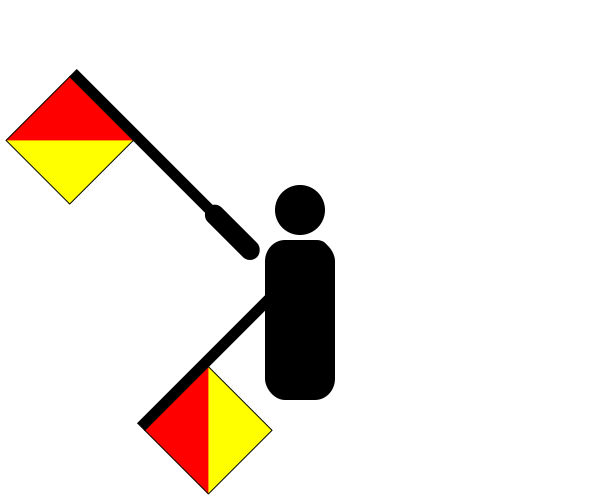
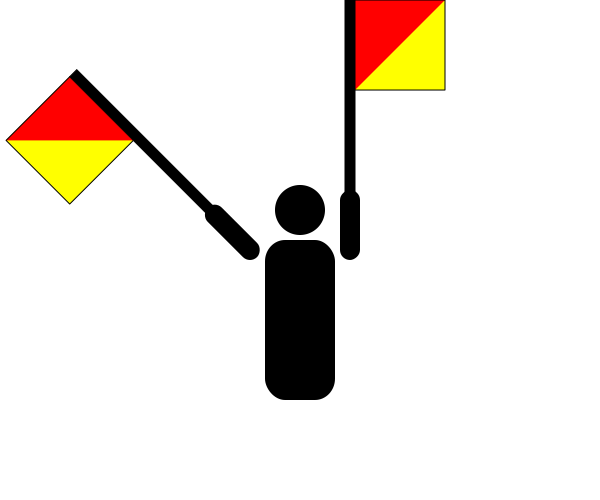
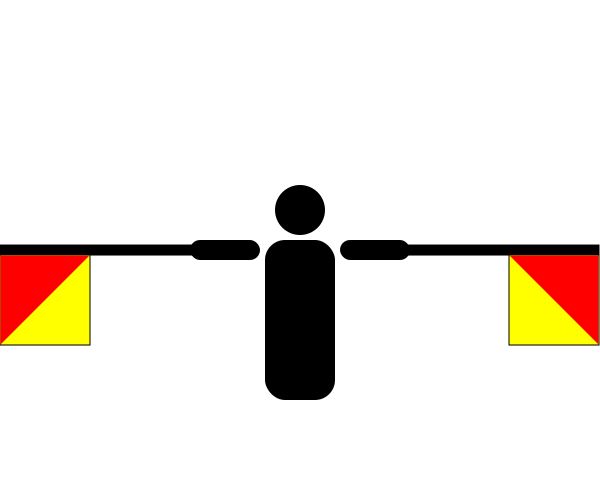
Semaphore



There are approximately 161 people named Whitehair in the UK. That makes it one of Britain's least common surnames. Only around two in a million people in Britain are named Whitehair.
