TUDOR
The surname Tudor traces its roots to Wales, one of the constituent nations of the British Isles. The name is derived from the Welsh personal name Tudur—or in its older forms, Tewdwr—which compounds the Brythonic elements *tout* meaning “people” and *orix* meaning “ruler.” Thus the meaning of the name is essentially “ruler of the people.”
As a patronymic before it became a hereditary surname, Tudor originally identified the descendants of a man called Tudur. The practice of passing on a given name as a family surname was common in medieval Wales and reflected a lineage that was often respected within local communities.
In the late fifteenth century the name rose to national prominence through its association with the Tudor dynasty, a line of monarchs who held the English throne from 1485 to 1603. The dynasty's most famous figures, including Henry VIII and Elizabeth I, left an indelible mark on English history, establishing the Tudor name as one of great renown.
Historical documents show that the surname has existed in over seventy spellings, such as the French Theodore, the Romanian Tudor, the Italian Teodori, and the Portuguese Teodoro. A later etymology links the name to the Greek *Theodoros*, a compound of *theos* (god) and *doron* (gift), meaning “god’s gift.” The Christian connotation of the name is reflected in the numerous saints who bore the Christianised forms of Tudur, which in turn explains the name’s popularity during the religious revival of the twelfth and thirteenth centuries.
Under the Church Calendar, the name has been borne by at least twenty‑eight saints, and early records indicate that it was already found in baptismal and later surname registers of Wales and the border counties from the sixth century. Early examples include John Tewdre, recorded in the 1334 Subsidy Rolls of Kent, and Michael Theodor, noted in the 1557 charters of Hartenstein in Germany.
The Tudor surname gained a royal dimension through Owen Tudor, clerk of the wardrobe to Catherine of Valois and grandfather to the future Henry VII. His story, which includes capture and execution at the Battle of Mortimer’s Cross in 1461, interweaves the family name with the political turbulence that ultimately forged the Tudor monarchy.
During the twentieth and early twenty‑first centuries, the name has continued to be used throughout the United Kingdom, notably in areas of Wales, the border counties, and in the communities that grew up around the vestiges of Tudor‑era architecture and civic life.
From the late eighteenth century onward, the Tudor surname crossed the Atlantic with Welsh settlers who arrived in North America. The earliest recorded use of the surname in the continent is attributed to Robert Tudor, who immigrated from Wales to Philadelphia in 1710. Subsequent generations spread the surname throughout the United States, including the Midwest, South, and West Coast, as well as into Canada, where it remains particularly common in eastern provinces such as Quebec. The name also appears in Caribbean colonies, notably Jamaica, a reflection of Welsh migration during the post‑colonial era.
Variants of the surname are numerous, encompassing spellings that originate from Latin, German, and Dutch traditions. Common alternatives include Tudur Ale, Tudorazzo, Teodore, Teodoro, Täufer, Teveto, Tate, Taylors, Teviot, Tedder, Teeton, Tetlow, Tetro, and Tutor. These variations, some of which incorporate the meaning “gift of God” or reference to baptism and sailing, illustrate how the Tudor name has been adapted across languages while preserving its core cultural heritage.
Today, although no longer confined to Welsh or border communities, the surname Tudor continues to be carried by families worldwide, preserving a linguistic link to a lineage that once ruled an entire nation and left a lasting imprint on the cultural and architectural landscape of England.
Typical given names associated with the Tudor surname
Male
- Andrew
- David
- James
- John
- Mark
- Michael
- Paul
- Richard
- Robert
- Stephen
Female
- Elizabeth
- Emma
- Jacqueline
- Jane
- Joanne
- Julie
- Karen
- Lorraine
- Margaret
- Mary
- Sarah
- Susan
Similar and related surnames
Related and similar names are generated algorithmically based on the spelling, and may not necessarily share an etymology.
How to communicate the surname Tudor in...
Braille
⠞⠥⠙⠕⠗
Morse
-..--..---.-.
Semaphore
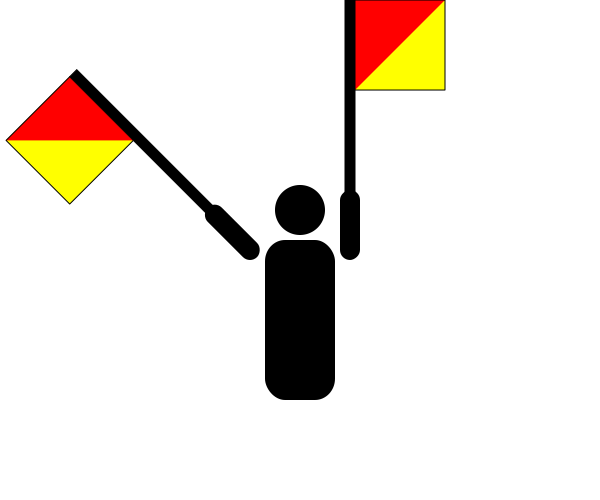


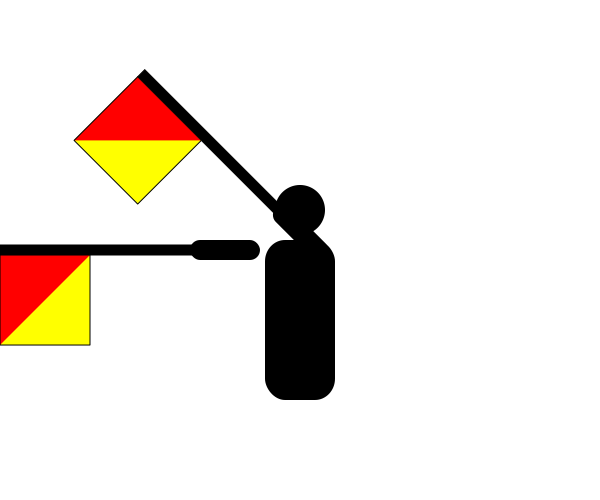
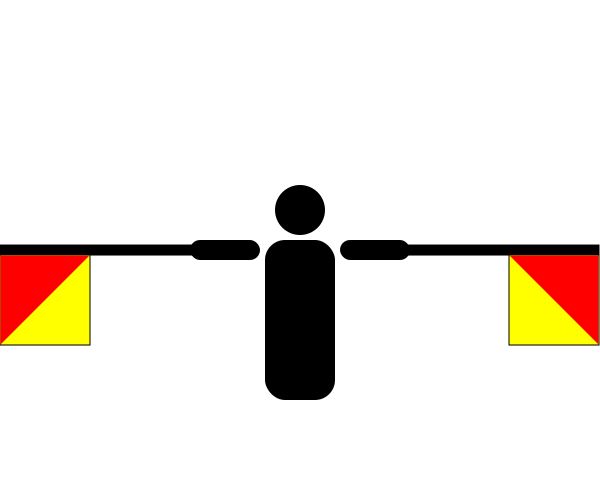
There are approximately 5,441 people named Tudor in the UK. That makes it roughly the 1,745th most common surname in Britain. Around 84 in a million people in Britain are named Tudor.
Surname type: From given name or forename
Origin: Celtic
Region of origin: British Isles
Country of origin: Wales
Religion of origin: Christian
Language of origin: Welsh

Famous people named Tudor
- Mary Tudor, Queen of France - Queen of France (1496 to 1533)
- Arthur Tudor, Prince of Wales - Prince of Wales, Earl of Chester and Duke of Cornwall (1486 to 1502)
- Margaret Tudor - Scottish Queen consort (1489 to 1541)
- Will Tudor - Actor
- Edward Tudor-Pole - Actor and singer
- Elizabeth Tudor - Princess (1492 to 1495)
- Henry Hugh Tudor - Army general (1871 to 1965)
- Alex Tudor - Cricketer
- Antony Tudor - Dancer and choreographer (1908 to 1987)
- John Tudor - Football player
- Andy Tudor - Video game designer
- Richard Tudor - Cricketer
- Roland Tudor - Cricketer (1890 to 1973)
- Ted Tudor - Football player
- Shane Tudor - Football player
- Frederick Tudor - Royal Navy officer who went on to be Third Sea Lord (1863 to 1946)
Names and descriptions courtesy of Wikipedia, and may contain errors. This is not intended to be an exhaustive list of every famous person with this name.