SEGO
Sego is a surname that exhibits a notable degree of etymological complexity, reflecting multiple origins that span Italian, Anglo‑Saxon, Basque, Celtic, and even Hebrew linguistic traditions. Each of these sources contributes distinct meanings and historical associations, underscoring the need for careful genealogical examination to determine an individual family’s lineage.
In the Italian context, the surname is believed to have arisen from the personal name Segusius, a Latinised form related to the root seges meaning “crop” or “field.” Consequently, Sego was likely employed as a nickname for someone involved in agriculture through occupation or land ownership, or as a locational reference to individuals residing near cultivated ground. This derivation is corroborated by historical naming conventions in late‑medieval Italy, where occupational and topographical surnames were common.
Concurrently, evidence placed in the early fourteenth century points to an Anglo‑Saxon origin. The surname appears in records such as the Subsidy Rolls of Yorkshire, where an Alan Segode is listed in 1327, and later in the Consistory Court of Rochester with Katerine Seegode in 1450. Earlier, the “Assize Court Rolls of Kent” record Adam Segud in 1317, during the reign of Edward of Caernavon (1307‑1327). These documents indicate that the name was in use in England well before the Norman Conquest, aligning with the personal name Saegod, meaning “sea‑good,” a Old English formation predating the seventh century. The persistence of the name through varied spellings—Segoe, Segot, Seagood, and others—highlights its deep roots in the English tradition.
In addition to these European origins, the surname is also linked to the Basque language, in which the words sego and related forms convey notions of victory, excellence, or superiority. Correspondingly, a Celtic derivation from the word sego would translate to “strength” or “power.” Moreover, a Hebrew term, segol, meaning “violet,” has occasionally been cited as a potential source, suggesting an occupational or descriptive origin tied to the cultivation or trading of violet flowers. The presence of a Spanish municipality named Sego in Castile and León further supports a toponymic explanation, where families adopted the name of their local settlement.
Geographical dissemination of the surname is broad. While it remains common in parts of Europe—including Italy, France, Germany, Austria, and Poland—its prevalence has grown particularly in the United States. The name was first documented in the late eighteenth century in states such as Utah, Texas, Missouri and Nebraska, and it has since become most widespread in the Southern regions of the country, notably Georgia, Florida, Alabama, Tennessee and Louisiana, with a significant concentration in Texas. This pattern reflects the movement of European settlers and pioneers during the nineteenth century, many of whom carried the name across the Atlantic and established roots in the expanding western frontier.
Variant spellings are numerous and often indicate regional linguistic influences. Besides the Anglo‑Saxon forms mentioned earlier, the surname has appeared as Segoy, Segue, Segou, Segni, Sigui, Sigou, and has also been anglicised to Segoe and Segue in some American contexts. In some French and Belgian lineages, the surname is considered a derivative of Segaux, itself a toponym linked to the Basque section of the Pyrenees. These variations underscore the fluidity of surname orthography across centuries and borders.
Given the multiplicity of possible origins—Italian occupational or locational, Anglo‑Saxon personal, Basque or Celtic descriptive, and even Hebrew linguistic—the meaning of Sego within any specific family line can only be ascertained through meticulous examination of genealogical records, historical documents and, where accessible, genetic evidence. The surname’s rich, multifaceted heritage remains a testament to the complex tapestry of cultural and linguistic exchange that has shaped European and American nomenclature over the past millennium.
Similar and related surnames
Related and similar names are generated algorithmically based on the spelling, and may not necessarily share an etymology.
How to communicate the surname Sego in...
Braille
⠎⠑⠛⠕
Morse
....--.---
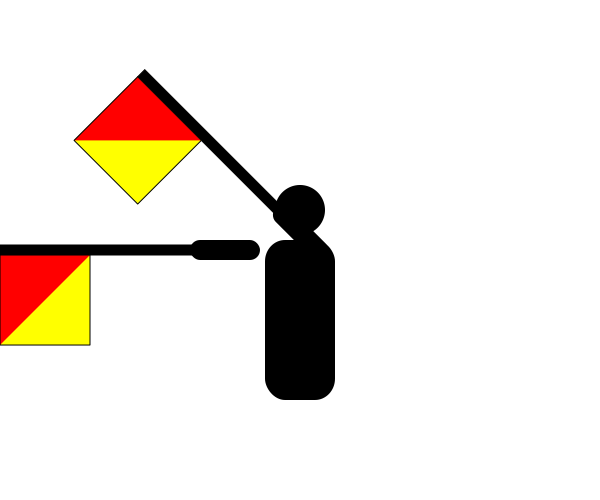
Semaphore


Sorry, we don't have any statistics on this name. That's probably because it's very uncommon in Britain.
