SEAGO
Origins of the surname Seago are firmly rooted in England, where it appears to have arisen during the Middle Ages. The earliest documented use dates back to 1273, with records from the same period confirming that the name was in circulation within the British Isles. A notable early example is Adam Segud, whose name is preserved in the Assize Court Rolls of Kent dated 1317, during the reign of King Edward I.
In linguistic terms, Seago is derived from the Old English word sæg, meaning “sea,” combined with the suffix -o, which typically indicates a place or a person associated with a place. Consequently, the surname was originally a topographic or locational name for someone who lived near a sea inlet or hailed from a settlement bearing a sea‑related designation.
A second line of evidence points to an alternative origin in the Olde English personal name Saegod, meaning “sea‑good.” Variants such as Sego, Segoe, and Segot are documented by the early 14th century and belong to the same family of spellings. Early parish records—including the christenings of Sarah Segoe in 1724, Peter Seago in 1735, and John Seago in 1763—demonstrate the name’s persistence in London and its environs.
The surname has a number of orthographic variants that have appeared throughout centuries: Seago, Seego, Seagoe, Seigoe, Seagow, Seegho, Seaghan, Segoe, Segud, Segut, and several others. These variations are recorded in both English parish registers and continental documents, reflecting the name’s modest migration beyond Britain in the 18th and 19th centuries, particularly to the United States, Canada, Australia, New Zealand, and South Africa.
While the majority of bearers of the surname are found in England—especially in London and the eastern counties—international distribution is observable. In the United States, the name is most common in North Carolina, Virginia, and the New England states, where it has risen in frequency in recent decades. Canadian, Australian, New Zealand, and South African occurrences are also documented, often linked to waves of emigration from the United Kingdom.
Beyond its topographic roots, some sources suggest that the name could also derive from the Old Norse word seggr, meaning “man” or “hero.” This possibility proposes that the surname may have begun as a nickname or personal name during the Viking Age before adopting a hereditary form. However, this hypothesis remains unconfirmed and is not as strongly supported by the primary evidence available.
Related surnames that share semantic or phonetic similarities include Seagriff, Seabrook, Seagull, Seabury, Sealock, and Seaver. These names often describe places near water or occupations connected with marine activities, though they are distinct from Seago.
Typical given names associated with the Seago surname
Male
- Andrew
- Colin
- Daniel
- David
- Edward
- George
- John
- Patrick
- Peter
- Philip
- Richard
- Robert
Female
- Charlotte
- Elizabeth
- Gillian
- Jane
- Joan
- Kathleen
- Kay
- Margaret
- Marion
- Mary
- Patricia
- Rachel
- Stephanie
- Susan
- Verity
Similar and related surnames
Related and similar names are generated algorithmically based on the spelling, and may not necessarily share an etymology.
How to communicate the surname Seago in...
Braille
⠎⠑⠁⠛⠕
Morse
.....---.---
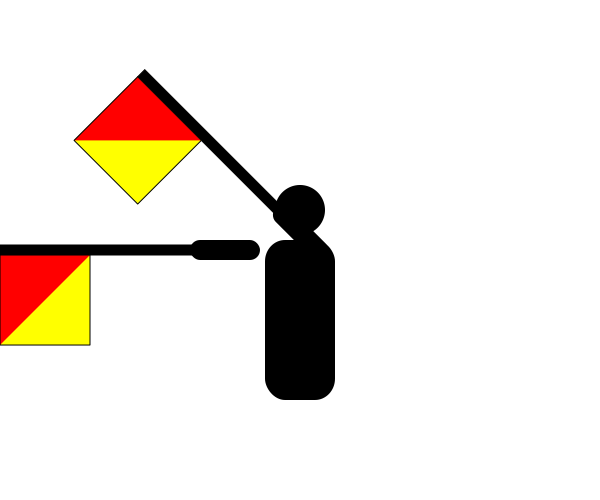
Semaphore


There are approximately 541 people named Seago in the UK. That makes it one of Britain's least common surnames. Only around eight in a million people in Britain are named Seago.
Origin: English
Region of origin: British Isles
Country of origin: England
Religion of origin: Christian
Language of origin: English