SCHNIEDER
The surname Schnieder is of German origin and is an occupational name denoting a tailor or dressmaker.
It derives from the Middle High German word sneider, which means “tailor” or “cutter”. The name is related to the older term snitare, itself a derivative of the pre‑8th century word snidden, all of which translate as “one who sews” or “one who cuts”.
In the past the surname has been recorded in a variety of spellings, including Schneidau, Schneidar, Schnieder and Schnitter. Other variants that appear in German‑speaking records are Schneider, Schneiders and Schnyder. English‑speaking communities have also used spellings such as Snider, Snyder and Sniderman.
Historical evidence indicates that the earliest known use of the name dates back to 1302, when a person called Rotcher Sniter is documented in the town of Greifswald, Germany. This record falls within the reign of Emperor Albert I of the German Empire, which lasted from 1298 to 1308.
Later authentic records include the marriage of Johann Christoph Schneidar to Maria Emig at Pleuzhausen in the Rhineland on 30 April 1754, and the marriage of Johann Gottlieb Schneidau to Anna Marie Philip at Danzig City in West Prussia on 17 April 1842.
Although the surname first appears as an occupational label, it has not impeded the social ascent of its bearers. Over the centuries, at least eight distinct coats of arms have been granted to individuals bearing the name, reflecting their recognised status in various communities.
Between 1912 and 1932 the surname gained international prominence through the Schneider Trophy, an annual air race that attracted global attention. The association with this event produced a widespread public awareness of the name beyond German borders.
In contemporary times the name remains common in Germany, with roughly 18,000 bearers recorded in 2020. It is most frequently encountered in the state of Lower Saxony and the city of Leipzig. The surname also enjoys a presence in Belgium, the United States, the Czech Republic and other parts of the world. Many individuals who carry the name in English‑speaking countries are descendants of 19th‑century immigrants who anglicised the spelling to forms such as Snyder or Snider.
Some historians propose that ancillary derivations of the name might arise from the German elements schnied (meaning “scythes”) and -er (meaning “man”), suggesting an earlier association with farmers or blacksmiths. Additionally, a topographical interpretation has been suggested, whereby the surname could refer to a person living near a stream or river, or to a particular locality known as Schnieder in the city of Dorsten.
Regardless of the precise origin, the surname Schnieder connotes a profession rooted in skillful craftsmanship. Bearers of the name may take pride in their shared heritage, which links them to the art of tailoring and a long history of industrious achievement.
Typical given names associated with the Schnieder surname
Male
- Axel
- Ferdinand
- Karl-eberhard
- Raimund
- Rudolf
Female
- Therese
Similar and related surnames
Related and similar names are generated algorithmically based on the spelling, and may not necessarily share an etymology.
How to communicate the surname Schnieder in...
Braille
⠎⠉⠓⠝⠊⠑⠙⠑⠗
Morse
...-.-.....-....-....-.
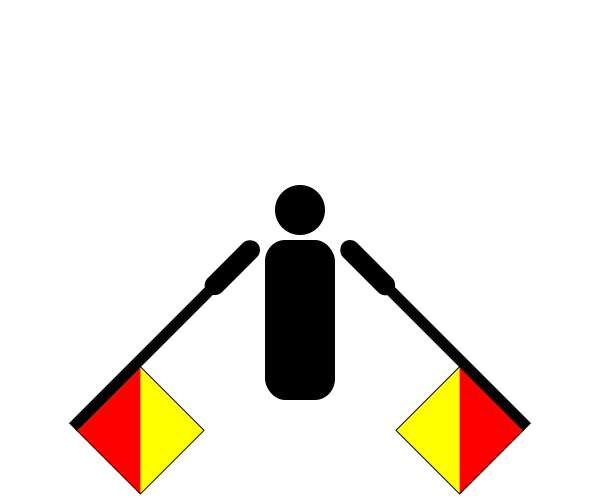
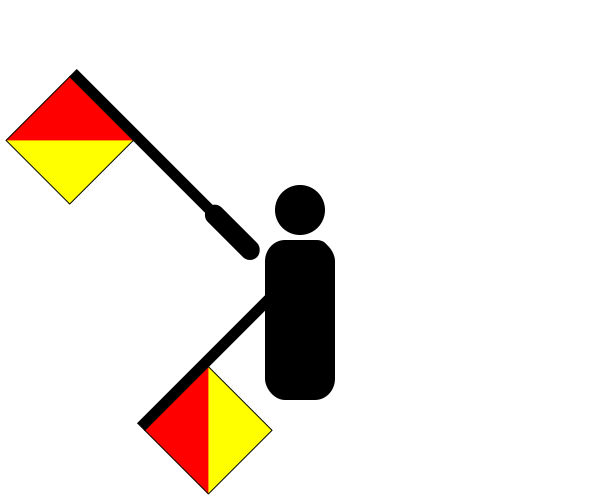
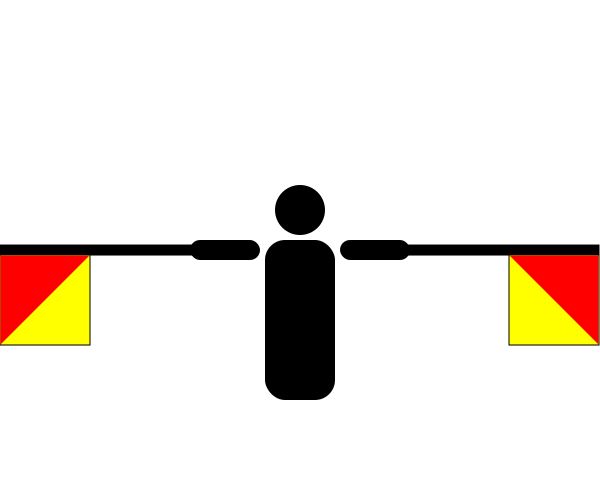
Semaphore




Sorry, we don't have any statistics on this name. That's probably because it's very uncommon in Britain.
