SAMMS
Samms is a surname of English origin with a roots that can be traced back to both the local medieval naming practices of England and the ancient Hebrew language. It owes its earliest form to the medieval given name Samson, a name itself derived from the Hebrew Shimshon, meaning sun. The adoption of Samms as a family name is therefore classed as a patronymic surname, formed to identify the descendants of a man called Samson or a diminutive thereof.
In addition to the Samson derivation, Samms can also descend from the shortened form Sam, a pet name for Samuel, which originates from the Hebrew Shemuel meaning name of God. Both Hebrew roots contribute to a layered connotation for the name, suggesting either a celestial association with the sun or a religious devotion to the divine.
The earliest documentary instance of the surname appears in the Poll Tax Returns of Yorkshire in 1379, recorded under the name Alan Samme. This evidence places the family within the County of York during the reign of King Richard II, who reigned from 1377 to 1399. The recorded spelling of the name demonstrates the fluidity of early English orthography and foreshadows later variants such as Sams, Samme, and Sammes.
Historical records also refer to a Samme Parvus in the 1273 Hundred Rolls of Lincolnshire, indicating that the patronymic practice was common by the late 13th century. Over the succeeding centuries, Samms grew in prevalence particularly across northern England, especially within the counties of West Yorkshire, Lancashire and Merseyside, where large numbers of the name can still be found today.
Evidence suggests that the surname may additionally derive from English placenames such as Samlesbury in Lancashire or Sambourne in Warwickshire. One documented instance of a place-related surname is Adam de Samlesbury, who appears in records dated 1280, further reinforcing the geographical connection.
The family seal of the Samms lineage, recorded in medieval heraldic rolls, depicts a black lion rampant standing upon a gold field, its breast wounded in red. A silver lion on the crest, also rampant, displays a gold collar and chain. The motto Deo juvante, translating to “God assisting”, reflects a pious stance distinguished in the family iconography.
In later centuries the surname spread outside the United Kingdom due to emigration during the 19th century. Relatives settled in Canada, the United States, Australia and South Africa. Though still predominantly located in Britain, contemporary searches reveal a modest number of individuals bearing the name in these former colonies, illustrating the modest but continued diaspora of the family name.
Variants of the surname Samms include Sammes, Sam, Sams, Samme, Simms, Simmes, and in continental Europe, the Dutch Simse. The most frequent spelling in North America is the double-sure form, Samms. All these forms reflect the same patronymic origin but differ in orthographic evolution, pronunciation and regional usage.
Typical given names associated with the Samms surname
Male
- Anthony
- Barry
- Christopher
- David
- Derrick
- Lloyd
- Michael
- Paul
- Philip
- Raymond
- Richard
- Robert
Female
- Abbie
- Dorothy
- Helen
- Isha
- Jacqueline
- Janis
- Lesley
- Paula
- Rachel
- Rosetta
- Stephanie
- Sylvia
- Veronica
Similar and related surnames
- Saam
- Sahm
- Saim
- Sam
- Samas
- Samassa
- Samb
- Same
- Sames
- Samios
- Samis
- Samm
- Samma
- Sammas
- Sammays
- Samme
- Sammes
- Sammi
- Sammie
- Sammis
- Sammy
- Samos
- Samps
- Sams
- Samsa
- Samsi
- Samus
- Samz
- Scam
- Scamm
- Seam
- Seames
- Seams
- Seamus
- Seeam
- Seems
- Seims
- Semas
- Semis
- Semiz
- Semm
- Semme
- Semmes
- Semos
- Sems
- Semus
- Siemasz
- Siemms
- Siems
- Simas
- Simes
- Simese
- Simis
- Simmes
- Simmis
- Simms
- Simoes
- Simos
- Sims
- Siomos
- Skam
- Skame
- Smaus
- Smees
- Smies
- Smis
- Smus
- Smusz
- Soames
- Soams
- Somas
- Somase
- Somes
- Sommas
- Sommes
- Sommese
- Somms
- Somos
- Somoza
- Soms
- Soomes
- Sumes
- Summas
- Summis
- Summs
- Sums
- Symes
- Symis
- Symmes
- Symms
- Syms
- Symss
- Szemes
- Szymas
- Ziems
- Zoumas
- Zyms
Related and similar names are generated algorithmically based on the spelling, and may not necessarily share an etymology.
How to communicate the surname Samms in...
Braille
⠎⠁⠍⠍⠎
Morse
....-----...
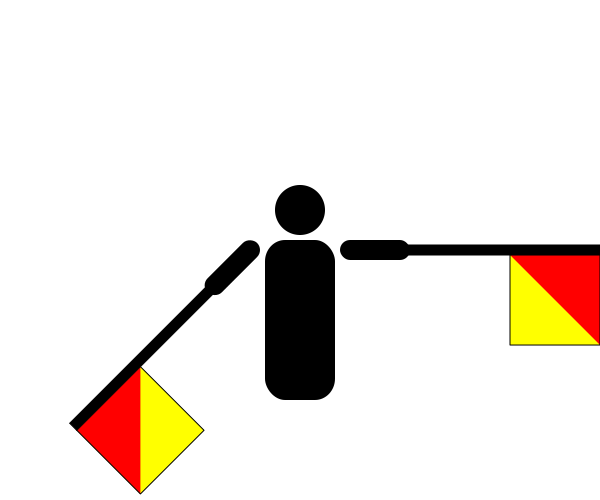
Semaphore


There are approximately 349 people named Samms in the UK. That makes it one of Britain's least common surnames. Only around five in a million people in Britain are named Samms.
Surname type: From name of parent
Region of origin: Europe
