SAMES
Sames is a surname of German provenance, with a history that extends into the British Isles, particularly England, where it has been borne by families since the late thirteenth century. Its etymology is linked to the German personal name Samo, which translates as “same” or “equal,” suggesting that the name may have originated as a nickname for an individual noted for similarity or equivalence to another.
According to surviving medieval records, the surname appears in the Poll Tax Returns of Yorkshire for 1379, ascribed to Alan Samme. The name was officially documented in the second half of the fourteenth century, signalling its transition from a personal designation to a hereditary family name.
There are several variant spellings that have been recorded over the centuries. These include Sams, Samms, Sam, Samme, Sammes, Saimes, Saems, Saymes, Saymse, Saims, Seyms, Saymeys, Simas, Seames, and Seimes. The diversity of forms reflects the surname’s spread across the Germanic regions of Europe and its adaptation to local orthographic conventions.
Beyond its Germanic roots, the name has been associated with Hebrew origins as well. It may be linked to the ancient Hebrew word shemesh meaning “sun,” a term that has symbolic resonance within both Judaic and Christian traditions. The association with the biblical name Samson (derived from the Hebrew Shimshon, “sun‑like”) has also been noted, with some references suggesting that the name was occasionally adopted by Christians in homage to the biblical figure’s strength or by those connected to the 6th‑century Welsh bishop Samson.
In heraldic tradition, the family’s arms are described as a gold shield displaying a black lion rampant, its breast marked by a crimson wound. The crest features a silver lion rampant surrounded by a gold collar and chain. The familial motto, Deo juvante, translates to “God assisting,” reflecting the spiritual affinity that has long been a hallmark of the Sames lineage.
Geographically, the surname has settled in a number of regions. In the United Kingdom it is predominantly found in England; in continental Europe it is present in Germany, Austria, Switzerland, Luxembourg, the Netherlands, and France, where it appears with different orthographic variants. In the United States, states such as Wisconsin, Texas, and New Mexico record notable concentrations of individuals bearing the surname. The name is also recognised in South Africa, where it is sometimes rendered as Samuels due to historical immigration patterns.
Overall, the Sames surname encapsulates a tapestry of linguistic and cultural influences that span several centuries and continents. Its multiple origins and wide geographic distribution have rendered it a subject of interest for those studying onomastics and genealogical history. Families that carry the name benefit from a rich heritage that continues to be celebrated and preserved through both heraldic tradition and communal gatherings.
Typical given names associated with the Sames surname
Male
- Alan
- Alistair
- Barry
- Craig
- Jonathan
Female
- Catherine
- Cynthia
- Debra
- Julia
- Pamela
Similar and related surnames
- Saam
- Saes
- Sahm
- Saim
- Sam
- Samaee
- Samas
- Samb
- Sambe
- Same
- Samec
- Samed
- Samee
- Samei
- Samey
- Samie
- Samiee
- Samios
- Samis
- Samm
- Sammas
- Sammays
- Samme
- Sammes
- Sammie
- Sammis
- Samms
- Samos
- Samps
- Sams
- Samsa
- Samsi
- Samus
- Samz
- Sayes
- Scam
- Scamm
- Seam
- Seames
- Seams
- Seamus
- Seeam
- Seems
- Seims
- Semas
- Seme
- Semis
- Semme
- Semmes
- Semos
- Sems
- Semus
- Siemms
- Siems
- Simms
- Sims
- Skam
- Skame
- Szemes
Related and similar names are generated algorithmically based on the spelling, and may not necessarily share an etymology.
How to communicate the surname Sames in...
Braille
⠎⠁⠍⠑⠎
Morse
....---....
Semaphore


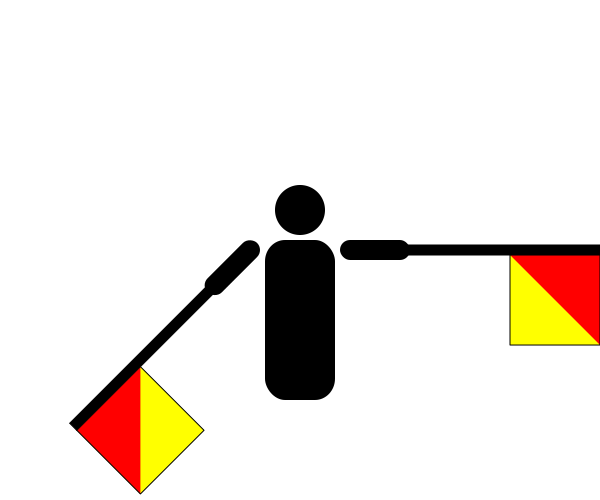

There are approximately 125 people named Sames in the UK. That makes it one of Britain's least common surnames. Only around two in a million people in Britain are named Sames.
Origin: English
Region of origin: British Isles
Country of origin: England
Religion of origin: Christian
Language of origin: English