SABINE
The surname Sabine is a pedigreed name of multiple linguistic origins, comprising English, French, Italian and Latin derivations. It therefore reflects a complex set of historical influences that span a range of geographic traditions.
Its first recorded form appears in the Early Middle Ages in England, after the Norman Conquest of 1066. The name was introduced by Norman settlers who had carried over the Old French personal name Sabine or its masculine counterpart Sabin, both ultimately usurped from the Latin appellation Sabinus or Sabina. These ancient Latin terms are themselves believed to identify a member of the Sabine tribe, an Italic people of central Italy who were noted for their influence upon early Roman culture.
In England the name gained prominence in the early half of the 13th century, as recorded in the Hundred Rolls of Cambridgeshire in 1279. Subsequent entries from 1625, 1645 and 1665 – such as the christening of William son of William Sabey and the marriage of Ann Sabbin – show continued usage amongst the gentry. The first definitive spelling is that of Richard Sabin (1221), witness in the Assize Court Rolls of Warwickshire during the reign of Henry the First.
Over the centuries the name developed a wide array of orthographic variants. According to record, these range from Saben, Sabban and Sabbin(s) to Sabine, Sabie and Saby, reflecting the fluid consonant and vowel practices of medieval scribes. In the modern period the Latinised forms Savin, Savigny and Sabien appear across a range of European and colonial archives.
The Sabine surname is also associated with heraldic bearings. The most frequently cited blazon features a silver shield with a black escallop, topped by a black chief bearing two silver mullets pierced. A silver demi bull rampant rises as the crest. This armorial device is preserved in several parish registers and is recognised as synonymous with the family name in certain heraldic collections.
Religious history has influenced the endurance of the name. Two early saints – the 4th‑century Bishop of Spoleto, St. Sabinus, and the Roman matron martyrdom under Hadrian, St. Sabina – provided spiritual legitimacy and early proliferation of the personal name. Their cults ensured the name survived beyond secular usage, and the custom of adopting patronymic surnames contributed to the persistence of Sabine as a family name.
Geographically the surname has spread widely. Within the United Kingdom it remains most prolific in the British Isles, particularly in the counties of Cambridgeshire and Bedfordshire. In France the name is most often found in the Auvergne‑Rhone‑Alpes, Centre‑Val de Loire and Brittany regions. Its presence in Belgium, in the Wallonia region with a minority in Flanders, mirrors historical migration patterns. French‑speaking Switzerland preserves the surname mainly in its western cantons. Beyond Europe, the name occurs in Haiti, Canada (especially in provinces with French‑Canadian heritage) and the United States, where it is concentrated in Maine, Massachusetts, New Hampshire, Minnesota, Wisconsin and Michigan.
Modern research indicates that Sabine is typically a locational or ethnic surname, originally applied to those from the Sabine region of Italy or who had direct ties to that people. When individuals migrated during the medieval era, adopting the name served as a marker of geographical origin and social distinction. This practice enabled the surname to survive in diverse contexts, preserving a link to an ancient tribal identity.
In contemporary usage the surname Sabine continues to be borne by families across the former French colonial sphere and by descendants of Norman settlers in Britain. Its endurance is underpinned by a solid historical record, geographical spread and an established heraldic identity, making it a testament to the enduring legacy of ancient Italic tribal nomenclature within the British and French linguistic traditions.
Typical given names associated with the Sabine surname
Male
- Andrew
- Anthony
- David
- John
- Jonathan
- Mark
- Nicholas
- Owen
- Peter
- Robert
- Stephen
- William
Female
- Anna
- Anne
- Elizabeth
- Emma
- Helen
- Jane
- Julie
- Katherine
- Kathleen
- Pamela
- Patricia
- Rachel
- Rosemary
- Sonia
Similar and related surnames
Related and similar names are generated algorithmically based on the spelling, and may not necessarily share an etymology.
How to communicate the surname Sabine in...
Braille
⠎⠁⠃⠊⠝⠑
Morse
....--.....-..
Semaphore


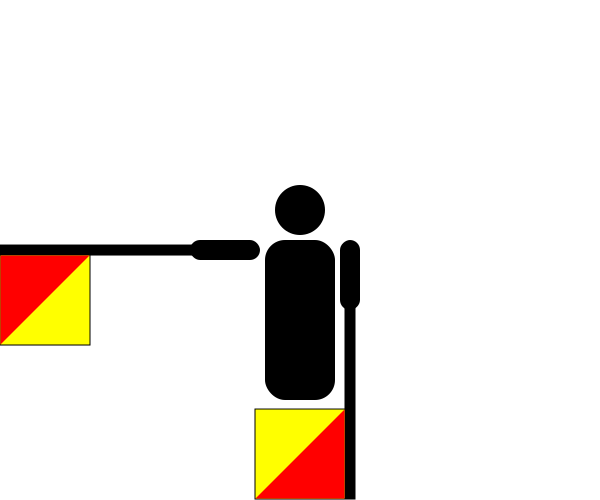
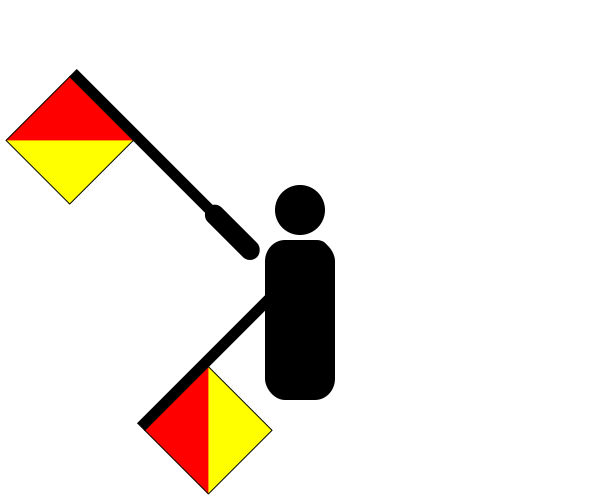
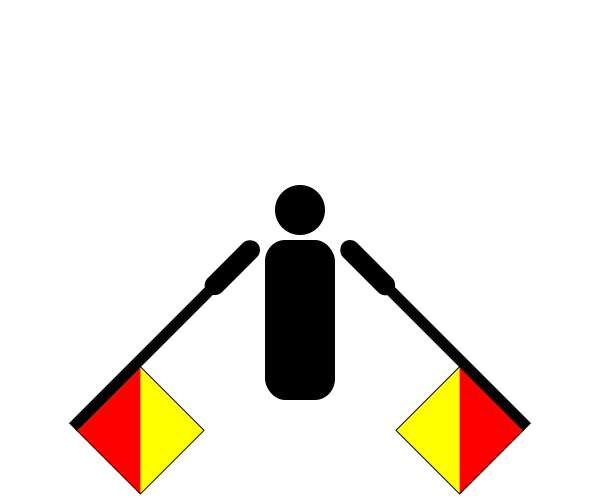

Did you know?
According to a survey carried out by Democracy Club, politicians and candidates with the surname Sabine are most likely to say that their favourite biscuit is a Toffypop.
There are approximately 457 people named Sabine in the UK. That makes it one of Britain's least common surnames. Only around seven in a million people in Britain are named Sabine.
Origin: English
Region of origin: British Isles
Country of origin: England
Religion of origin: Christian
Language of origin: English

Famous people named Sabine
- David Sabine - Cricketer
- Henry Sabine - Football player
- Joseph Sabine - Botanist and zoologist (1770 to 1837)
Names and descriptions courtesy of Wikipedia, and may contain errors. This is not intended to be an exhaustive list of every famous person with this name.