SABIN
The surname Sabin is a hereditary appellation that can be traced to three linguistic traditions: English, French and Latin. It forms part of the family of names that entered England during the first thousand years of the Common Era and has been preserved by documentary evidence to the present day.
In its earliest form the name derives from the medieval personal name Sabine, which itself is a borrowing of the Latin patronymic Sabinus. The Roman appellation signified a person connected with the Sabine tribe of ancient Italy, a people of whom the surviving historical record is fragmentary but who were perceived in antiquity as courageous and hardy. Consequently, the surname Sabin may well have been applied as a nickname to an individual who displayed Sabine‑like qualities of bravery or strength, as suggested by contemporary onomastic studies.
Following the Norman Conquest of 1066, the Old French masculine form Sabin and the feminine variant Sabine were introduced to the British Isles. These forms were in turn inherited from the Latin source and were popularized by the cult of several saints bearing the name. St. Sabinus, a 4th‑century Bishop of Spoleto, and St. Sabina, a Roman matron martyred under Hadrian, secured the name’s circulation in ecclesiastical and popular memory. The medieval English record includes the feminine version without the surname in an entry at St. Benet of Holme, Norfolk in 1286.
The first documented instance of the family name in England occurs in the early half of the 13th Century. A witness named Richard Sabin appears in the “Assize Court Rolls of Warwickshire” in 1221, a record produced during the reign of King Henry, known popularly as “The Frenchman”, 1216–1272. This establishes the surname’s presence in the English legal system by the early reign of Edward I.
Spelling variations proliferated in the Middle Ages, with the name recorded as Saben, Sabban, Sabine, Sabie and Saby in a range of parish and tax documents. The Hundred Rolls of Cambridgeshire in 1279 list a John Sabine, illustrating the name’s dissemination beyond its initial point of origin and into rural communities.
Later parish registers provide further evidence of the name’s endurance. In a christening entry dated 15th November 1645 for William, son of William Sabey, the ceremony took place at St. Peter’s, Cornhill, London. A marriage record of Ann Sabey to Philip Allen in 1665 is recorded at Flitton, Bedfordshire. Such documents show the continued use of the surname and its variants through the early modern period.
Heraldic tradition associates the name with a silver shield emblazoned with a black escallop; on a black chief appear two silver mullets pierced. The crest is described as a silver demi‑bull rampant. The use of this device in contemporary records underscores the family’s claim to a distinct identity within the broader Norman‑English society.
Although the precise etymology of the term *Sabine* itself remains uncertain, its adoption across Italy, France and England illustrates the fluidity of onomastic transmission in the medieval world. The Sabin surname, therefore, represents a lineage that is simultaneously local to the British Isles and cosmopolitan, echoing the movement of peoples and ideas across continental boundaries.
In modern Britain the surname Sabin continues to be used, though its prevalence is modest. Genealogical research, often supported by parish and civil registration records, remains the principal method for tracing descent and clarifying the family’s historical footprint. The surname stands as a testament to the enduring legacy of medieval naming practices within the English culture.
Typical given names associated with the Sabin surname
Male
- Andrew
- Christopher
- David
- John
- Mark
- Michael
- Paul
- Philip
- Robert
- Simon
- William
Female
- Ana
- Barbara
- Elizabeth
- Emma
- Julie
- Lisa
- Margaret
- Michelle
- Rebecca
- Sarah
- Susan
- Valerie
- Victoria
Similar and related surnames
Related and similar names are generated algorithmically based on the spelling, and may not necessarily share an etymology.
How to communicate the surname Sabin in...
Braille
⠎⠁⠃⠊⠝
Morse
....--.....-.
Semaphore


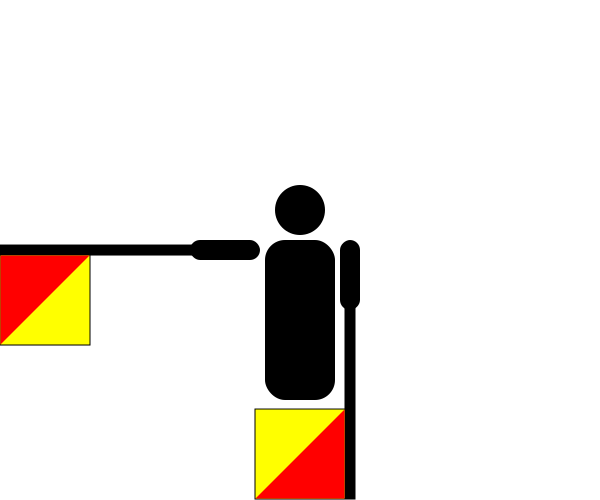
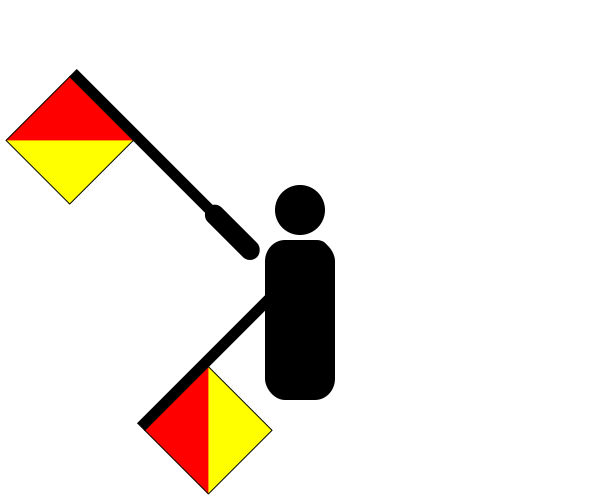
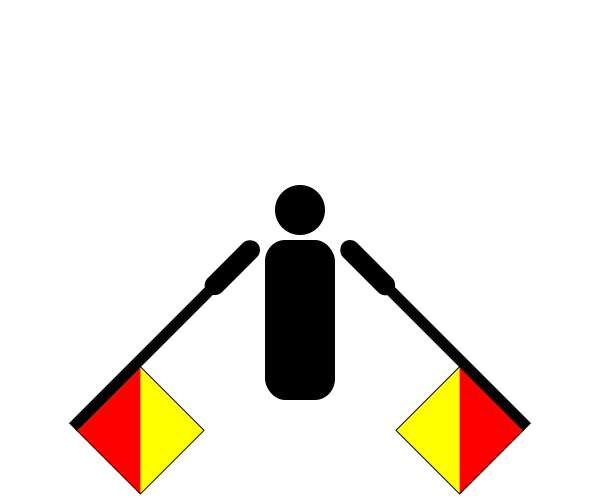
There are approximately 1,314 people named Sabin in the UK. That makes it roughly the 5,957th most common surname in Britain. Around 20 in a million people in Britain are named Sabin.
Origin: English
Region of origin: British Isles
Country of origin: England
Religion of origin: Christian
Language of origin: English

Famous people named Sabin
- Oliver Sabin - Electronic music/chip music composer and musician
- Alec Sabin - Actor
- Alfred Sabin - Football player (1905 to 1982)
- Lloyd Sabin -
- Joseph Sabin - American bibliographer (1821 to 1881)
Names and descriptions courtesy of Wikipedia, and may contain errors. This is not intended to be an exhaustive list of every famous person with this name.