RUSK
Rusk is a surname of Scottish and Norse origin, with the earliest known spelling recorded in 1552 as John Reisk, a witness at the Crown Court of Glasgow during the reign of Mary, Queen of Scots.
The name is derived from the Old Norse word hroskr, meaning horse. It is thought to have begun as a nickname for a person associated with a strong or swift horse, or for an individual who worked with horses. Over time, this nickname evolved into a hereditary surname and has been transmitted through successive generations.
In addition to its Norse roots, the surname has a Gaelic dimension. Variants such as Ruske or Rusk are linked to the Gaelic word riasg, denoting a moorland area covered with sedge grass. This topographical meaning suggests that early bearers of the name lived near such terrain. Only a few Gaelic surnames are purely topographical, which makes Rusk relatively uncommon in this regard.
Historically, most holders of the name in modern times are situated in Ireland. Records show that the surname arrived in the province of Ulster following the plantations policy of Oliver Cromwell after 1651 and later under King William I after 1690. One early Irish instance is the marriage of Margarett Rusk to John Mac Knitt at Burt, Donegal, on 8 December 1691. Subsequent baptisms include Robert Dixon Rusk at Carmoney, County Antrim, in 1774, and John William Ruske at Brookeborough, County Fermanagh, in 1866.
Within Britain, the name is predominantly found in Scotland, with early attestations in Perth, such as the christening of William Rush of Perth on 20 January 1656, and the marriage of John Rusk to Margaret Cock at Perth on 2 February 1818. The variant spelling Rush is also documented, highlighting the fluidity of orthography in early modern records.
Beyond the British Isles, the surname is present in the United States, particularly in states such as Wisconsin, Virginia, Pennsylvania and New York, and in Canada’s Ontario province. In the United Kingdom, the name is mainly concentrated in England, with smaller communities in Wales and Northern Ireland.
Variants of the surname reflect its diverse linguistic influences. Common spellings include Ruske, Rush, Rousk, and Roose. Each variation preserves the original phonetic elements while adapting to regional orthographic conventions.
The surname Rusk thus embodies a rich tapestry of Norse, Gaelic, and British heritage. Its endurance across centuries and across continents attests to the enduring legacy of early medieval naming practices and the migration patterns that have shaped the genealogical landscape of the modern world.
Typical given names associated with the Rusk surname
Male
- Andrew
- Dean
- Gary
- Graham
- James
- John
- Karl
- Matthew
- Robert
- Simon
- Thomas
- William
Female
- Barbara
- Caroline
- Elizabeth
- Gillian
- Judith
- Louise
- Margaret
- Mary
- Nicola
- Rita
- Sarah
- Sharon
- Una
- Zoe
Similar and related surnames
Related and similar names are generated algorithmically based on the spelling, and may not necessarily share an etymology.
How to communicate the surname Rusk in...
Braille
⠗⠥⠎⠅
Morse
.-...-...-.-
Semaphore
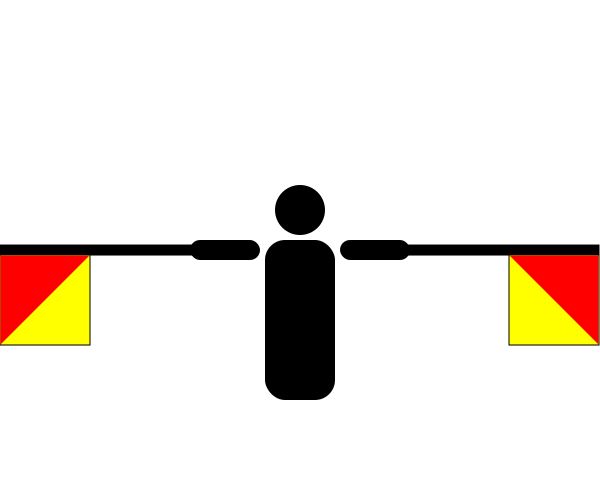


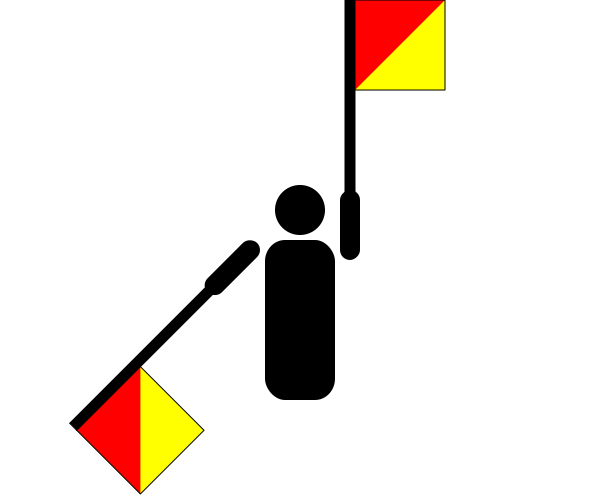
There are approximately 332 people named Rusk in the UK. That makes it one of Britain's least common surnames. Only around five in a million people in Britain are named Rusk.
Origin: Celtic
Region of origin: British Isles
Country of origin: Scotland
Religion of origin: Christian
Language of origin: Gaelic

Famous people named Rusk
- Simon Rusk - Football player
Names and descriptions courtesy of Wikipedia, and may contain errors. This is not intended to be an exhaustive list of every famous person with this name.