RUSH
Rush is a surname that finds its roots in both the English and Hebrew traditions. In the British Isles it is commonly encountered, particularly in England, where it is associated with Christian families and derived from the English language. The surname is linked to the English place name and to a specific geographical feature, namely the presence of rushes in wetland areas.
In England the surname is predominantly a topographic name. It is thought to arise from the ancient word rysc, meaning rushes, and was applied to individuals who lived near or worked with these tall, grass‑like plants. The use of rush as a surname dates back to pre-7th‑century times, before the Norman Conquest. Historical documents record a person named Alan le Russere of Sussex in the Subsidy Rolls of 1296, indicating that the name could also refer to a reed cutter or reed merchant.
Throughout the British Isles the surname appears in a wide variety of spellings. Common variants include Rush, Rushe, Rosher, Rusher, Rushman, Risch, Rischer, Rosch and Roscher. The German and Swiss variations echo the English form, reflecting the early Anglo‑Saxon connection. An example is Luczo Rosche, recorded at Ulm in 1319.
In Scotland and parts of Ireland the surname is derived from the Gaelic word risag, which also denotes rushes. The name evolved in Scotland into forms such as Ruske and Risk. Many Irish families of definite Gaelic origin bear the prefix O’, giving surnames such as O’Ruis, the descendant of the personal name Ros. In the province of Connacht, Rush has been used as the English translation of the Gaelic surname O’Luachra, where Luachra means to rush, thereby creating the modern spelling.
In addition to its English and Gaelic associations, Rush also has a Hebrew origin. It may be a variant of the Jewish name Rosh, derived from the Hebrew word for head or chief. This variant has appeared among Jewish families and indicates a separate line of origin from the English or Gaelic roots.
In summary, the surname Rush encapsulates a diversity of origins, each tied to distinct linguistic, cultural and geographical contexts. Whether stemming from the wetlands of England, the reed‑cutting trades of the medieval period, the Gaelic landscapes of Scotland and Ireland, or the Hebrew word for chief, the name reflects a rich tapestry of heritage that has persisted through the centuries.
Typical given names associated with the Rush surname
Male
- Andrew
- David
- James
- John
- Michael
- Paul
- Peter
- Robert
- Stephen
- Thomas
Female
- Ann
- Catherine
- Christine
- Elizabeth
- Emma
- Helen
- Linda
- Margaret
- Mary
- Patricia
- Sarah
- Susan
Similar and related surnames
Related and similar names are generated algorithmically based on the spelling, and may not necessarily share an etymology.
How to communicate the surname Rush in...
Braille
⠗⠥⠎⠓
Morse
.-...-.......
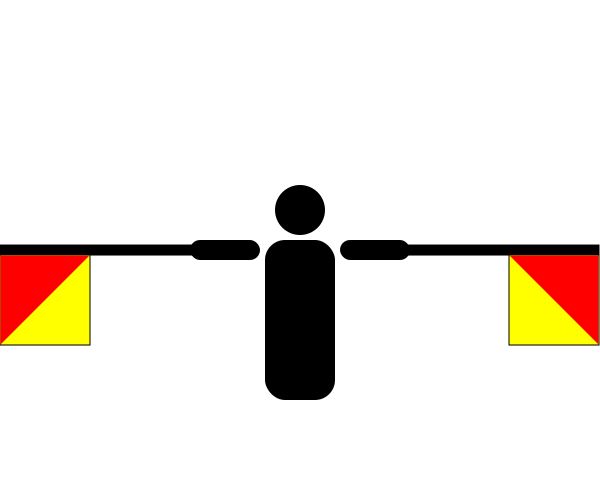
Semaphore


There are approximately 6,475 people named Rush in the UK. That makes it roughly the 1,462nd most common surname in Britain. Around 99 in a million people in Britain are named Rush.
Surname type: Location or geographical feature
Origin: English
Region of origin: British Isles
Country of origin: England
Religion of origin: Christian
Language of origin: English

Famous people named Rush
- Ian Rush - Welsh football player
- Geoffrey Rush - Australian actor and film producer
- Tom Rush - American singer
- William Rush - Actor
- Poppy Rush - Television actress
- David Rush - Football player
- Matthew Rush - Irish football player
- Christopher Rush - Writer
- Martin Rush - Athlete
- Michael Rush - Australian rower (1844 to 1922)
Names and descriptions courtesy of Wikipedia, and may contain errors. This is not intended to be an exhaustive list of every famous person with this name.