RUE
Rue is a surname with a multifaceted heritage that spans several European linguistic traditions. According to historical records it appears in England, Germany, France, Belgium, and the Low Countries, and the name has been present in the British Isles since at least the late twelfth century, with the earliest documented spelling William de Rugge in 1196.
The name is said to have three principal linguistic origins. In France it may derive from the Old French word rue, meaning “street”, which in turn comes from Latin routa “way” and eventually from ruga “crease”. Consequently, it is often a topographic or locational surname for someone who lived by a prominent road or lane. In Germanic contexts the surname can be linked to the personal name Hrod or the Old Norse hrothi, both signifying “fame” or “glory”, and in these situations it may have originated as a nickname for a notable or celebrated individual.
Another accepted derivation regards the word for the colour red. In Germanic and Norse languages the root ruegg or *-ruge* referred to a ruddy complexion or red hair. The surname Rue and its variants – such as Rew, Rug, Rugg, Rag, and Rueged – were sometimes applied to people with red hair, a trait that was remarkable enough to become an identifying feature. This interpretation is supported by the concentration of the name in regions such as Shropshire, where the locational variant Rudge can be traced to the village of the same name or to the medieval word for ridge.
In England the spelling has varied widely. Recordings include Welzlin Ruegg in 1412, Margaret Rug christened in Westminster in 1560, William Rugge of Fleet Street in 1591, and Ulrich Ruegg who married in London in 1790. These examples illustrate the evolution of the name from a foreign or ornamental form into an English habitational surname as families moved for work or other reasons.
Variants of the name are numerous in different linguistic communities. In Dutch and German areas it may be rendered as Rue, Ruegg, Rudiger, or even Ruh, while in French it appears as de la Rue, de la Ruelle, or Ruaudel. The Gaelic form Ó Rua (from the personal name Ruadh “red”) is attested in Scotland, and in Italian, Spanish, and Portuguese contexts related forms such as Rinaldi or Rin exist. These variations demonstrate the wide geographical spread and adaptive nature of the family name.
Today the surname Rue remains common in Northern Europe, particularly in Germany, Belgium, and France, and it is also found in English-speaking countries such as the United Kingdom, United States, and Canada. Its persistence and diversity reflect the name’s multiple origins and the mobility of its bearers across centuries and borders.
Typical given names associated with the Rue surname
Male
- Alain
- Alan
- Christopher
- Clive
- David
- Edmond
- John
- Justin
- Martin
- Peter
- Stephen
- Steven
- Terence
- Thomas
Female
- Carol
- Emily
- Emma
- Jane
- Jodie
- Judith
- Julie
- Margaret
- Marie
- Rebecca
- Sarah
- Sharon
- Valerie
Similar and related surnames
- Ru
- Reu
- Rou
- Roe
- Rhue
- Rew
- Reau
- Rieu
- Rhoe
- Rhew
- Rowe
- Roes
- Rous
- Roux
- Roze
- Rose
- Reus
- Ro
- Roue
- Rewe
- Rouz
- Raux
- Ure
- Rua
- Ra
- Raa
- Rae
- Raee
- Raei
- Rai
- Raia
- Raie
- Raii
- Raio
- Rao
- Rau
- Raue
- Re
- Rea
- Ree
- Rei
- Reio
- Reo
- Reux
- Rews
- Ria
- Rie
- Rio
- Riou
- Riu
- Roa
- Roi
- Roo
- Rooe
- Roou
- Rues
- Ruez
- Rugh
- Rughes
- Ruh
- Ruhe
- Rui
- Ruia
- Ruie
- Ruis
- Ruiu
- Ruiz
- Ruo
- Rus
- Ruus
- Ruz
- Ryrie
- Wrae
- Wroe
- Wyre
- Rueb
- Ruel
Related and similar names are generated algorithmically based on the spelling, and may not necessarily share an etymology.
How to communicate the surname Rue in...
Braille
⠗⠥⠑
Morse
.-...-.
Semaphore
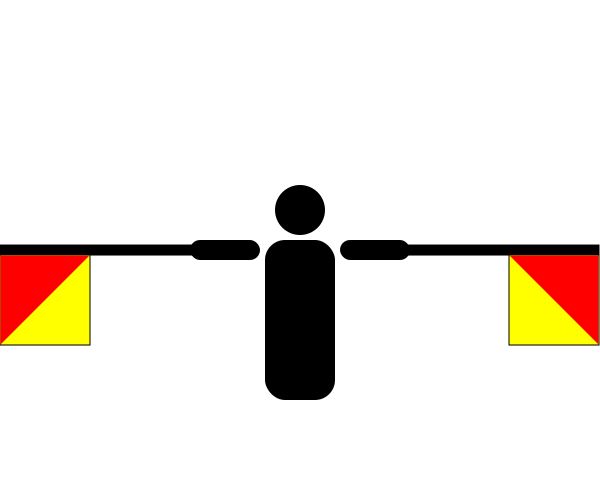


There are approximately 185 people named Rue in the UK. That makes it one of Britain's least common surnames. Only around three in a million people in Britain are named Rue.
Surname type: Location or geographical feature
Origin: English
Region of origin: British Isles
Country of origin: England
Religion of origin: Christian
Language of origin: English

Famous people named Rue
- Rosemary Rue - Physician and civil servant (1928 to 2004)
Names and descriptions courtesy of Wikipedia, and may contain errors. This is not intended to be an exhaustive list of every famous person with this name.