RAU
The surname Rau is firmly rooted in Germanic heritage. It is a traditional German surname that, according to contemporary scholarship, exhibits several plausible linguistic origins and has a documented presence within the broader German-speaking world.
In Old High German it appears in two principal forms. One derivation stems from the Middle High German word rouwe, meaning red; this variant typically served as a nickname for individuals distinguished by red hair or a ruddy complexion. The second derives from the Germanic word rauh or rau, signifying rough or rugged; such a meaning would have been applied to a person of a rough or brusque disposition, or to someone with a notably tough appearance.
Another linguistic route traces the name to a topographic origin. The Middle High German term rō denotes a bush or scrub, and the related verb form rauhe refers to a clearing. Consequently, Rau could have been a descriptive surname for someone dwelling near a bush, scrub, or cleared area of woodland.
The surname also bears a rich connection to Old Norse and subsequent Norman influences. The personal name Radulfr – a blend of the Germanic elements for ‘counsel’ (rad) and ‘wolf’ (ulf) – entered England during the Viking invasions of the ninth and tenth centuries. From this personal name the modern surname Rau evolved, along with a host of variants such as Rauf, Raulf, Ralf, and Rawle. The Latinised form Radulfus appears in early medieval records, for example the 1186 entry in the Abbey of Bury St. Edmunds. After the Norman Conquest, the Old French form Raoul and its Norman derivatives were introduced, and the spelling Rau was reintroduced into English society by French Huguenot refugees in the late sixteenth century.
Within Germany, the surname is mainly concentrated in the states of Hessen, Baden–Wurttemburg, and Bavaria. It remains among the most common surnames in Austria, ranking within the top 100 according to a 2019 survey. The name is also present, albeit less frequently, in Switzerland. Across Europe it has spread into neighbouring linguistic areas – the Netherlands, France, Sweden, as well as the Baltic states of Finland, Lithuania, Estonia, and Latvia, where the surname retains its Germanic roots.
Outside of Europe the name has migrated extensively. In the United States, early nineteenth‑century immigration brought families bearing the surname to the Midwest, where it is particularly frequent in Pennsylvania, Ohio, and Michigan. The surname is also found in Australia and New Zealand, typically reflecting the broader patterns of European emigration.
Variant spellings and cognates add further breadth to the name’s history. In Germany the most common variants include Rauer, Raue, and Rauh. In Ashkenazi and Yiddish contexts the name appears as Rou or Roh, while in the Netherlands the form de Rauw is recognised. In Britain, derivatives such as Rauch, Rouke, and Rawes have been documented. In France and Spain the name has been transformed into forms such as de Raux and Ruano, respectively, whereas in Scandinavia variants like Raud and Rask are observed.
The persistence of the surname Rau across multiple cultures and continents testifies to its robust linguistic and cultural adaptability, while its core Germanic roots remain evident in both the name’s phonology and its historical documentation.
Similar and related surnames
Related and similar names are generated algorithmically based on the spelling, and may not necessarily share an etymology.
How to communicate the surname Rau in...
Braille
⠗⠁⠥
Morse
.-..-..-
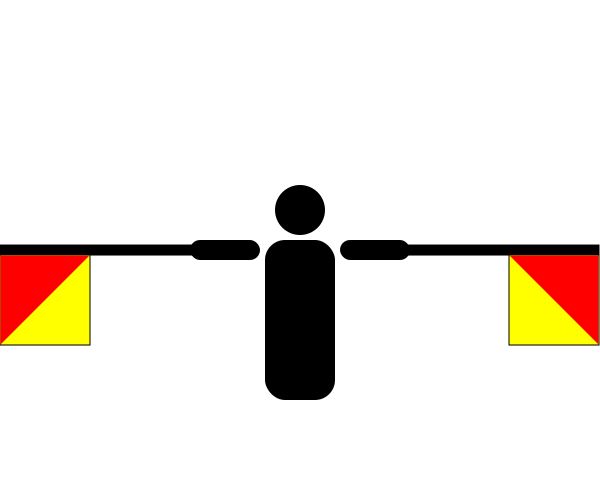
Semaphore


There are approximately 120 people named Rau in the UK. That makes it one of Britain's least common surnames. Only around two in a million people in Britain are named Rau.
Region of origin: Europe
Country of origin: Germany
Language of origin: German
