ROSIN
The surname Rosin originates in Germany, where it derives from the Middle High German word rosin, meaning resin or pitch. It was originally an occupational name for someone who worked with or traded in resin or pitch, commodities used in shipbuilding, woodwork and medicinal preparations.
Over centuries, migration and cultural interchange have produced a wide array of spellings and forms. In England the name appears as Rose, Rising, Roset and Rossi; in Scotland it is recorded as Ross; in France as Larose, Roz or Rosente; in Italy as Rossi, Rosetti or Rosone; and in Poland as Rosanski. In also documented instances: Rudolf Rosse of Basel (1283), Richard Roys in Suffolk (1327), Hugh Rosesone of Staffordshire (1342), Christof Rosa in Friedberg (1579) and Anna Russon of Stepney (1628).
In France the name has been linked to the French word resin and reportedly was adopted by families involved in the resin trade of north‑west France during the Middle Ages. It may also denote individuals bearing red hair, or those dwelling near a local place name derived from the same term. An alternate derivation cites the German rauchen, meaning smoke or burn, which would connect the name to charcoal production or other smoke‑producing industries.
There is also a significant Jewish component to the Rosin surname. In the Ashkenazi community it is frequently found across Central and Eastern Europe, notably in Poland, Germany, Belarus, Hungary, Lithuania, Russia and Ukraine. Following the Holocaust and the founding of the State of Israel, many bearers settled in Israel, where the name has become particularly common. Other diaspora communities are established in the United States, Canada, Australia, Mexico and Argentina, a pattern reflecting historic emigration from Europe.
Scholars recognise several possible origins for the name in its Jewish usage. These include a derivation from the Russian word ros (dew), an adaptation of the German surname Rosen or the Jewish surnames Rosenszweig and Rosenberg. Although the precise etymology remains uncertain, the consistent motif across all variants is a linkage to either an occupational activity or a locational reference.
In contemporary usage the Rosin surname exhibits remarkable resilience in its plural form. Variations such as Razin, Rossin, Raisin, Rasson and Roussin are recorded, alongside the pluralised Rosine and the composite forms Rosinov, Rosinove and Rossinove. These forms are often found in parallel Jewish and non‑Jewish contexts, underscoring a shared linguistic heritage.
Thus, the Rosin surname reflects a multifaceted history that spans occupational practice, geographical origin and cultural identity. Its endurance across languages, regions and generations speaks to the capacity of surnames to embody labour, settlement and communal memory over time.
Similar and related surnames
Related and similar names are generated algorithmically based on the spelling, and may not necessarily share an etymology.
How to communicate the surname Rosin in...
Braille
⠗⠕⠎⠊⠝
Morse
.-.---.....-.
Semaphore
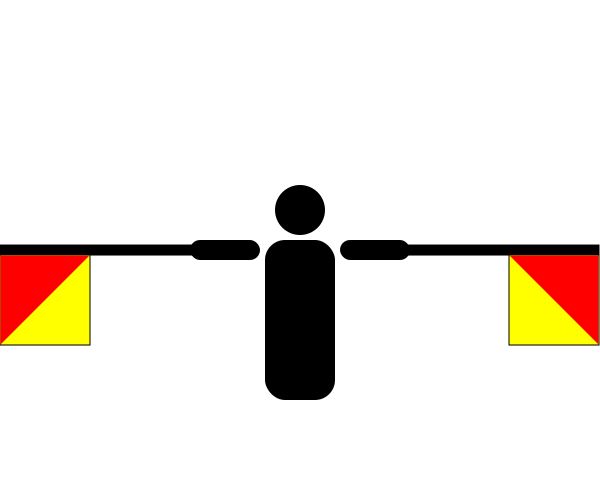
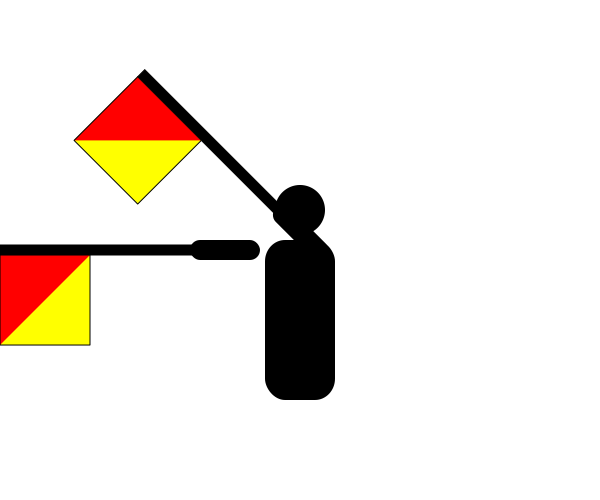

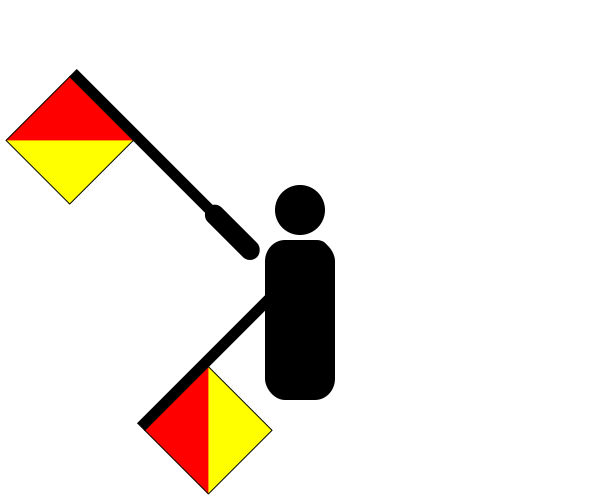
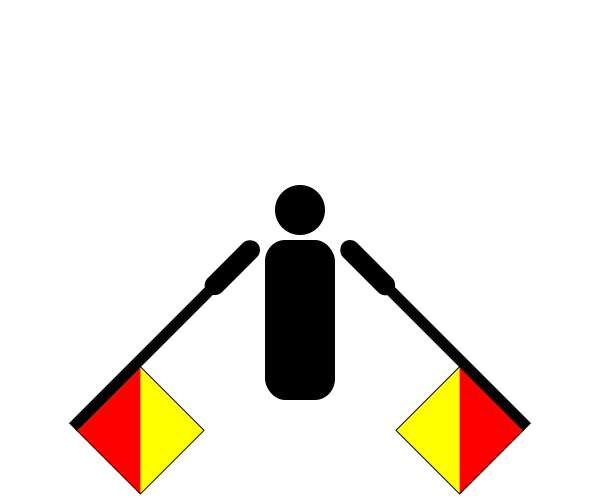
There are approximately 136 people named Rosin in the UK. That makes it one of Britain's least common surnames. Only around two in a million people in Britain are named Rosin.
