ROSIE
Rosie is a surname whose etymology is rooted in the Latin word rosa, meaning “rose”. The derivation is linked to the given name Rose, itself taken from Latin and used as a personal name in medieval Europe. As a surname, it is therefore thought to have arisen either as a nickname or a patronymic for someone bearing the given name or for an individual associated with the flower.
In the British Isles, particularly in Scotland, the name is documented within Gaelic linguistic traditions and appears among Christian families. Early Scottish records indicate use of the surname in the 14th and 15th centuries, with variations such as Rosie and Rose noted in English and German sources, for example the Subsidy Rolls of Suffolk (1327) and the Stuttgart records of 1350. The earliest known spelling in England appears in the London Court Rolls Register of 1302, in the reign of King Edward I.
The surname has been associated with several folk theories of origin. One proposes that it is a topographical name for a dweller in an area where wild roses grew, or for a resident of a place or inn marked by the sign of the rose. Another hypothesis regards it as a descriptive nickname for a person of rosy complexion, reflecting the image of a bright or fair complexion. A further possibility situates the name within the context of Yiddish, where the feminine personal name Royze is derived from the word for the flower.
From a different perspective the surname is also linked to the French word rosier, meaning a rose-grower. In early modern France the name designated a professional involved in cultivating roses, a trade that was significant both for medicinal uses and for ornament. The name has thus a long attachment to horticulture and to the cultural symbolism of the rose, which has historically represented beauty, charm, and devotion.
Later migration patterns have spread the name beyond the British Isles. Its presence in Italy, Spain, and Eastern Europe reflects both Roman Catholic and Ashkenazi Jewish influences, with spellings such as Roze, Rosen, Royze, and Rosello appearing in various national records. The name is historically noted in the United States, Canada, and Mexico as a common surname among Italian, Irish, and Spanish diaspora communities.
Contemporary bearers of the name are found worldwide, and the surname remains a testament to the enduring cultural resonance of the rose. The multiplicity of its variants—such as Rosy, Rosey, Royce, and other forms—illustrates the adaptability of the root across linguistic and geographic boundaries while preserving its original floral association.
Typical given names associated with the Rosie surname
Male
- Alexander
- Andrew
- David
- Donald
- George
- James
- John
- Jonathan
- Michael
- Stephen
- William
Female
- Alison
- Catherine
- Elizabeth
- Helen
- Irene
- Jane
- Janet
- Karen
- Kathleen
- Manijeh
- Margaret
- Mary
- Sarah
Similar and related surnames
- Rosey
- Roice
- Rocio
- Roci
- Roise
- Rohse
- Roase
- Rosi
- Rosia
- Roce
- Rosai
- Rosea
- Rosee
- Rosic
- Rosice
- Rosies
- Rosik
- Rosin
- Rosine
- Ross
- Rosse
- Rossey
- Rossi
- Rossie
- Rossis
- Rossy
- Rosy
- Rosz
- Royse
- Rozi
- Rozie
- Rozzi
- Rohss
- Roseau
- Roshe
- Roske
- Rosses
- Rossin
- Rossite
- Rozze
- Race
- Raza
- Reis
- Roos
- Roscoe
- Rosiek
- Rosier
- Rous
- Rouse
- Rowse
- Royce
- Ruiz
- Ruse
- Russ
- Russo
Related and similar names are generated algorithmically based on the spelling, and may not necessarily share an etymology.
How to communicate the surname Rosie in...
Braille
⠗⠕⠎⠊⠑
Morse
.-.---......
Semaphore

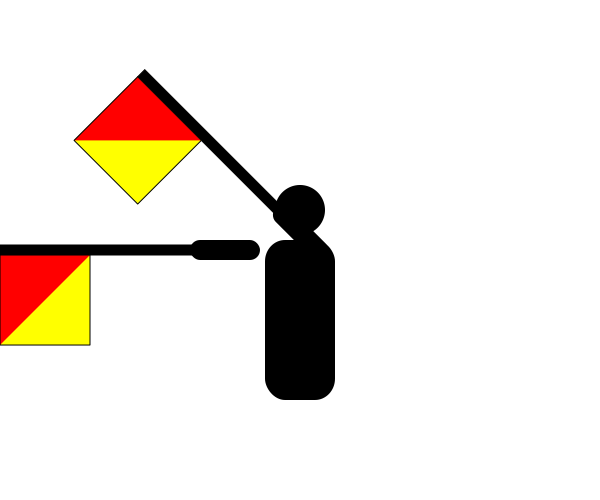

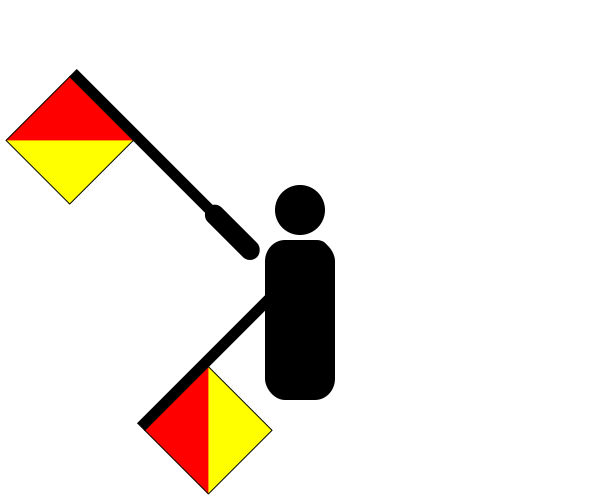

There are approximately 1,056 people named Rosie in the UK. That makes it roughly the 7,074th most common surname in Britain. Around 16 in a million people in Britain are named Rosie.
Origin: Celtic
Region of origin: British Isles
Country of origin: Scotland
Religion of origin: Christian
Language of origin: Gaelic
