RODER
Roder is a surname of Germanic origin that has been associated with several linguistic and geographical variants as a result of migration and linguistic evolution.
According to authoritative etymological sources, the name Roder derives from the Old German personal name Rüdiger, itself composed of the elements ruod meaning “fame” and ger meaning “spear”. Consequently, the surname can be interpreted as “famous spear”, suggesting that it may have originally been a nickname for someone skilled in battle or renowned for bravery.
An alternative derivation is recorded from the Old German personal name Hrodhar, which combines hrod “fame” with hari “army”, yielding the broad meaning “famous army”. In the Middle Ages it was common to name a child after desirable attributes, and thus Roder would have signified a brave or respected warrior. A topographical interpretation also exists, with the German word rother “clearing” applied to a person living near a cleared area.
The surname has several orthographic variations including Roeder, Röder, Roderer, Roddar, Rooder, Rudder and Roders. These variations arise from linguistic differences among German, Dutch and English speakers as the name spread across Europe.
In addition to its Germanic roots, Roder is also documented as an English or Anglo‑Saxon locational surname. Historian Canon Charles Bardsley, writing in 1880, traced the name to the pre‑7th century Old English word rod, an early form of the medieval measurement rood, and suggested that it described an area of agricultural land of sufficient size to feed a family of four. The village of Rodd in Herefordshire, first recorded in the 1273 Hundred Rolls through the name Nicholas de la Rodd, provides a locational source for many modern bearers of the surname. Other early records include Johannes Rodde in the 1379 Yorkshire Poll Tax rolls, Anne Rodders in 1687 London, Mary Rodda in 1730 Westminster, and Ruth Roder in 1745 Westminster.
Geographically, Roder is most ubiquitous in Germany, particularly in the north‑western states of Lower Saxony, North Rhine‑Westphalia and Saxony‑Anhalt, where it is recorded as an “exceptionally common” name dating back to at least 1598. According to sbzoo.org, the family’s historical migration from the Dutch city of Roden led to its concentration in these German regions. The surname is also the 25th most common surname in the Netherlands, reflecting its Dutch origins. In the United Kingdom and the United States, particularly in Michigan and Illinois, Roder appears among immigrant families, a pattern that aligns with broader German emigration during the 19th and early 20th centuries.
Collectively, the evidence demonstrates that Roder is a surname rooted in Germanic personal naming traditions, enriched by topographical and locational influences in both Germany and England, and disseminated across Europe and North America through migration.
Typical given names associated with the Roder surname
Male
- Alan
- Barry
- Christopher
- David
- Derek
- John
- Mark
- Martin
- Paul
- William
Female
- Beatrice
- Carol
- Doreen
- Elizabeth
- Gillian
- Hilda
- Lisbeth
- Megan
- Michelle
- Sandra
Similar and related surnames
Related and similar names are generated algorithmically based on the spelling, and may not necessarily share an etymology.
How to communicate the surname Roder in...
Braille
⠗⠕⠙⠑⠗
Morse
.-.----....-.
Semaphore
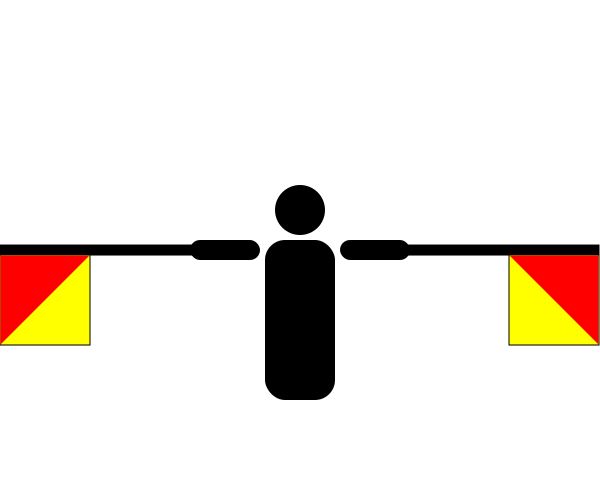
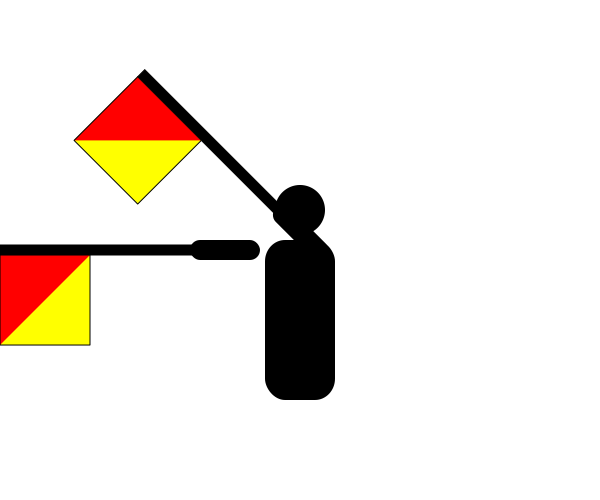


There are approximately 116 people named Roder in the UK. That makes it one of Britain's least common surnames. Only around two in a million people in Britain are named Roder.