RIDDER
Ridder is a surname of Dutch origin. The name derives from the Dutch word ridder, which means knight in English. Its development is typical of occupational names that were originally given to individuals who held a particular office or performed a specific service. In the case of Ridder, the name was associated with the rank of knight or with people who were closely linked to knighthood, such as members of a knight’s household or those who played the role of a knight in medieval drama.
The medieval use of the word ridder referred to a mounted and armoured soldier, a figure of chivalry and nobility. Individuals who were recognised for their martial skill or who served a lord on horseback were often identified by the sobriquet Ridder. Over time the term became hereditary, retaining the connotation of courage and honour while passing from one generation to the next.
Historical records show that the first clear attestation of the surname is found in the early 13th century. A deed dated 1204 records Thomas le Rider as a witness to an agreement in the “Assize Court Rolls of Yorkshire” during the reign of King John (1199–1216). This illustrates that spill-over of the name across the Anglo‐Saxon‑speaking realm was already occurring in the late Middle Ages.
While the Dutch root is dominant, the spelling Ridder is also seen as a variant of the English surname Rider or Ryder, which itself originates from the Old English verb ridan meaning to ride. Following the Norman Conquest of 1066, the English term shifted, with Rider and Ryder falling out of favour as the concept of knighthood solidified. In both linguistic traditions the surname thus conveys a connection to mounted service, whether military or custodial.
Geographically, Ridder remains most common in the Netherlands, where it ranks among the one‑hundred most popular surnames. In Belgium it is predominantly found in Flanders, especially East Flanders, whereas in Germany it is largely concentrated in North‑Rhine‑Westphalia. The name also survives in Denmark, North‑Rhein‑Westphalia, Norway and Sweden, reflecting the broader Germanic spread of the same root. Emigration from the Low Countries in the 16th and 17th centuries further dispersed the surname across North America, Australasia and other parts of the world, where it continues to appear, though less frequently, in states such as Pennsylvania, Ohio, New York, Massachusetts and Maryland.
The surname has a variety of orthographic variants that reflect regional pronunciation and transliteration practices. Common forms include Rider, Ryder, Rieder, Riederle, Rydder, Ridderhausen, Ridderhuis, Riddershuys and the German Ritter. In Dutch contexts the spelling Der Ridder is also recognised. All these versions share the same etymological foundation in the concept of mounted service or chivalry.
In summary, Ridder is a surname deeply rooted in the medieval tradition of knighthood. Its persistence across centuries and borders illustrates both the cultural importance of the knightly class in European history and the way occupational identities can transform into hereditary family names. The breadth of its variants and geographic spread provides a testament to the enduring legacy of the term ridder in both Nether‑European and broader Germanic societies.
Typical given names associated with the Ridder surname
Male
- Adrian
- Martin
- Willem
Female
- Sheridon
Similar and related surnames
Related and similar names are generated algorithmically based on the spelling, and may not necessarily share an etymology.
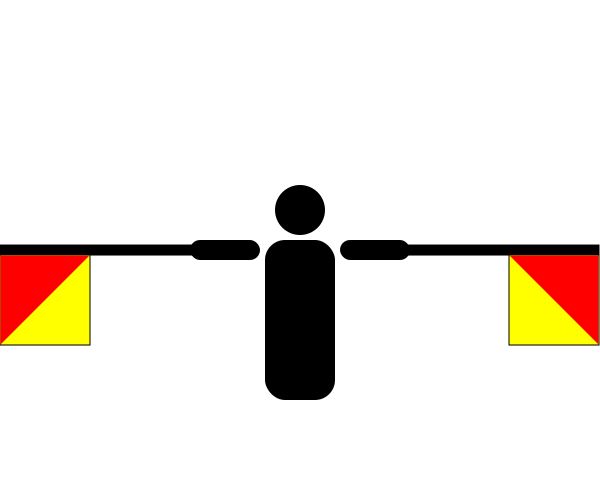
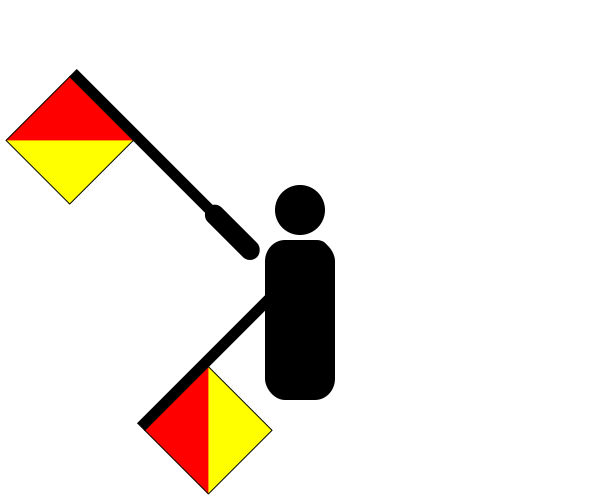
How to communicate the surname Ridder in...
Braille
⠗⠊⠙⠙⠑⠗
Morse
.-...-..-....-.
Semaphore


Sorry, we don't have any statistics on this name. That's probably because it's very uncommon in Britain.
