REIN
Rein is a surname of German provenance, whose etymological roots are diverse and reflect a range of linguistic influences across Europe. The name appears in more than fifty different spellings, including Raine, Reen (both common in Britain), Renne, Reynon and Reyne (found in France), Rehn and Renn (Germany), and Reina (Italy, Spain and Portugal). These variants attest to the widespread dispersal of the surname throughout the continent.
One principal source of the name is the Germanic personal name Reinhard, composed of the elements ragin meaning “counsel” and hart meaning “hardy” or “strong”. As a result the surname can be interpreted as relating to the notion of “brave counsel” or “strong advice”. A second derivation is from Middle High German rein, meaning “pure” or “clean”. In occupational contexts this form is often associated with craftsmen such as silversmiths, whose work required a great deal of purity in metal or glass. A third possibility ties the name to the medieval female given name Reine, itself stemming from Latin regina “queen”; here the surname might have been adopted as a status indicator.
In Scotland the name is linked to a locational origin. The place name Raine, situated in Aberdeenshire, derives from Old Gaelic rath chain, meaning “the ford where the tax is paid”. The earliest Scottish record of the name is that of Robert de Rane in 1180, in the Episcopal Registers of Aberdeenshire, during the reign of King Malcolm, of the late eleventh century. Other early European documents contain instances such as Sir Thomas Rane of Irvine (Scotland, 1260), Alan Reyne of Cambridgeshire (England, 1260), Counrad ze Rine of Basel (Switzerland, 1272) and Johannes Rayne of Yorkshire (England, 1379).
The surname has been carried across many countries owing to migration during the 18th and 19th centuries. In particular German emigrants who settled in the United States, Australia, Canada and parts of Eastern Europe – such as Belarus and Ukraine – brought the name with them. In the United Kingdom it remains less common than in Germany, though it can still be found in pockets where German heritage is retained. In the United States, by 1890 the number of German-born immigrants was estimated at 213,000, many of whom would have borne the name Rein or one of its variants such as Rain or Rhine.
Throughout the surname’s history, variation in spelling has often been used to distinguish distinct family lines. Examples include the addition of articles such as de or von, producing forms like Rein de or Rein von. In some regions the name has been adapted to fit local orthography, yielding versions such as Reyne in France, Rhein in Austria, Reinhold in Scotland, and even Dutch forms like Raven, Reyneke and Run.
Despite its relatively uncommon status today, the name Rein remains a source of pride for its bearers, who often celebrate the long and varied lineage that knits together elements of bravery, counsel, purity and noble heritage within a single surname. Its enduring presence across Europe and beyond attests to the resilient nature of family identity in the face of social and geographical change.
Similar and related surnames
- Erin
- Raan
- Rahn
- Rain
- Raina
- Raine
- Raines
- Raini
- Raino
- Rains
- Rainu
- Ran
- Rane
- Rann
- Rayn
- Rayne
- Rean
- Reane
- Reano
- Reans
- Reena
- Reene
- Rehn
- Rei
- Reign
- Reina
- Reine
- Reines
- Reiney
- Reing
- Reini
- Reinis
- Reinl
- Reino
- Reins
- Rena
- Rene
- Reneau
- Renee
- Renes
- Reni
- Renia
- Renie
- Renna
- Renne
- Rennie
- Renno
- Reno
- Renoo
- Renou
- Renu
- Reny
- Renz
- Reyna
- Reyne
- Reyno
- Reyns
- Rhean
- Rhein
- Rheins
- Rhene
- Rien
- Riene
- Ruane
- Rynn
- Rynne
- Wrean
- Wrenne
Related and similar names are generated algorithmically based on the spelling, and may not necessarily share an etymology.
How to communicate the surname Rein in...
Braille
⠗⠑⠊⠝
Morse
.-....-.
Semaphore
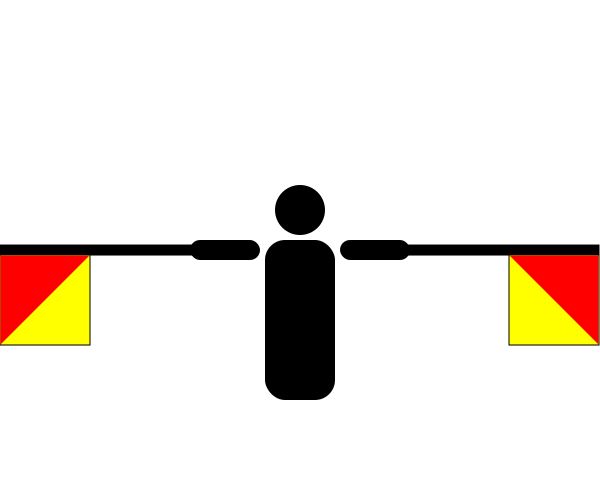

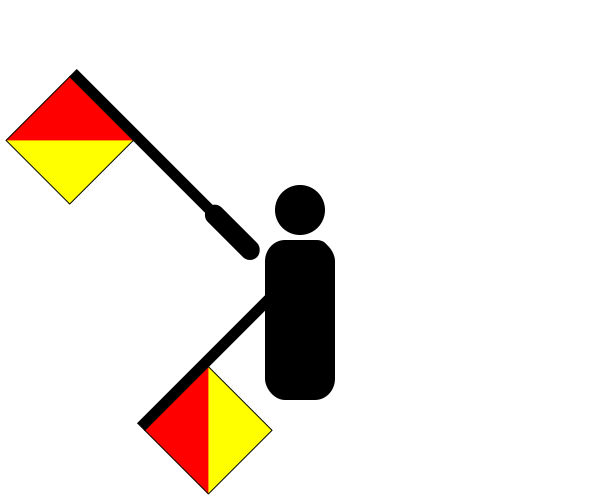
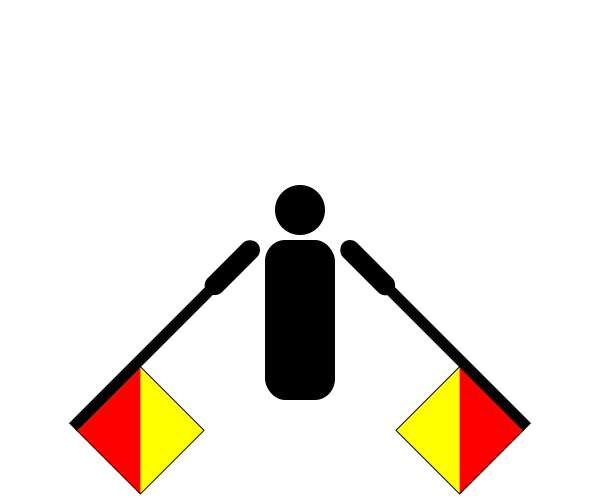
There are approximately 87 people named Rein in the UK. That makes it one of Britain's least common surnames. Only around one in a million people in Britain are named Rein.