REHN
The surname Rehn is of German origin, deriving originally from the Middle High German word renne, meaning “reindeer”. It is believed to have first been used as a nickname for an individual who displayed traits associated with the reindeer, such as agility or speed. Over centuries the nickname became hereditary and was transmitted from generation to generation, eventually establishing itself as a recognised family name.
In addition to its occupational origin, the name Rehn may also trace back to a shortened form of various pre‑7th-century Germanic male personal names that began with the element ragin, meaning “counsel”. Examples of such names include Raymond and Reynold, which together imply “counsel‑rule”. This etymology is reflected in other European variants such as Rene, Renne, and Rein, all of which share a common linguistic ancestry.
The surname appears in a wide array of spellings across Europe. In Britain it is commonly seen as Rain, Raine, Rean and Reen, while in France the forms include Rene, Renne, Rainon, Renon and Reyne. In German-speaking regions the surname occurs as Rein, Rehn and Renn, whereas in Italy it appears as Regina or Reina and in Spanish and Portuguese as Reina. These variations illustrate the widespread distribution and adaptation of the name across linguistic borders.
Records of the name reach back to the late 12th century. The earliest documented instance is that of Robert de Rane, recorded in the Episcopal Registers of Aberdeenshire, Scotland in 1180 during the reign of King Malcolm III. Other early examples include Sir Thomas Rane of Irvine, Scotland in 1260; Alan Reyne of Cambridgeshire, England, also in 1260; Counrad ze Rine of Basel, Switzerland in 1272; and Johannes Rayne of Yorkshire, listed in the 1379 Poll Tax rolls.
Through the Middle Ages the surname also developed a locational element in Scotland. It may have been adopted by families residing near or associated with a place called Raine in Aberdeenshire, the name of which derives from the Old Gaelic rath chain, meaning “the ford where the tax is paid”. Thus, some bearers of the name acquired a surname that signified both personal characteristics and geographical association.
In modern times, Rehn continues to be recognised in regions with Nordic heritage, such as Norway, Sweden and Finland, where it is shared by tens of thousands of people. It remains a comparatively rare surname in German-speaking countries, particularly in Germany and Austria, but still attains a presence wherever Germanic and Scandinavian communities have settled, including the United States, Canada and Australia.
Other linguistic variants highlight the name’s ability to blend into diverse cultures. In Finland the surname is spelt Rehn, while in Swedish society it is Rehn and in Danish it appears as Reen. In Estonia, Latvia and Lithuania the name is found among Baltic populations, and in Hungary the spelling Rén is occasionally encountered. In Arabic-speaking contexts, comparable surnames such as Rahim or Raheem are observed, although these are not direct derivatives of Rehn but are included to illustrate common phonetic patterns.
The meaning of the name is often associated with wisdom and prudent counsel, owing to its connection with the Proto‑Germanic root ragin. Consequently, bearers of the name are traditionally perceived as individuals who possess wisdom and the capacity to offer thoughtful advice. The symbolic link to reindeer further enriches the surname’s historical narrative, suggesting speed and adaptability as cherished attributes.
Over time the spelling of the surname has varied considerably. Common forms include Rehn, Rehne, Rhein, Rhine, Rein, Raine, Rheine, Rhyne, Rayne and Rayn. In Germany it may be joined to a locative suffix, giving rise to surnames such as Rheinheimer, Rheinitze and Rheinig. In Scandinavian contexts it sometimes appears in spelling forms such as Rahn or Rehbander. These variants reveal how orthography has evolved in response to regional dialects and administrative conventions.
The surname’s breadth across continents can also be observed in diaspora communities. In the United States the name is occasionally written as Rhine, while in Canada a more frequent spelling is Rhyne. Migration from Europe during the 19th and 20th centuries brought these diverse spellings to North America and Australia, where they have been preserved in the genealogical records of many families.
In contemporary usage the surname Rehn is still chosen for new births in families who wish to maintain a connection with their Germanic heritage and the noble attributes it conveys. Its longevity and adaptability underscore the enduring relevance of this family name throughout history and in the modern world.
Similar and related surnames
- Reh
- Reha
- Raan
- Rahn
- Rahna
- Rahne
- Rain
- Ran
- Rane
- Rann
- Rayn
- Rean
- Reane
- Reano
- Reans
- Reena
- Reene
- Reign
- Rein
- Reina
- Reine
- Reini
- Reino
- Reins
- Rena
- Rene
- Renee
- Renes
- Reni
- Renie
- Renna
- Renne
- Renno
- Reno
- Renoo
- Renou
- Renu
- Reny
- Renz
- Reyna
- Reyne
- Reyno
- Reyns
- Rhan
- Rhean
- Rhein
- Rheins
- Rhene
- Riene
- Wrean
- Wrenne
- Raine
- Rayne
- Reneau
- Rennie
- Ruane
- Rynn
- Rynne
Related and similar names are generated algorithmically based on the spelling, and may not necessarily share an etymology.
How to communicate the surname Rehn in...
Braille
⠗⠑⠓⠝
Morse
.-......-.
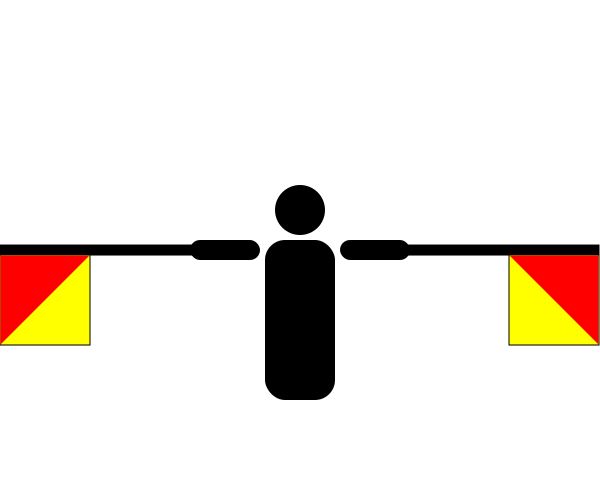
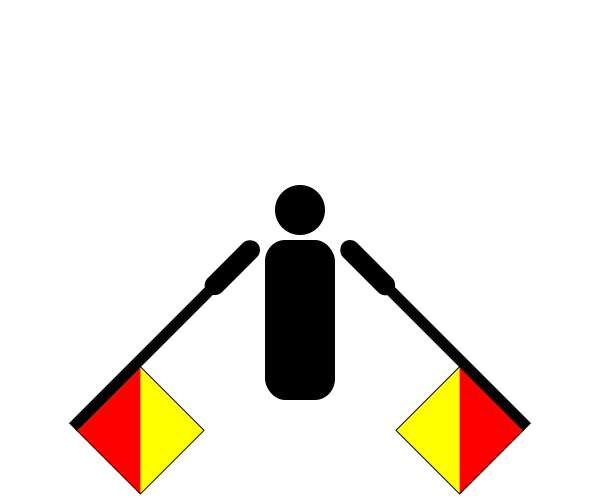
Semaphore


Sorry, we don't have any statistics on this name. That's probably because it's very uncommon in Britain.
