POOLEY
Pooley is an English surname of locational origin, recorded within the British Isles as early as the twelfth century. The name derives from Old English elements: pol, meaning “pool” or “small body of water”, and leah, meaning “wood” or “clearing”. It therefore designates a person who lived near a small pool or a clearing within a woodland, or who hailed from a place named Pooley.
Two principal English settlements are traditionally associated with the surname. The hamlet of Pooley in Warwickshire, situated in the Black Country, and a location formerly known as Polheia in the area now called Hunts Hall in Essex. The latter place was recorded in 1291, indicating that this surname had already entered the parish records of that period.
The earliest surviving documentation of the surname appears in the Hundred Rolls of the late fifteenth century. William de Poleye is listed in the 1273 Rolls of Berkshire, Elias de Polye in the 1275 Rolls of Norfolk, and William de Polleye in Worcester the same year. Earlier evidence is found in the “Feet of Fines” of Essex, where Walter de Polhey is dated to 1248, during the reign of King Henry I, the Frenchman, who ruled from 1216 to 1272.
From these records it can be seen that the surname was already established by the late 1200s, with a variety of spelling variants reflecting medieval orthographic practices. The forms Polye, Polhey and Pooleye all appear in contemporary documents.
In the post‑medieval period the name continued to be attested. Notable entries include Thomas Pooley, son of George Pooley, christened at Allresley, Warwickshire, on 23 November 1587; Robert Pooly, who married Jane Brewer at St Stephen’s, Coleman Street, London, on 4 August 1601; and Sarah Pooley, who married Nathaniel Day at St James Church, Duke Street, London, on 12 March 1694. These records confirm the persistence of the surname in both rural and urban settings.
The Pooley coat of arms is blazoned as a gold field charged with a black lion rampant. On the creature’s shoulder a gold crescent is depicted, symbolising the defeat of infidels. The heraldic device further emphasises the noble aspirations often associated with early English families bearing the name.
Throughout its documented history the Pooley family remained within Christian communities, practising the faith of the Church of England. The surname is exclusively English in origin, with no known foreign influences affecting its formation. It is a testament to the enduring tradition of place‑based surnames in England, reflecting the intimate connection between family identity and local geography.
Typical given names associated with the Pooley surname
Male
- Andrew
- Anthony
- Christopher
- David
- John
- Mark
- Martin
- Michael
- Richard
- Robert
- Stephen
Female
- Angela
- Christine
- Elizabeth
- Emma
- Helen
- Jean
- Karen
- Margaret
- Maureen
- Nicola
- Sarah
- Susan
- Victoria
Similar and related surnames
Related and similar names are generated algorithmically based on the spelling, and may not necessarily share an etymology.
How to communicate the surname Pooley in...
Braille
⠏⠕⠕⠇⠑⠽
Morse
.--.------.-...-.--
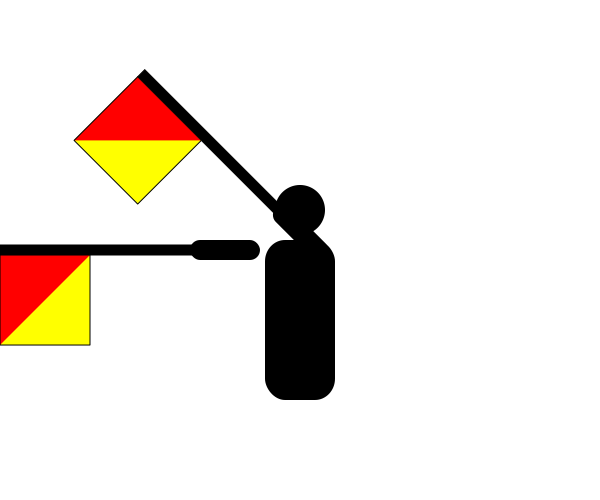
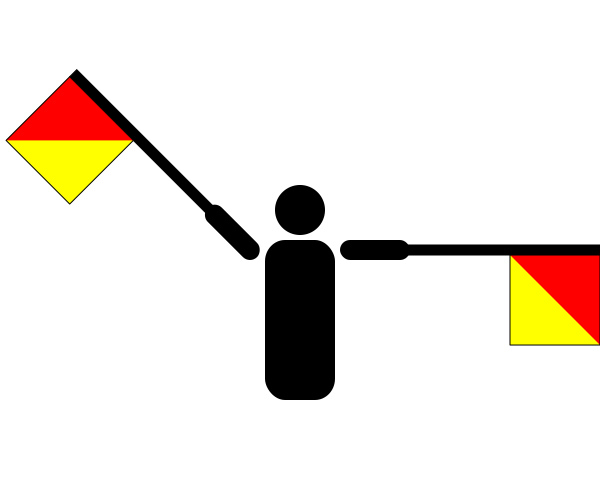
Semaphore



There are approximately 4,140 people named Pooley in the UK. That makes it roughly the 2,252nd most common surname in Britain. Around 64 in a million people in Britain are named Pooley.
Surname type: Location or geographical feature
Origin: English
Region of origin: British Isles
Country of origin: England
Religion of origin: Christian
Language of origin: English

Famous people named Pooley
- Emma Pooley - Road racing cyclist
- Olaf Pooley - Actor (1914 to 2015)
- Dean Pooley - Football player
- Isobel Pooley - High jumper
- Frederick Pooley - Cricketer (1852 to 1905)
- Guy Pooley - Rower
- Ted Pooley - Cricket player of England. (1842 to 1907)
Names and descriptions courtesy of Wikipedia, and may contain errors. This is not intended to be an exhaustive list of every famous person with this name.