POLLY
Polly is a family name that bears a multifaceted etymology shared across several linguistic and cultural traditions.
Its earliest English form arises from the medieval personal name Polly, a diminutive of Mary. The name Mary itself descends from the Hebrew Miryam, translating as “beloved” or “wished‑for child.” Consequently, the surname Polly may be construed as signalling descent from an ancestor nicknamed or known by this affectionate form of Mary.
Parallel etymological data reveal that the name Polly may also be linked to the Old French poli, meaning “polished” or “agreeable.” In this sense it would have designated a courteous or amiable person. The surname, with variant spellings such as Poley, Pollee, Pollie and Poly, is well documented in English parish records from the mid‑sixteenth century. For instance, the christening of Symon Polley at St. Botolph without Aldgate, London, in 1559, and the marriage of Robert Polley to Grace Goodaye in 1574, are among the earliest entries. Another early record is the marriage of James Polye in 1555 at St. Andrew’s, Enfield, London, during the reign of Queen Mary, known historically as “Bloody Mary.”
In addition to its English roots, the surname Polly has connections with French Huguenot refugees. The christening of Elisabeth, daughter of Jacob Pollee, at the Threadneedle Street French Huguenot Church in London on 13 August 1671, demonstrates that some bearers of the name were of Huguenot extraction, having entered England to escape religious persecution in the sixteenth and seventeenth centuries. An example of inter‑national marriage within this community is the union of James Polley and Martha Shadwell Pertey on 22 November 1845, which was solemnised in the British Embassy Chapel, Paris, Seine, France.
A heraldic representation associated with the families spelling their name as Poley depicts a gold shield punctuated by a black lion rampant, with a silver martlet on the shoulder, a design that has been officially granted to the family.
Other scholarly accounts propose that the surname Polly may be derived from the personal name Paul, which in turn originates from the Latin Paulus meaning “small” or “humble.” Under this interpretation the family name could symbolise the lineage of a modest or unassuming individual. Yet another hypothesis, grounded in Greek, suggests a derivation from polloi, meaning “many,” a nickname possibly bestowed upon people with large families.
Throughout history, the spelling of the surname has varied because of regional pronunciation and orthographic shifts. The forms Polley, Pooley, Polliet and Polly have all appeared, and the name has been recorded in a range of countries outside of England, including the United States, Canada, Australia, New Zealand, and the United Kingdom, with the largest contemporary concentration in the United States, especially in the south‑eastern states, though such distribution is secondary to the English historical record.
In sum, the family name Polly exhibits a rich tapestry of linguistic origins, encompassing Hebrew, Latin, French, and Greek roots, each contributing to the name’s long‑standing heritage and the diversity of its bearers across centuries and continents.
Typical given names associated with the Polly surname
Male
Female
Similar and related surnames
Related and similar names are generated algorithmically based on the spelling, and may not necessarily share an etymology.
How to communicate the surname Polly in...
Braille
⠏⠕⠇⠇⠽
Morse
.--.---.-...-..-.--
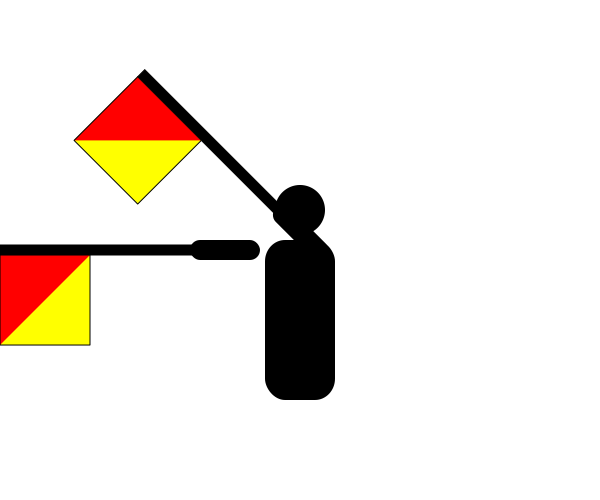
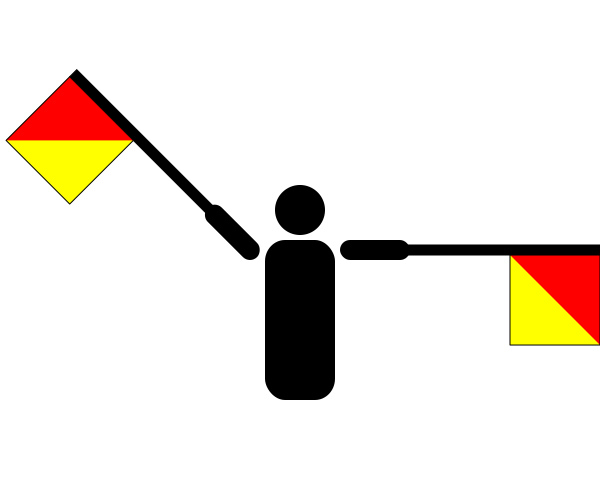
Semaphore


There are approximately 93 people named Polly in the UK. That makes it one of Britain's least common surnames. Only around one in a million people in Britain are named Polly.