PENDER
Pender is a surname with a complex heritage that reflects the linguistic and social history of the British Isles and their former colonies. Though it can be traced to more than one linguistic origin, the name most commonly retains three primary sources of derivation: Welsh, Anglo‑Saxon, and Irish.
Beginning in Wales, the form Pender was originally a patronymic surname. It is thought to arise from the personal name Pyndara, meaning chief or leader. Thus the name would initially have been used to identify the descendants of an individual named Pyndara, and the earliest record of a comparable form, Richard le Pynder, dates back to 1219 in the Assize Court Rolls of Yorkshire. By the early thirteenth century the spelling had already converged onto the form Pender, evident in the recorded names of William le Pendere (1231) and Richard le Pundere (1296).
In medieval England and later in colonial migration, Pender also evolved as an occupational surname. The term was reserved for an official responsible for rounding up stray animals and placing them in a pound. The occupation finds its roots in the Middle English word pin(en), itself an agent derivative of Old English pyndan meaning “to shut up or to enclose.” Accordingly the name appears in a number of early English and Irish legal and ecclesiastical documents. Among these are the marriage record of Margaret Pynder and John Hobby at St. Stephen’s, Coleman Street on 13 October 1549, and the christening of William, son of William and Cathren Pender, at St. Olave’s, Southwark on 2 November 1729. Members of the family also appear in the London Church Registers from the sixteenth to seventeenth centuries, reflecting a concentration of the surname in the capital and its surroundings.
The Irish connection emerges from the Gaelic Mac Fhionndoire, literally “son of the white‑haired warrior.” This translation emerges from the Gaelic elements Mac, meaning “son of,” and Fhionndoire, a personal name that has been interpreted as “white‑haired.” As with many Irish surnames, the name was anglicised to a form more familiar to English‑speaking clerks and officials; thus Pender arose as the accepted English version. The name was particularly common in Donegal, in the north‑west of Ireland, and later it spread to other counties such as Kildare and Dublin. After the Great Famine of the nineteenth century, emigration brought bearers of the name across the Atlantic and to the colonies, where it can now be found in the United States, Canada, Australia, and New Zealand, alongside its parents in Ireland and the United Kingdom.
The spectrum of spelling variations is extensive, reflecting both phonetic changes and administrative transcription practices. These include Pinder, Pindar, Pindor, Pender, Pendre, Pendry, Pendher, Pendor, Pendrar, McPender, O’Pender, Pendergast, and Pendergrass. Some variants incorporate prefixes such as Mac or O, signalling patronymic origins, while others such as Pendergast represent distinct family lines that share certain etymological roots but diverge in geographical clustering.
During the late medieval period, the surname appears in the Subsidy Rolls of Sussex (1296) as Richard le Pundere, and in the Calendar of the Patent Rolls for Essex (1231) as William le Pendere. These documentary witnesses show that the name was firmly established in both southern coastal counties of England and in the north of the island. A later, noteworthy example is Thomas Pender, a 24‑year‑old famine emigrant who sailed from Dublin aboard the Perseverance bound for New York on 18 May 1846, a record that illustrates ongoing migration by the name during a period of mass displacement.
In contemporary usage the surname remains primarily concentrated in Ireland and the United Kingdom, although it is also represented in the Commonwealth of Nations and the United States. Statistical sources indicate that the name is relatively uncommon on a global scale but that it still retains a recognizable presence in regions historically connected with its origins. Today, researchers examining genealogical records frequently observe that the name clusters in particular areas: majority of convergent records are concentrated in historic counties of Ireland, specific parish churches in London and his county of Essex, and select Scottish localities that share a linguistic heritage with the Gaelic source.
Notwithstanding the multiplicity of origin stories, the surname Pender exemplifies the way in which personal names evolve over time through patronymic identification, occupational designation, and the anglicisation of Gaelic forms. Its documented presence from the early thirteenth century to present day provides a clear thread through which one can trace societal change, migration patterns, and linguistic adaptation across the Irish Sea and beyond.
Typical given names associated with the Pender surname
Male
- Andrew
- Christopher
- David
- James
- John
- Mark
- Michael
- Robert
- Thomas
- William
Female
- Angela
- Claire
- Elizabeth
- Helen
- Karen
- Kirsty
- Lynda
- Margaret
- Mary
- Michelle
- Nicola
- Sarah
- Susan
Similar and related surnames
- Pander
- Panduro
- Pendar
- Pendaer
- Panders
- Pandor
- Pende
- Painter
- Paintor
- Panadero
- Pandher
- Pandiri
- Pandore
- Pandre
- Pandrea
- Panduru
- Paniter
- Pannetier
- Panter
- Pantor
- Paunder
- Pawntree
- Paynter
- Payntor
- Pend
- Pendaries
- Pendarves
- Pendel
- Pendered
- Penderell
- Pendergart
- Pendergas
- Pendergass
- Pendergast
- Pendergest
- Pendergist
- Pendergost
- Pendergras
- Penderis
- Penders
- Pendersen
- Penderson
- Penderton
- Pendery
- Pendle
- Pendler
- Pendorf
- Pendorous
- Pendower
- Pendraigh
- Pendrak
- Pendray
- Pendre
- Pendred
- Pendree
- Pendreigh
- Pendrel
- Pendrell
- Pendress
- Pendreth
- Pendrey
- Pendriegh
- Pendril
- Pendry
- Pener
- Pennetier
- Penter
- Pfender
- Pignataro
- Pindar
- Pinder
- Pindor
- Pindur
- Pintar
- Pinter
- Pintor
- Pintori
- Pionter
- Poinder
- Pointer
- Pointor
- Ponder
- Pondor
- Ponnudurai
- Ponter
- Pontier
- Pontiero
- Pontor
- Pounder
- Pounter
- Pownder
- Poynder
- Poynter
- Poyntor
- Punatar
- Punder
- Pundir
- Puntar
- Punter
- Pendergood
- Pendrill
Related and similar names are generated algorithmically based on the spelling, and may not necessarily share an etymology.
How to communicate the surname Pender in...
Braille
⠏⠑⠝⠙⠑⠗
Morse
.--..-.-....-.
Semaphore


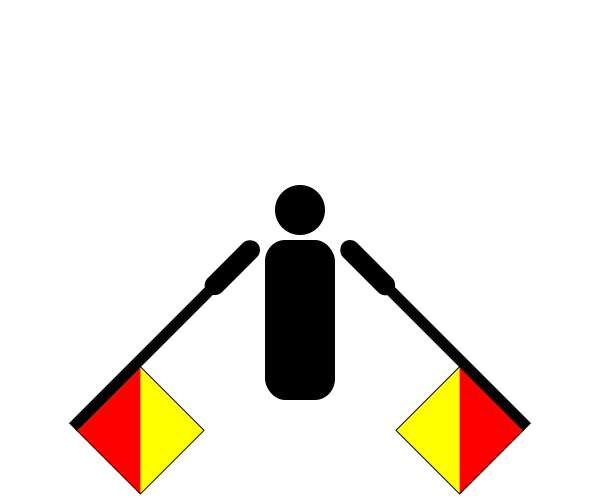

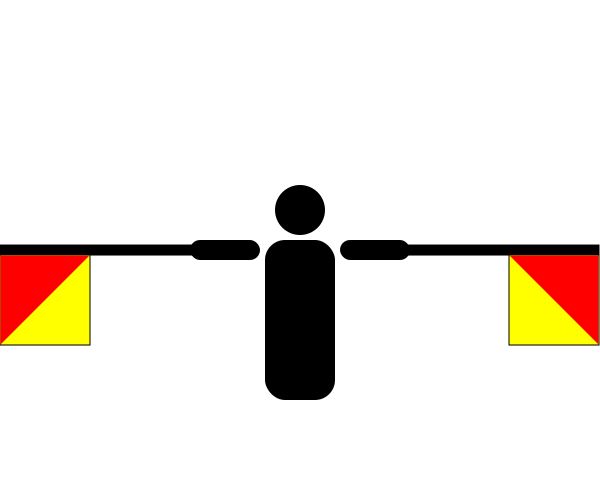
There are approximately 2,261 people named Pender in the UK. That makes it roughly the 3,801st most common surname in Britain. Around 35 in a million people in Britain are named Pender.
Surname type: Occupational name
Origin: English
Region of origin: British Isles
Country of origin: England
Religion of origin: Christian
Language of origin: English

Famous people named Pender
- Mike Pender - Musician
- Norman Pender - Rugby union player
- Robert Pender - Scottish football player
- John Pender - Irish football player
Names and descriptions courtesy of Wikipedia, and may contain errors. This is not intended to be an exhaustive list of every famous person with this name.