PAYNTER
Paynter is a surname of English origin which, like many of its counterparts, derives from an occupation. It is recorded in the English Isles from the early thirteenth century and remains a recognised family name in the United Kingdom and beyond.
The name Paynter originates from the Middle English word peintour (also rendered as paynter) which itself comes from the Old French peintour and the Latin paenere, all meaning “painter”. The surname therefore originally described an individual engaged in painting, whether that be the decoration of houses, the finishing of sculptures, or the creation of stained‑glass windows. It is an occupational name common to many English families whose ancestors contributed to the visual arts or the practical decoration of buildings.
The earliest extant mention of a surname which can be treated as a prototype for Paynter is that of Richard de Paintur, dated 1240 in the “Feet of Fines” of Yorkshire. Subsequent court and parish records provide a continuous history: John Peynter is recorded in the 1317 Assize Court Rolls of Kent; Thomas Peyntour appears in the 1430 Cartulary of Osneney Abbey, Oxfordshire; John Paynter and Margery Taylor are married in a London church register on 19 October 1530; Thomas Painter and Emme Wyllet are united on 4 July 1540. The poet William Painter (c. 1540–1594) is noted for his work “The Palace of Pleasure” (1566). In the early sixteenth century, an Elin Painter is documented as residing in Virginia in 1623, and a Michael Painter sailed from Liverpool to New York on 4 June 1846 aboard the Hayti, being recorded as a 20‑year‑old emigration in the name of famine relief.
Beyond the simple designation of a house or church painter, the surname Paynter has occasionally been linked to specialised roles such as the production of stained‑glass panels for cathedral windows. In some records the name may also have identified an officer responsible for painting targets used in archery practice, an occupation that required both skill and precision. These associations reinforce the artisanal character of the early bearers of the name.
Geographically, the surname has traditionally concentrated in the south of England, with a notable presence in counties such as Devon, Cornwall, Hampshire, and East Sussex. The 1881 census records a concentration in Hampshire, Cornwall, Devon, and, to a lesser extent, in Dorset and Kent. Today, the name remains uncommon, with only a few hundred individuals holding the surname in the United Kingdom. Diaspora from the United Kingdom, especially during the eighteenth and nineteenth centuries, has carried the name to the Americas, Canada, Australia, and New Zealand, where it continues to be observed.
Spelling variations of the surname are frequent, reflecting medieval phonetic transcription and regional dialects. The forms Paynter, Peynter, Peyntour, Painte, Painter, Paunter, Paunters, Painters, Pinter, Pynter and occasionally Paye appear in historical documents. These variants generally preserve the same occupational meaning and are often interchangeable within family genealogies. Modern usage tends to standardise on the spelling Paynter, though descendant families may retain other historically appropriate forms.
In sum, the surname Paynter is firmly rooted in the occupational tradition of medieval England. Its provenance is well documented from the thirteenth century, and it has endured through centuries of social change, geographical expansion, and linguistic evolution. Today it stands as a testament to the crafts and trades that shaped English society and to the families who carried these skills through generations.
Typical given names associated with the Paynter surname
Male
- Alan
- Andrew
- Anthony
- David
- James
- John
- Michael
- Richard
- Simon
- Stephen
- William
Female
- Helen
- Janet
- Jennifer
- Joanne
- Julie
- Karin
- Kelly
- Louise
- Margaret
- Marie
- Mary
- Sarah
- Susan
Similar and related surnames
Related and similar names are generated algorithmically based on the spelling, and may not necessarily share an etymology.
How to communicate the surname Paynter in...
Braille
⠏⠁⠽⠝⠞⠑⠗
Morse
.--..--.---.-..-.
Semaphore


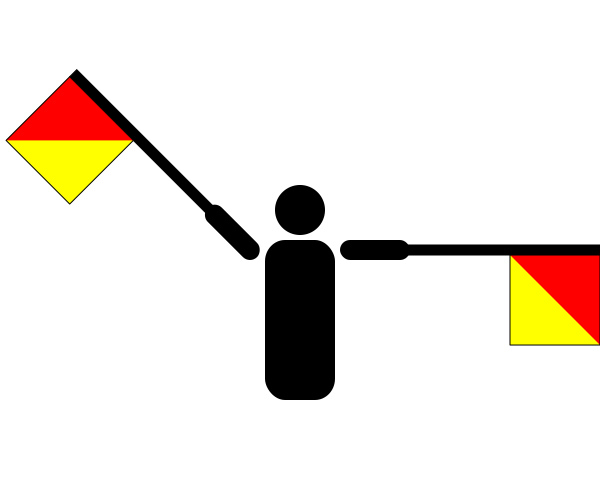
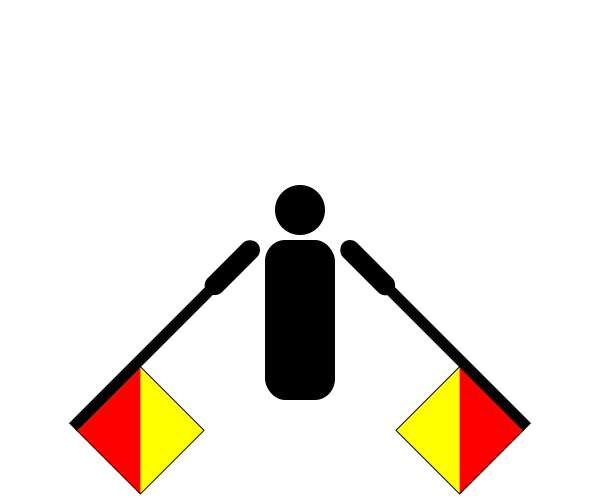
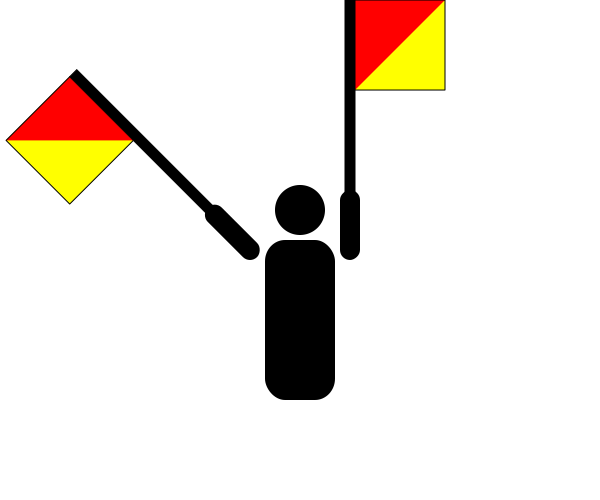

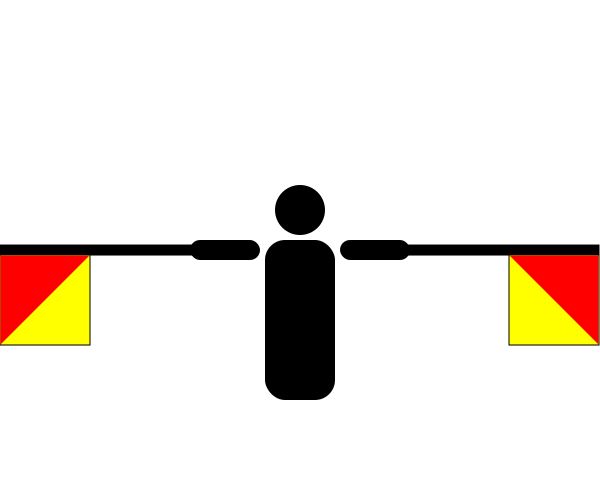
There are approximately 1,604 people named Paynter in the UK. That makes it roughly the 5,071st most common surname in Britain. Around 25 in a million people in Britain are named Paynter.
Surname type: Occupational name
Origin: English
Region of origin: British Isles
Country of origin: England
Religion of origin: Christian
Language of origin: English

Famous people named Paynter
- Billy Paynter - Football player
- John Paynter - Composer (1931 to 2010)
- Eddie Paynter - Cricketer (1901 to 1979)
- Robert Paynter - Cinematographer (1928 to 2010)
- Charlie Paynter - Football player (1879 to 1970)
- George Paynter - (1880 to 1950)
- David Paynter - Cricketer
- Hilary Paynter - Wood engraver and printmaker
- Noel Stephen Paynter - Aerial warfare pioneer (1898 to 1998)
Names and descriptions courtesy of Wikipedia, and may contain errors. This is not intended to be an exhaustive list of every famous person with this name.