PARKMAN
The surname Parkman is of English provenance, originating as an occupational name derived from the Middle English word park, which described an enclosed tract of land reserved for hunting. The suffix -man indicates that the bearer was either employed within such a park or resided adjacent to it. Consequently, the name traditionally identified a park keeper, gamekeeper or a person connected to a nobleman’s hunting grounds.
Historical records reveal several early attestations of the name in its various forms. In 1285, a document from Kent records Iselota atte Park, evidencing the use of the toponymic “at the park.” Henry del Parks appears in Worcestershire in 1304, while Johannes del Parkhouse is listed in the Poll Tax rolls for Yorkshire in 1379. In 1668, Humphrey Parkman is noted in St. James Clerkenwell, London. A further instance is Thomas Parkes, an early settler in the Virginia colony, who appears in the first muster of inhabitants on 24 February 1624, listed as residing in James Cittee.
During the Middle Ages the surname evolved alongside its French counterpart parc, the pre‑10th‑century loan‑word for an enclosed enclosure. Variants such as Park, Parke, Parks, Parkes, and Perks emerged, as did more resettlement‑centric forms like Parkhouse. The shape of the name reflects both a metonymic and a topographical origin: a man associated with a park or a person dwelling near such a place.
In the early modern period, the surname is recorded beyond England. The Scottish explorer Mungo Park (1771–1806), renowned for two expeditions aimed at locating the source of the Niger River, published his accounts under the simple title Travels in 1799. In the United States, the surname was borne by notable figures such as the American historian Francis Parkman and the 19th‑century Bostonian George Parkman.
Modern demographic data indicate that the surname is most common in the United States, where the 2020 census records approximately 8,766 individuals bearing the name. It remains widespread in the United Kingdom, Canada, Australia, New Zealand, and other parts of the English‑speaking world. A rough estimate of the global population of Parkman surnames places the figure at about 12,500, distributed across several countries.
As discussed, the name has also given rise to various spellings, including Parkmann, Perkman, Parkmon, Parkmoon, and others. In Ireland, where it appears less frequently, the surname may derive from the Gaelic root meaning “pardoned” or “gray‑haired.” Variants such as Parkes have been linked to the Latin parcus (“enclosed”) and the Scottish Parks to persicus (“pear tree”). The multiplicity of spellings reflects the name’s long history and its geographic dispersion.
In all, the surname Parkman conveys a clear occupational and locational heritage, rooted in the medieval tradition of hunting parks and preserved through centuries of linguistic variation. Its endurance across continents and eras underscores its significance within English‑language surname studies.
Typical given names associated with the Parkman surname
Male
- Andrew
- Christopher
- Clive
- Daniel
- David
- Gary
- Jonathan
- Matthew
- Philip
- Robert
- Thomas
- Timothy
- Wayne
- William
Female
- Amy
- Christine
- Elizabeth
- Emma
- Jacqueline
- Janice
- Kay
- Laura
- Margaret
- Nicola
- Sally
- Sarah
- Stella
- Viviana
Similar and related surnames
Related and similar names are generated algorithmically based on the spelling, and may not necessarily share an etymology.
How to communicate the surname Parkman in...
Braille
⠏⠁⠗⠅⠍⠁⠝
Morse
.--..-.-.-.---.--.
Semaphore


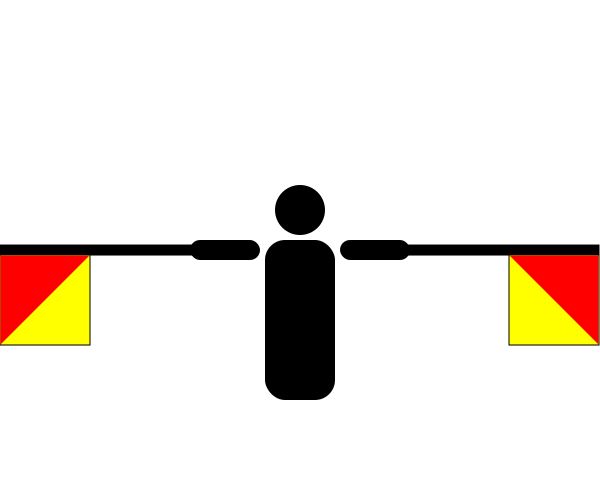
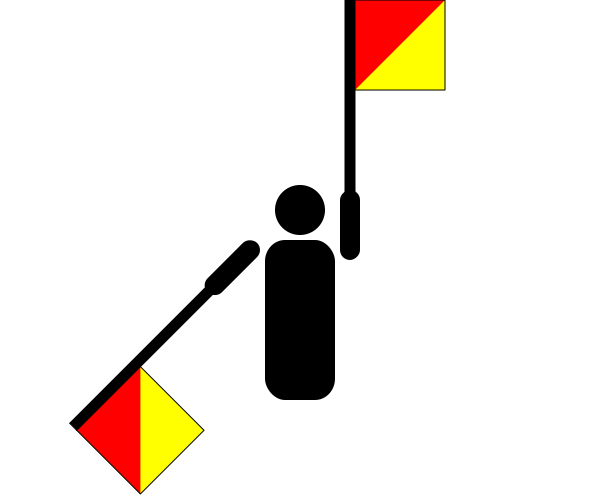
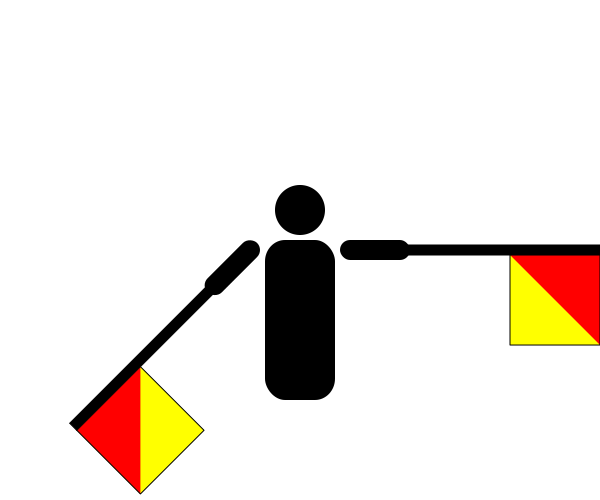
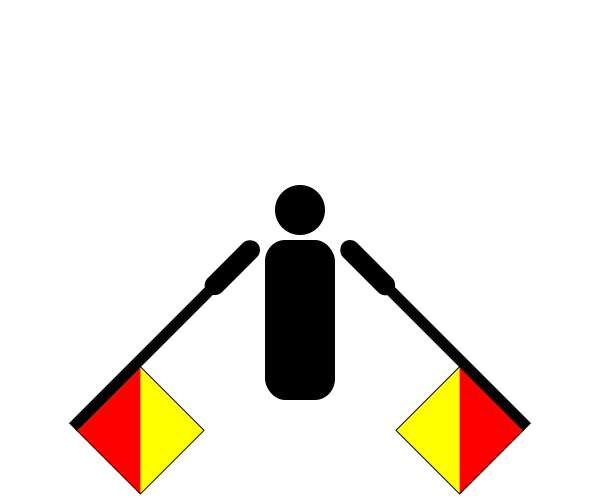
There are approximately 442 people named Parkman in the UK. That makes it one of Britain's least common surnames. Only around seven in a million people in Britain are named Parkman.
Surname type: Occupational name
Origin: English
Region of origin: British Isles
Country of origin: England
Religion of origin: Christian
Language of origin: English
