PARKIN
Parkin is a surname of English origin that appears to have a dual etymological heritage, reflecting both Greek and Polish influences within the English medieval period. The name derives from the medieval given name Parkin, a diminutive form of Peter, itself sourced from the Greek word petros meaning rock or stone. In this sense the surname may be interpreted to mean “son of Peter” or in broader use “descendant of Peter.” The construction of the surname – a nickname or affectionate diminutive supplemented by the suffix -kin – is a common feature of many English patronymic surnames.
The suffix -kin is a diminutive marker that was often appended to personal names in middle‑English to indicate a younger or smaller version of the original name. Thus the full form has in common with other surnames such as Perkin and Perkins, which have similarly evolved through the usage of a diminutive suffix. While some scholars highlight the suffix’s ornamentation, historically it served to form a specific family lineage that could be identified by a diminutive cognate of a popular Christian name.
Records of the surname date back to the early fourteenth century. In 1327 the rolls of Staffordshire name a Robert Parkyn, while the county rolls of Warwick in the same year contain a mention of Maud Parkyns. A further entry from the Round Rolls of Somerset in 1380 records John Perkyn. These early mentions represent the earliest documentary confirmation of the name, and also illustrate how spelling varied even within formal records. Further evidence arises from the parish register of the church of St Dunstans in East Stepney, where, in 1599, a John Perkins is recorded as marrying Penelope Vaughan. The same name appears in the hundreds of the late sixteenth and early seventeenth centuries, attesting to its continued use through successive generations.
From the mid‑seventeenth century onward, the surname occurs in several spelling variants. Parkyns appears in the documentation of a Sir William Perkins, who was noted for his involvement in a failed plot against King William and was executed on Tower Hill in 1696. The name is thus documented in both legal and ecclesiastic sources throughout the eighteenth century as well. In that period the name was also appeared as Parkens, Parks, Perks and Perkins. These forms reflect a confluence of regional dialectal spellings and the lack of standardised orthography at the time.
In addition to the Greek‑origin derivation, another common thread in the history of the surname ties it to the personal name Patrick. Originating in Latin (ober meaning “nobleman” or “patrician”) and introduced to the British Isles by the Normans, the name became popular in northern England during the medieval era. A diminutive of Patrick then evolved into the form that is now recorded as Parkin. This variant is also viewed as an Anglicised form of the Irish surname Ó Páircín. Scholars relate the Irish presence to the Norman pilgrimage and migration patterns in the fifteenth and sixteenth centuries. Consequently, the surname is particularly common in the North of England and in Scotland, where it is the 51st most common surname in the United Kingdom according to recent household surveys.
The distribution of Parkin remains extensive across the United Kingdom, with high frequencies noted in Yorkshire and Lancashire. The name also appears above average in Wales, Scotland and Ireland, and a number of records from the late eighteenth century show the migration of families bearing this name to the United States, Canada, South Africa, Australia and various parts of Europe. In the United States, the surname is most frequently noticed in the mid‑Atlantic states of New York and Ohio, alongside Illinois. In these communities the name has been carried forward although the spelling differences have included ostensible variations such as Parken, Parkson and Parkenstein. However, the core name remains recognisable in all instances.
Alternative forms of the surname demonstrate the breadth of its evolution. The following variants have recurrently been documented in legal and parish records: Parken, Parkins, Parks, Perkin, Perkins, Parkyn, Perlkin, Perkens and Parkman. In Scotland the terminologies Parkison, Parkisson and Parkisoun arise, while in the United States a few spellings occasionally appear without the -kin suffix, such as Parkson and Parkeen. Some rare pedigrees display more elaborate forms, including Parkkinnen, Parkendar and Parkley. Though the variations are considerable, they all derive from the same patronymic base (Peter or Patrick) and reflect local linguistic tendencies.
It has also been suggested, from an etymological standpoint, that the earliest bearers of the surname might have been employed as managers or custodians of royal or noble parks. This hypothesis traces back to the Old English term Parking, meaning “dweller in or near a park.” Although there is no direct documentary evidence linking specific families to such roles, the plausible semantic construction supports the notion that the surname could have signaled a professional association with land stewardship in plants, jest or game‑keeping.
In sum, the surname Parkin encapsulates a multifaceted historical lineage: it evidences Irish and Norman influence, it showcases the medieval English propensity for diminutive patronymics rooted in Greek Christian names, and it demonstrates the wide geographical spread of a surname that began in the Midlands and expanded both within Britain and abroad. Its many orthographic iterations, creeds of patronym, and visible distribution across the world attest to the enduring legacy of this surname in both historical and contemporary contexts.
Typical given names associated with the Parkin surname
Male
- Andrew
- Anthony
- Christopher
- David
- James
- John
- Michael
- Richard
- Robert
- Stephen
Female
- Christine
- Elizabeth
- Emma
- Helen
- Janet
- Joanne
- Julie
- Margaret
- Mary
- Patricia
- Sarah
- Susan
Similar and related surnames
- Parkins
- Perkin
- Parkyn
- Perkins
- Parkinson
- Peter
- Perkinson
- Parken
- Parin
- Parkyns
- Parki
- Parkens
- Parkie
- Parking
- Parkings
- Parkinton
- Parkis
- Parkkinen
- Parkon
- Parkson
- Parkynn
- Pearkins
- Perking
- Perkings
- Perkyn
- Perkyns
- Perquin
- Pirkin
- Pirkins
- Porkins
- Purkin
- Purkins
- Parcon
- Pargan
- Parkingson
- Parkington
- Parkman
- Parky
- Parsina
- Parsing
- Parsins
- Pearsin
- Perken
Related and similar names are generated algorithmically based on the spelling, and may not necessarily share an etymology.
How to communicate the surname Parkin in...
Braille
⠏⠁⠗⠅⠊⠝
Morse
.--..-.-.-.-..-.
Semaphore


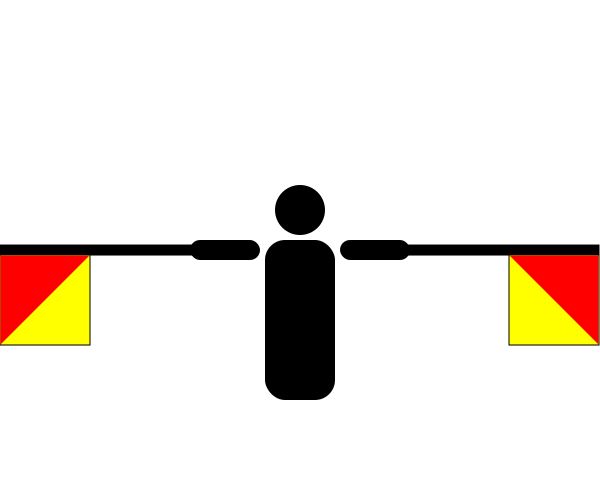
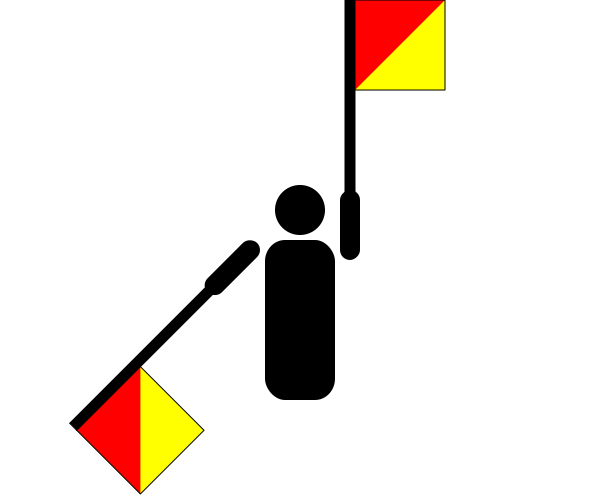
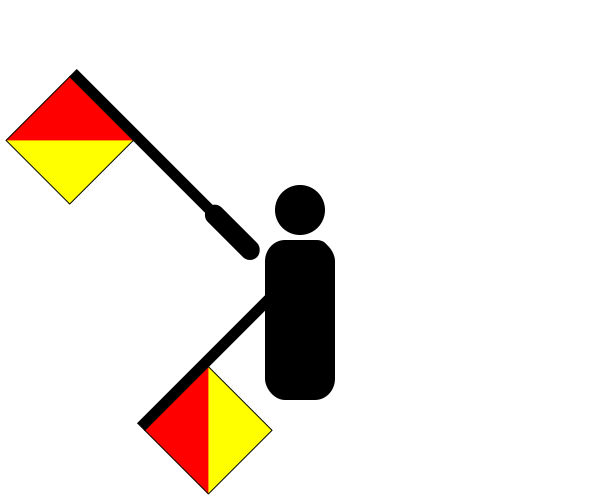
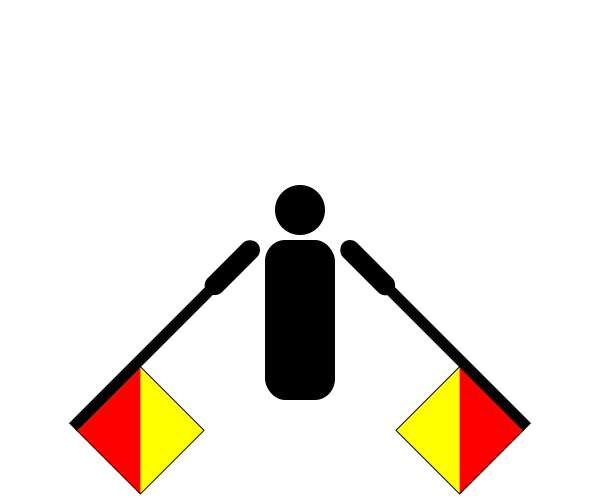
Did you know?
According to a survey carried out by Democracy Club, politicians and candidates with the surname Parkin are most likely to say that their favourite biscuit is a Shortbread.
There are approximately 18,244 people named Parkin in the UK. That makes it the 479th most common surname in Britain. Around 280 in a million people in Britain are named Parkin.
Surname type: Diminutive
Origin: English
Region of origin: British Isles
Country of origin: England
Religion of origin: Christian
Language of origin: English

Famous people named Parkin
- Jon Parkin - Football player
- Steve Parkin - Football player and manager
- Leonard Parkin - Journalist (1929 to 1993)
- Derek Parkin - Football player
- Sara Parkin - Politician
- Molly Parkin - Artist
- Jonty Parkin - Rugby league football player, and coach (1894 to 1972)
- Tommy Parkin - Football player
- Reginald Parkin - Cricketer (1909 to 1994)
- Ray Parkin - Football player (1911 to 1971)
- Stuart Parkin - Physicist
- Frank Parkin - Sociologist and writer (1931 to 2011)
- George Parkin - Football player (1903 to 1971)
- John C. Parkin - Canadian architect (1922 to 1988)
- Ben Parkin - Politician (1906 to 1969)
- John Parkin - Cricketer
- A.M. Parkin - Artist (1943 to 2012)
- Ernest Parkin - Rugby league player (1894 to 1)
Names and descriptions courtesy of Wikipedia, and may contain errors. This is not intended to be an exhaustive list of every famous person with this name.