MURTY
Murty is a surname whose recorded occurrences are found both in the British Isles and in South Asia, reflecting distinct historical origins in these regions.
In the Irish context the name is derived from the Gaelic patronymic Ó Muircheartaigh, meaning “descendant of Muircheartach”. The personal name Muircheartach itself is composed of the elements muir (sea) and ceartach (skilled or righteous), so that the surname can be interpreted as “descendant of the skilled one” or “descendant of the righteous one”. The surname appears in several historical spellings, among them MacBrearty, McBrearty, McMurty, Murty and Murdy. It is regarded as an Ulster surname, with early attestations in the Pettys Census of 1659 under the forms MacMearty, MacMerty and MacBrairty. The early Gaelic prefix Mac, meaning “son of”, is preserved in variants such as Mac Muircheartaigh (modernised as Murty). In the parish of Glenties some members of the MacBrearty line adopted the name Brady, while others, especially those recorded as MacMurtie or Murty, noted associations with the Scottish MacMurdoch clan, part of the wider MacDonald kinship.
Notable early documented bearers include Teag McBrairty of Milford, Donegal, in 1659, and Joe McMurty, who left Belfast on the ship Wrenham on 1 June 1847 bound for New York. This migration was part of the broader exodus that occurred during the Irish Potato Famine, which lasted from 1846 to 1848 and left a lasting scar on Irish society.
In the Indian sub‑continent the surname Murty is predominantly found in the southern states, especially Maharashtra, Kerala, Karnataka and Tamil Nadu. It is most commonly associated with the Brahmin caste, and its root is the Sanskrit word Murti, meaning idol or image. Over time Murti was anglicised to Murty, a form adopted by several Hindu communities. The name conveys a connection with divinity, given its meaning of a physical representation of a deity. Variant spellings – such as Murthy in certain regions – also exist.
Another account, describing the usage among North‑Indian Brahmins, states that Murty is derived from the Sanskrit Maati meaning knowledge or wisdom. This account lists a wide array of orthographic variations, including Murti, Murta, Mortha, Morthi, Murdi, Morte, Murtee, Morty, Morti and others, which reflect regional pronunciations.
Prominent individuals bearing the surname include Sudha Murty, an author and social worker, and N R Narayana Murthy, the joint founder of the global information‑technology firm Infosys. While the name is most frequently encountered in India, it also appears in the diaspora populations of the United States, Canada and the United Kingdom, where it is increasingly common among immigrants from southern India.
Typical given names associated with the Murty surname
Male
- Alexander
- Andrew
- Christopher
- David
- Edward
- James
- John
- Jonathan
- Michael
- Peter
- Robin
- Stephen
- William
Female
- Alison
- Dorothy
- Elaine
- Elizabeth
- Elsie
- Gillian
- Jacqueline
- Jill
- Lesley
- Mary
- Miranda
- Nicola
- Sandra
- Sarah
Similar and related surnames
- Mahrt
- Maret
- Maretti
- Marety
- Marity
- Mart
- Marte
- Martey
- Marti
- Martie
- Martis
- Martiz
- Martt
- Marty
- Martye
- Martyn
- Martyr
- Martys
- Mauti
- Mayarty
- Meartty
- Meert
- Merity
- Mert
- Mertyn
- Mirt
- Moraty
- Mordt
- Moret
- Moretti
- Mority
- Mort
- Morte
- Mortey
- Morti
- Mortis
- Mortiz
- Mortt
- Morty
- Mortyn
- Murdy
- Murt
- Murta
- Murte
- Murtey
- Murthy
- Murti
- Murtie
- Murtin
- Murto
- Murtow
Related and similar names are generated algorithmically based on the spelling, and may not necessarily share an etymology.
How to communicate the surname Murty in...
Braille
⠍⠥⠗⠞⠽
Morse
--..-.-.--.--
Semaphore
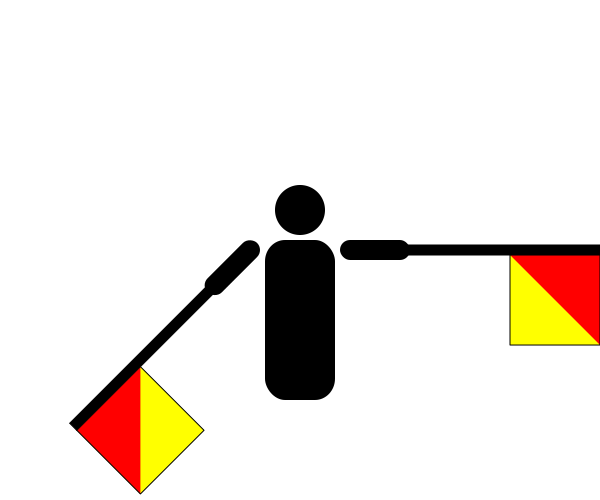

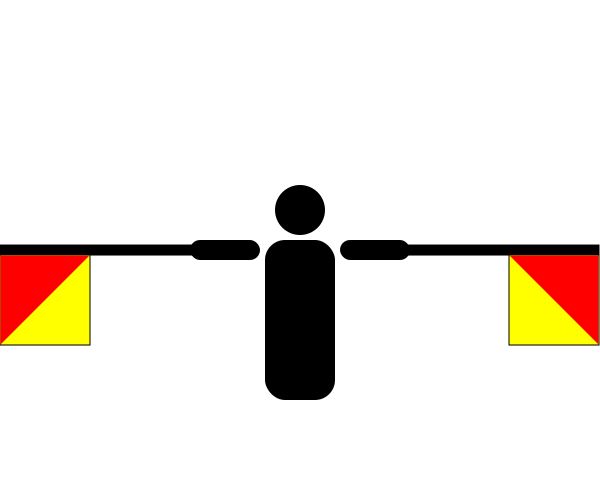
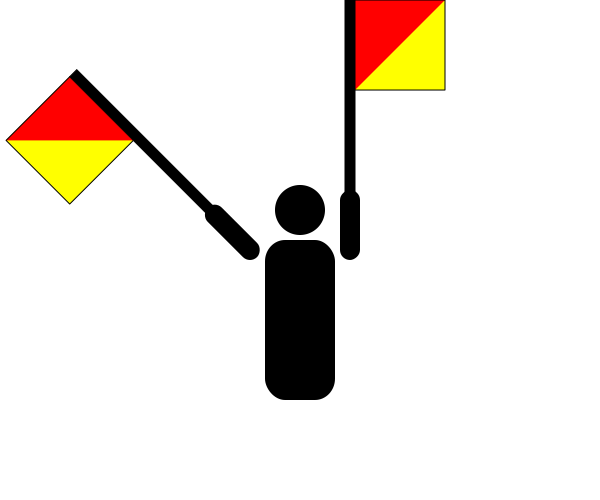
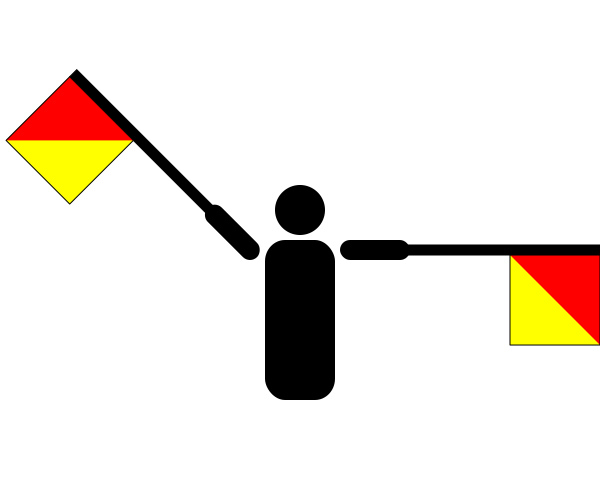
There are approximately 197 people named Murty in the UK. That makes it one of Britain's least common surnames. Only around three in a million people in Britain are named Murty.
Origin: English
Region of origin: British Isles
Country of origin: England
Religion of origin: Christian
Language of origin: English

Famous people named Murty
- Graeme Murty - Football player and manager
Names and descriptions courtesy of Wikipedia, and may contain errors. This is not intended to be an exhaustive list of every famous person with this name.