MERKEL
Origins of the surname Merkel are firmly rooted in the Germanic linguistic heritage of continental Europe. The name is predominantly found in Germany but has been documented in a variety of European languages owing to historic migration patterns and linguistic evolution. It is recorded in ecclesiastical and civil documents dating back to the late Middle Ages, with the earliest secure reference appearing in a 1390 charter of the town of Biberach in Germany where an individual named Heinrich Mark is mentioned.
The primary derivation of Merkel is traced to the Middle High German word merkele, meaning “little hammer.” In medieval society the hammer was a ubiquitous tool associated with the craft of a blacksmith. Consequently, the surname is classically understood to have originated as an occupational nickname for a smith or a person who regularly employed hammers in his trade. The diminutive ending -el reflects a familiar or affectionate form, thereby rendering the name literally “little hammer” or “small smith.”
Across different linguistic regions the name has appeared in numerous orthographic variants. In English the forms Mark, Marke and Markes are found; in French the spellings Marc and Marcq occur; Italian and Spanish records give Marco and Marcos; Dutch sources utilise Murkus; and Czech usage lists Marek. The name has also produced diminutive variants such as the Russian Markowitz and Markovski. Many of these forms derive, via a different route, from the Roman personal name Marcus, itself connected to the Latin root mar “to gleam” and, in certain traditions, to the deity Mars, god of war. The surname therefore appears both as an occupational marker and as a patronymic or locational surname linked to the wider European practice of adopting ecclesiastical or saintly names tied to places of worship.
In some German dialects the surname is also associated with the Middle High German word merhel, meaning “blackbird.” Here the name may have functioned as a metonymic occupational label for a bird-keeper or as a nickname for an individual with a melodious voice or cheerful disposition reminiscent of a blackbird. This alternative semantic branch of the name demonstrates how a single surname can accumulate distinct meanings in varying historical and linguistic contexts.
In contemporary times Merkel remains a moderately common surname within Germany, a status reinforced by the global prominence of former Chancellor Angela Merkel. It is also observed in countries with substantial German diaspora communities, such as the United States, Canada, Australia and New Zealand. The surname bears a range of orthographic variants – Merkle, Merkell, Merklein, Merckel, Merkley, Maerkel, and Mäerkel – and may be extended by additional locative elements (for example Merkelberg or Merkelman). In certain cases the prefix von precedes the name, signalling nobiliary heritage within German‑speaking societies. While similar‑sounding surnames appear in Slavic, Celtic and other linguistic traditions, genealogical evidence is required to confirm any direct connection to the German Merkel line. The name’s endurance across centuries exemplifies the persistence of occupational and patronymic naming conventions within Germanic and European onomastic history.
Similar and related surnames
Related and similar names are generated algorithmically based on the spelling, and may not necessarily share an etymology.
How to communicate the surname Merkel in...
Braille
⠍⠑⠗⠅⠑⠇
Morse
--..-.-.-..-..
Semaphore
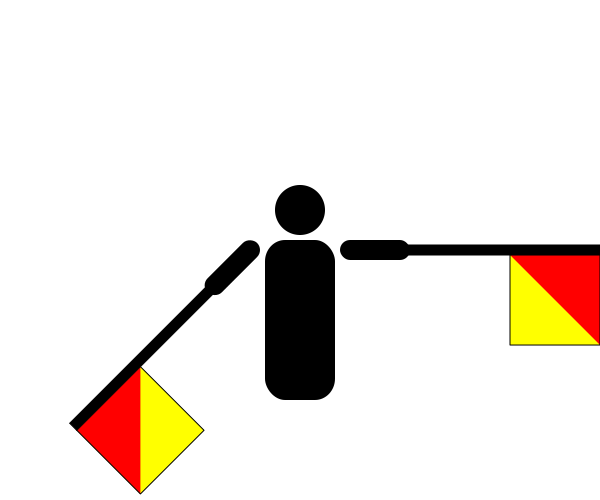

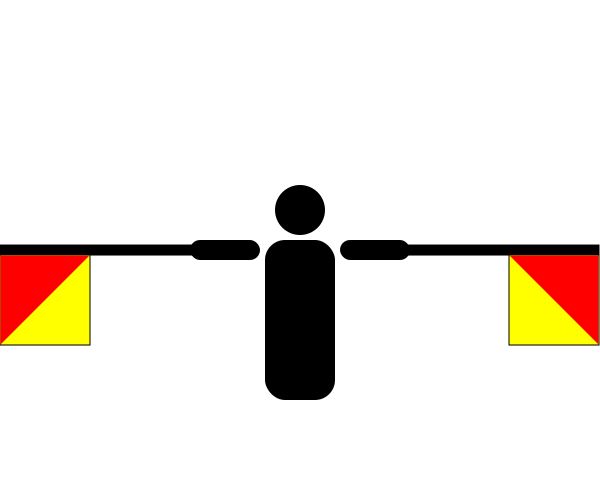
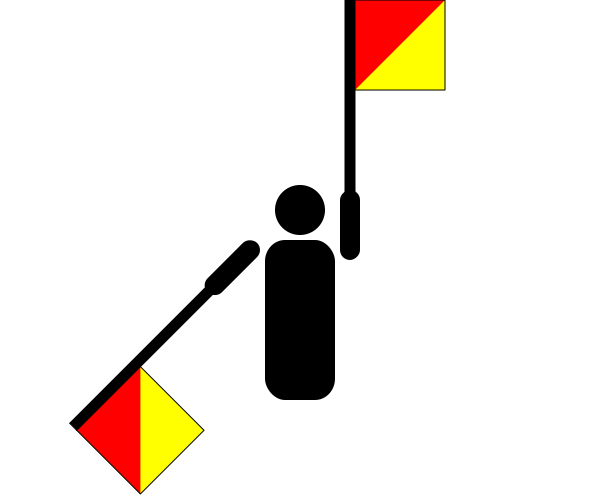

There are approximately 105 people named Merkel in the UK. That makes it one of Britain's least common surnames. Only around two in a million people in Britain are named Merkel.
Region of origin: Europe
Country of origin: Germany
Language of origin: German

Famous people named Merkel
- Angela Merkel - Chancellor of Germany
Names and descriptions courtesy of Wikipedia, and may contain errors. This is not intended to be an exhaustive list of every famous person with this name.