MARKEL
Markel is a surname of Germanic origin, first recorded in the late fourteenth century, which has grown considerably in number of variant forms across Europe and the Americas.
The core element of the name is the personal name Mark, which is a Latinised version of the Roman name Marcus and is associated with the Roman god Mars, the deity of war. In the medieval period, Mark was commonly used as a masculine given name meaning ‘warrior’ or ‘dedicated to Mars’. The surname Markel is therefore a patronymic form, literally meaning ‘descendant of Mark’, and places the name firmly within the pattern of surnames derived from an ancestor’s first name.
Alternative derivations relate the surname to the Germanic elements marah (‘horse’) and wolf, producing the compound Markolf, or to marah and wald (‘rule’), giving Marcwald. In this sense, Markel can also be interpreted as ‘horse‑wolf’ or ‘ruler of horses’, a combination that would have provided a descriptive or occupational identifier for carriers of the name in the Middle Ages.
The earliest surviving reference to a person bearing the name in Germany comes from the charters of the town of Biberach, where a Heinrich Mark is recorded in 1390. This early attestation shows that the surname had already become hereditary by the end of the fifteenth century.
Throughout Europe the name appears in a wide range of linguistic forms. In English it is found as Mark, Marke and Markes; in French as Marc and Marcq; in Italian as Marco and Marcos; in Spanish the same forms are common; Dutch variants include Murkus; Czech usage records Marek; and Russian diminutives such as Markowitz and Markovski reflect the name’s spread into Slavic territories. Other European spellings that fall within the same family are De Marco, Di Marko, Marcus, Marchi, Merck, Marck, Van der Marck, Marconi and Marczewski.
In the late twentieth and early twenty‑first centuries the surname spread beyond continental Europe through emigration. Large numbers of Germans bearing the name settled in the United States, Canada, Australia and the United Kingdom, where it subsequently appears in census and vital registration records. In the United States the surname is relatively uncommon but is concentrated in states that received large numbers of German immigrants, notably Ohio, Pennsylvania and Wisconsin. Although still much rarer than other Germanic surnames, Markel persists in registries across Britain, Canada, the United States, Australia and New Zealand.
Modern frequency data indicate that Markel is not widely found in any single country; rather it is dispersed in small pockets, with the United States showing the highest numbers. The surname’s variants such as Markell, Marckel and Markle are equally uncommon but occasionally appear in official documents, sometimes as a result of anglicisation during the immigration process or transcription errors in record keeping.
In sum, the surname Markel has its roots in ancient personal names that carried martial and animalistic connotations, reflects a typical patronymic naming practice, and has travelled across continents while adopting a variety of orthographic forms. Its persistence into the present day, though limited in size, remains a testament to the enduring nature of medieval naming traditions and the mobility of European peoples in the modern era.
Similar and related surnames
- Marke
- Marcal
- Marcall
- Marcela
- Marcelin
- Marcelis
- Marcell
- Marcella
- Marcelle
- Marcelli
- Marcello
- Marcellus
- Marcelo
- Marcille
- Marcol
- Markall
- Markalow
- Markee
- Markell
- Markil
- Markill
- Markille
- Markl
- Markle
- Marklem
- Markwell
- Marquelli
- Marskell
- Mearkle
- Mercell
- Merckel
- Merkel
- Merkell
- Merkelt
- Merkle
- Morkel
- Morkill
- Murcell
- Marker
- Marklew
- Markley
Related and similar names are generated algorithmically based on the spelling, and may not necessarily share an etymology.
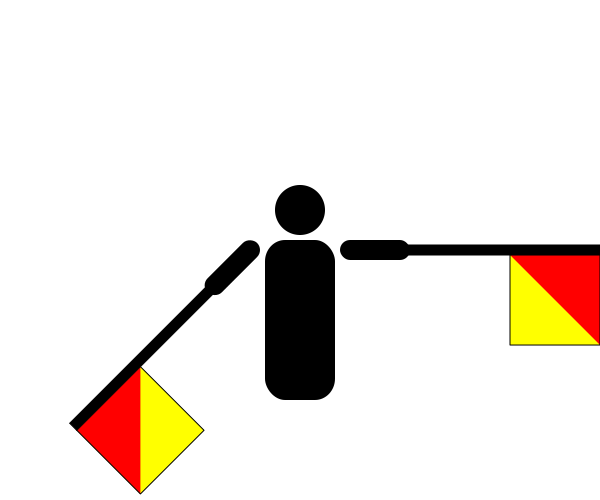
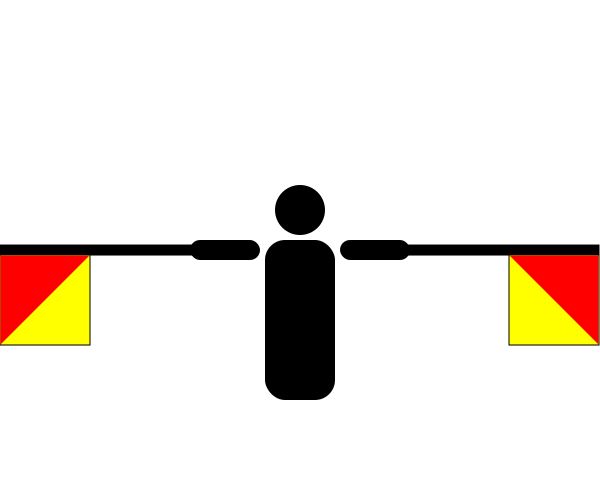
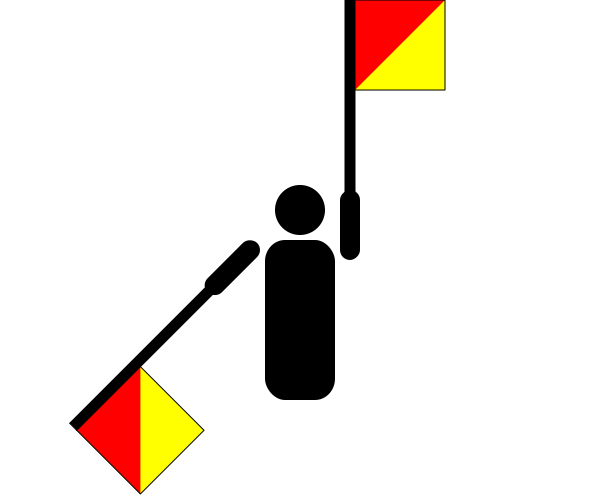
How to communicate the surname Markel in...
Braille
⠍⠁⠗⠅⠑⠇
Morse
--.-.-.-.-..-..
Semaphore



Sorry, we don't have any statistics on this name. That's probably because it's very uncommon in Britain.
