MERCK
Merck is a surname that originally derives from Germanic linguistic roots and is predominantly found in Germany. Its history, however, has spread across many European countries and the United States through migration and the expansion of associated families and institutions.
The name is documented from the 14th century in the German town of Biberach, where a Heinrich Mark appears in the local charters of 1390. In German it is traditionally spelt Merck, and it is regarded as a regional variant of the name Mark, which itself was applied to people living in or near the historic region of Mark Brandenburg.
In Middle High German the word *merke* means ‘boundary’ or ‘border’. Consequently, Merck is considered an occupational name originally given to individuals who lived near a frontier or who served as boundary keepers or markers. This explanation emphasises the surname’s locality and administrative role in medieval society.
Other scholarly sources link the surname to the Latin personal name Marcus, which in turn originates from the word *mar*, meaning ‘to gleam’, and may also bear a secondary association with the Roman god Mars. The widespread adoption of the name St Mark as a patronymic in pre‑medieval Europe led to a large number of locational surnames such as De Marco, Di Marko, and Marck. In this line of transmission Merck appears as a later derivation, particularly within Italian, Spanish, and French regions where the saint’s cult was influential.
In addition to its locational and occupational origins, the surname is also linked to commerce. Germanic studies identify merck as a word meaning ‘merchant’. Historical records describe the early Merck families of the Rhine Valley in the 16th and 17th centuries as traders. By the early 18th century they had established the company that would become Merck KGaA, a pharmaceutical and life‑sciences enterprise founded in Darmstadt. Over the following centuries the firm expanded into global markets, employing more than 100,000 people and operating in over 140 countries. The modern corporation remains an important bearer of the family legacy, retaining the spirit of innovation and collaboration that characterised the original merchant families.
Today the surname remains most common in Germany, though it is also found in the United States—particularly among descendants of German immigrants and within communities of the Church of Jesus Christ of Latter‑Day Saints. In Britain the name is sparsely represented and often appears in its variant Merckham or simply Merk. European variants also include Marck, Merc, Marec, Merke, Merkx, and the Dutch form Meercke. In the United States some bearers have simplified the spelling to Merk or Merkx in order to ease pronunciation.
Financially and socially, the Merck name is associated with significant wealth. The family behind Merck KGaA and its sister company Merckle GmbH, based in Ulm, is considered one of the oldest and most prominent families in Germany. Estimates place their wealth in the billions of euros, a result of an extensive enterprise that spans pharmaceuticals, chemicals, and technology. While the name has Christianised links through the patron saint and also medieval occupancy of boundary lands, the modern identity of the surname is largely characterised by commerce and scientific advancement, a legacy that persists in the present day.
Similar and related surnames
Related and similar names are generated algorithmically based on the spelling, and may not necessarily share an etymology.
How to communicate the surname Merck in...
Braille
⠍⠑⠗⠉⠅
Morse
--..-.-.-.-.-
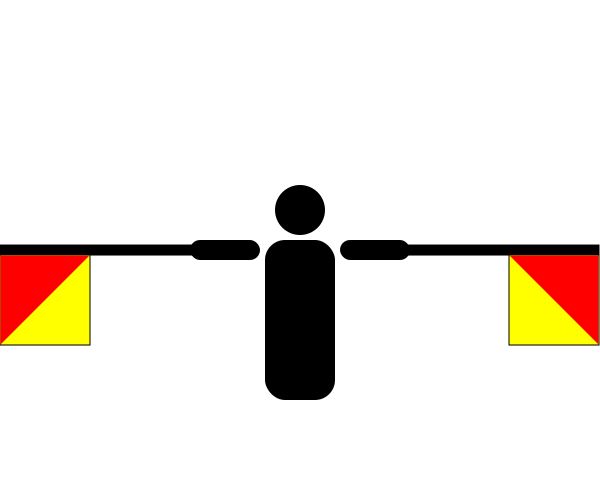
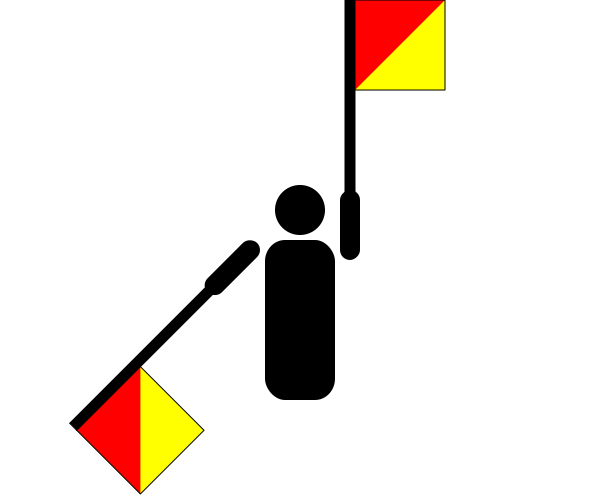
Semaphore



Sorry, we don't have any statistics on this name. That's probably because it's very uncommon in Britain.
