MARK
Mark is a surname that is found throughout the British Isles and beyond, yet its roots lie well outside the island. Marcus, the Latin forename from which the surname descends, was originally a Roman praenomen meaning “dedicated to Mars, the god of war”. The name was adopted widely in the Roman Empire, and later, under Christian influence, it was associated with St Mark the Evangelist, the author of the second Gospel.
In England, the surname appears in records in a range of spellings – Mark, Marke, and Markes – reflecting the orthographic variations of the Middle Ages. The earliest extant reference that is routinely cited is that of Heinrich Mark in the town of Biberach, Germany, in a charters dated 1390. This illustrates the surname’s presence in continental Europe before it reached the British Isles, most likely during the Roman occupation or later migration waves.
The surname is of both German and Latin origin. In Germany the name was recorded as part of the population register and is found in street names and clan histories. In England the name is typically regarded as a patronymic form derived from the given name Mark, which itself was a shortened version of Marcus. The transition from a personal name to a hereditary surname occurred in the Middle Ages, when individuals were often identified by the name of a relative or patron.
Another dimension of the name is its possible topographical or occupational significance. In Old English, the word mearc means “border” or “boundary”, and it is plausible that a Mark could have been a person who lived near or worked at a boundary post. In Scandinavian contexts, the name appears in forms such as Markusson or Markson, indicating the patronymic convention of “son of Mark”. In Dutch contexts, the surname Murkus is regarded as a variant. These variations all stem from the same linguistic root, yet show the flexibility of the name across cultures.
In Jewish communities, especially in the 19th and early 20th centuries, Mark sometimes served as an anglicised form of surnames that sounded similar, such as Markovich or Markowitz. These adoptions were part of a broader pattern in which immigrants adopted simple, easily pronounceable English surnames to assimilate or to avoid discrimination.
Across Europe the surname is known by many reputable variants: the French Marc and Marcq; the Italian and Spanish Marco and Marcos; the Czech Marek; the Russian Markowitz and Markovski; and the Polish Marki among others. All these share a common etymological link to the Latin Marcus, demonstrating the widespread influence of Roman culture on European naming traditions. The prevalence of the name in Italy and Spain can in part be attributed to its religious significance, as many places were named San Marc or San Marcos in honour of the evangelist.
In modern demographics, the surname is most common in the United States, followed by the United Kingdom and Germany. Diaspora communities have carried the name to Nigeria, Canada, Australia, and other former colonies, resulting in a broad geographic distribution. Historiographically, genealogical study of family lines bearing the surname often reveals a traceable lineage that can be connected back to the original patronymic or honorific usage of Marcus.
In conclusion, the surname Mark encapsulates a convergence of Roman, Christian, and Germanic linguistic strands. Its evolution from a personal name, through religious homage, and into a hereditary surname demonstrates the fluidity of naming practices across medieval and modern Europe. The persistence of the name in many linguistic contexts, together with its varied spellings, attests to a lasting legacy that continues to be recognised in contemporary surname studies.
Typical given names associated with the Mark surname
Male
- Andrew
- David
- Ian
- James
- John
- Peter
- Richard
- Robert
- Stephen
- Thomas
- William
Female
- Catherine
- Denise
- Elizabeth
- Emma
- Helen
- Joanna
- Laura
- Margaret
- Mary
- Sarah
- Susan
- Victoria
Similar and related surnames
- Marks
- Marx
- Marck
- Marc
- Marcks
- Marco
- Marca
- Mar
- Marcou
- Maarek
- Marcke
- Marcki
- Mrak
- Mara
- Marka
- Marke
- Marki
- Marko
- Maragh
- Marak
- Maraki
- Maraqa
- Marckey
- Marcq
- Marcu
- Marcy
- Marec
- Marecki
- Marega
- Marek
- Marg
- Marga
- Margh
- Margo
- Margue
- Maric
- Marica
- Marick
- Mariga
- Marigo
- Marik
- Marika
- Markay
- Markee
- Markes
- Markew
- Markey
- Markie
- Markies
- Markis
- Markiw
- Markl
- Markos
- Markose
- Markou
- Markow
- Markowe
- Marksey
- Markt
- Marku
- Markus
- Markway
- Marky
- Marocco
- Marock
- Marok
- Marqua
- Marque
- Marquie
- Marqus
- Marrack
- Marreco
- Marrick
- Marrocco
- Mars
- Maruca
- Maryk
- Marz
- Mauck
- Mauk
- Mauric
- Mawkes
- Mayrick
- Mayrock
- Meirick
- Merc
- Merca
- Merck
- Merec
- Merecki
- Merek
- Merga
- Meric
- Merica
- Merick
- Merico
- Meriggi
- Merighi
- Merk
- Merka
- Merki
- Merko
- Merks
- Merkx
- Merrick
- Merricke
- Merx
- Meurig
- Meyrick
- Meyricke
- Miarka
- Miracco
- Mirco
- Mirecki
- Mirek
- Miric
- Mirica
- Mirick
- Mirk
- Mirka
- Mirko
- Mirks
- Mirrick
- Moerk
- Moraca
- Morack
- Morag
- Moraga
- Morago
- Morak
- Morake
- Morck
- Morek
- Morga
- Morgue
- Moric
- Morico
- Moriggia
- Morioka
- Mork
- Morka
- Morke
- Morks
- Morocco
- Morock
- Moroka
- Morrick
- Morrocco
- Morrogh
- Morrough
- Moryc
- Mourgue
- Mourik
- Mrok
- Mrowca
- Mrowka
- Mruk
- Muraca
- Muraoka
- Murg
- Murga
- Murgai
- Murgo
- Murgu
- Murguia
- Muric
- Murick
- Muriuki
- Murk
- Murko
- Murks
- Muroki
- Murrick
- Murrock
- Murrough
- Murugu
- Myrick
- Whymark
- Wymark
- Markwei
- Murka
Related and similar names are generated algorithmically based on the spelling, and may not necessarily share an etymology.
How to communicate the surname Mark in...
Braille
⠍⠁⠗⠅
Morse
--.-.-.-.-
Semaphore
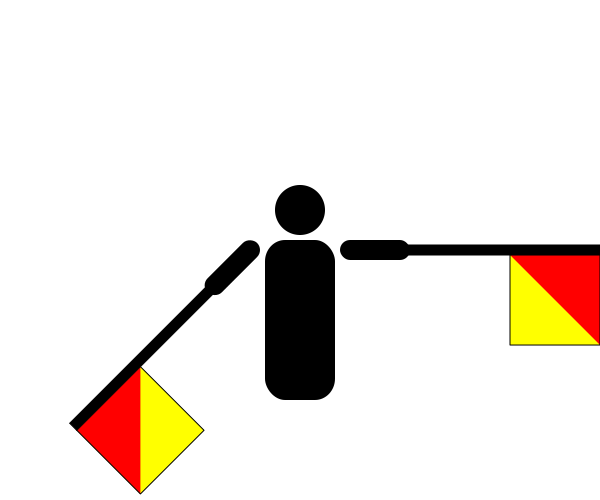

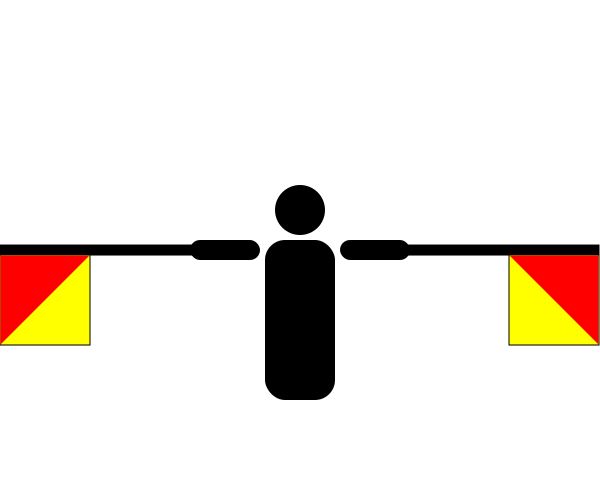
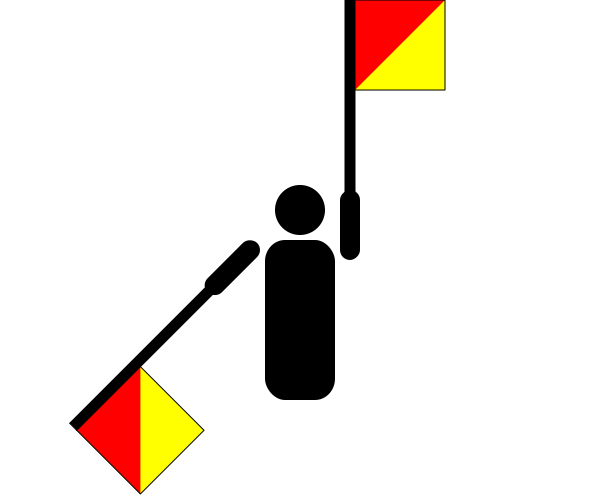
There are approximately 3,391 people named Mark in the UK. That makes it roughly the 2,689th most common surname in Britain. Around 52 in a million people in Britain are named Mark.
Surname type: From given name or forename
Origin: English
Region of origin: British Isles
Country of origin: England
Religion of origin: Christian
Language of origin: English

Famous people named Mark
- Robert Mark - Commissioner of the Metropolitan Police (1917 to 2010)
- Louisa Mark - Singer (1960 to 2009)
- Jon Mark - Musician
- Jan Mark - Writer best known for children's books (1943 to 2006)
- John Mark - Athlete (1925 to 1991)
- David Mark - Novelist
Names and descriptions courtesy of Wikipedia, and may contain errors. This is not intended to be an exhaustive list of every famous person with this name.