LINCK
Origin and Etymology
The surname Linck originates from Germanic roots. It is derived from the Middle High German word linke, which translates literally as “left.” In medieval Germanic society, a nickname based on a physical or personal characteristic was frequently adopted as an identifier. Consequently, a person who was left‑handed, or who was associated with the left side of a village, would be called linke. Over time, this nickname stabilised as a hereditary surname. Versions of the name that have survived into modern usage include Link, Lincke, and Linke.
The name also appears in English records, where it has a separate topographic origin. In this context Linck derives from the pre‑7th century word hlinc, meaning a bank, ridge or slope that separates strips of arable land. Dialectal variants of this term were rendered as linch or lench, which became the basis of the English form of the surname. The earliest documented instance of an English bearer of this name is found in the Fine Court Rolls of Suffolk, where a Geoffrey Linch is named as a witness in 1228 during the reign of King Henry VIII (the Frenchman) (1216‑1272). Subsequent records include Gilbert de la Lynche (1275, “Subsidy Rolls of Worcestershire”), Robert Bynithelinche (1278, “Assize Court Rolls of Somerset”) and Robert Lincke (1279, “Hundred Rolls of Cambridgeshire”). More recent evidence from the 17th century shows Elizabeth Link marrying John Wears in St. Matthew’s, Friday Street, London, on 31 October 1647.
Historical Context
In the Middle Ages left‑handedness was uncommon and sometimes perceived as unusual or noteworthy. As a result, a distinctive trait such as being left‑handed could serve as a convenient and memorable form of identification. The adoption of the nickname linke as a surname likely began with a particularly prominent individual whose left‑handedness was known by his community; his descendants inherited the name as a family marker. The inclusion of the name in official documents such as parish registers, court rolls and subsidy rolls demonstrates that it was accepted as a legitimate surname by contemporary authorities.
Meanwhile, the English topographic variant reflected the geographical feature of a hill or slope. Settlers living adjacent to a ridge or riverbank were easily identified by the descriptor linch or linck, and over generations this descriptor became formalised as a surname. The persistence of both the Germanic personal nickname and the English place‑based origin shows how the same orthographic form can emerge from distinct linguistic pathways.
Variant Spellings and Geographic Distribution
Variations of the surname have arisen due to regional pronunciation differences, spelling conventions and the influence of other languages. Common variants include Lincke, Lynck, Linc, Lynk, Lemke, Lenck, Linco, Lanc, Lanck and Lank. The use of the consonant cluster ck is characteristic of German surnames and frequently appears in the Germanic forms. In some instances, families modified the spelling to ease pronunciation or to assimilate into new linguistic environments, leading to names such as Lee or Lynn. Such changes were often motivated by practical considerations when migrating to English‑speaking countries.
In contemporary times, the surname Linck remains relatively uncommon. It is most frequently found in Germany but also occurs in the United States, Switzerland, and Canada, largely reflecting historical migration patterns. Despite its presence in several countries, the name remains uncommon enough to be recognisable and distinctive. Statistical data indicate that the overall distribution is uneven, with a concentration in German territories that originally gave rise to the name. The emergence of a wide range of spelling variants has contributed to a more diffuse geographic spread, yet the core meaning associated with left‑handedness or a topographic feature is preserved across these forms.
Conclusion
The surname Linck offers an example of how a single orthographic representation can arise from multiple linguistic traditions. Its Germanic origin as a nickname for left‑handed individuals is rooted in Middle High German, while its English heritage reflects a topographic description of a ridge or slope. Both pathways have produced documented medieval records that cement the name’s legitimacy and provide a clear lineage for modern bearers. By tracing the survival of the name through historical documents and analysing its variants, one gains insight into the ways in which identifiers evolve from personal traits or geographical markers into hereditary surnames that persist across centuries and borders.
Similar and related surnames
Related and similar names are generated algorithmically based on the spelling, and may not necessarily share an etymology.
How to communicate the surname Linck in...
Braille
⠇⠊⠝⠉⠅
Morse
.-....-.-.-.-.-
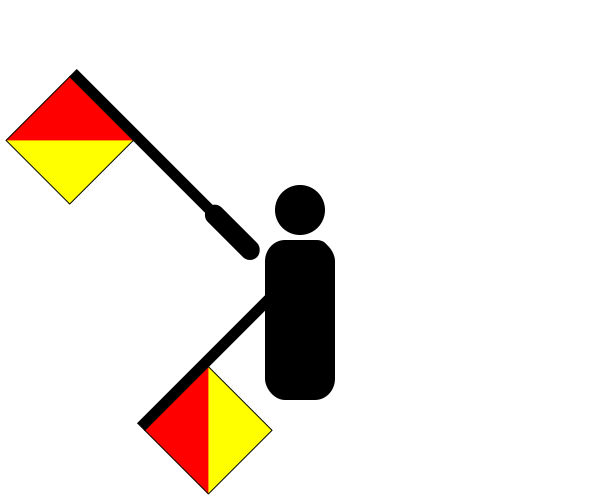
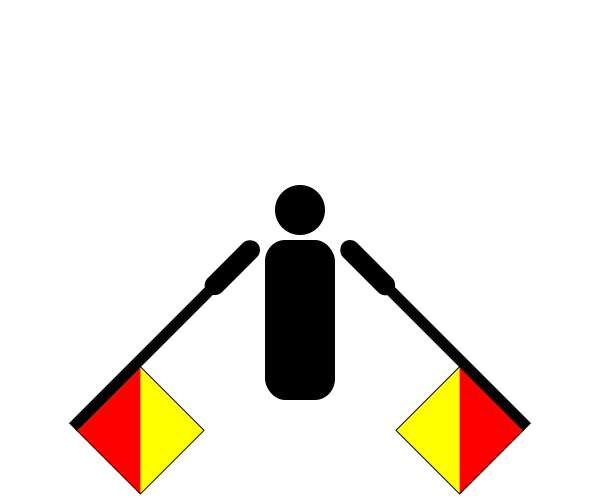
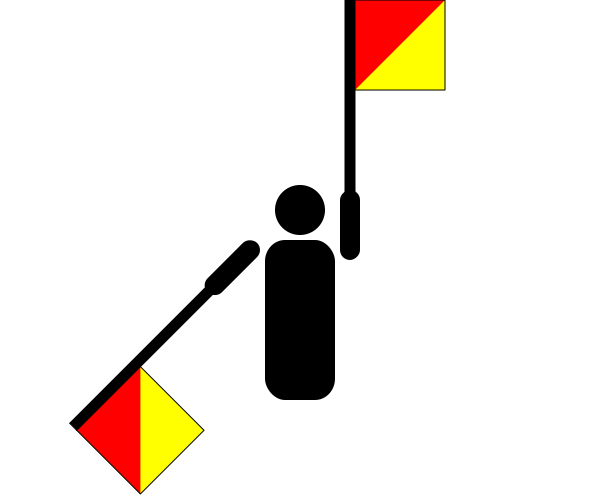
Semaphore


Sorry, we don't have any statistics on this name. That's probably because it's very uncommon in Britain.
