LINCH
Linch is a surname of dual heritage, appearing both in the English and Irish contexts. In England it derives from the Old English word hlinc, meaning a hill or ridge, while in Ireland it stems from the Gaelic name Ó Loingsigh, signifying a descendant of Loingseach, a term for a mariner.
As a topographical name in England, Linch was traditionally applied to individuals who dwelt near a prominent bank, slope or ridge. The earliest known record of a spelling variant is found in the 1228 Fine Court Rolls of Suffolk, where a witness bears the name Geoffrey Linch. Subsequent medieval documents include Gilbert de la Lynche in the 1275 Subsidy Rolls of Worcestershire, Robert Bynithelinche in the 1278 Assize Court Rolls of Somerset, and Robert Lincke in the 1279 Hundred Rolls of Cambridgeshire. Such records illustrate the name's persistence during the early 13th century and its gradual evolution into the modern form Linch.
The Irish form of the surname belongs to one of the 14 “Tribes of Galway”, a group of influential merchant families who governed the city during the Middle Ages. The lineage was noted for its maritime associations, reflected in the meaning of Loingseach. Figures of note include Cearbhall Óg Ó Lynch, a 12th‑century bishop and poet whose work contributes to the cultural heritage of the name.
Variant spellings are common, reflecting regional pronunciation and orthographic practices. In Britain the surname has appeared as Linck, Lince, Lench, and Lynche. In Ireland variants such as Lynch, Lynck, and Lynch are frequently encountered. The name has also been recorded in Germanic contexts, although its meaning is less thoroughly documented in those locales.
During the nineteenth‑century Irish diaspora, many bearers of the surname emigrated to the United States, Canada, Australia, and other English‑speaking regions. The Migration via Ellis Island ensured a significant concentration of the name on the East Coast of America, while large communities also established themselves in the United Kingdom and Australia. Contemporary demographic data, though not exhaustive, indicate that the surname remains most prevalent in Ireland, with considerable representation in the United States, England, and Australia.
It is worth noting that, despite superficial similarities in spelling, the Irish Lynch family is generally unrelated to European Jewish surnames that may appear similar. The origins of the name are distinct, grounded in nautical and geographical roots rather than religious or cultural lineage.
Typical given names associated with the Linch surname
Male
- Andrew
- Brian
- David
- Derek
- Gary
- Kevin
- Marc
- Mark
- Paul
- Peter
- Raymond
- Thomas
Female
- Anna
- Catherine
- Claire
- Dominique
- Emma
- Felicia
- Jane
- Joan
- Margaret
- Sarah
- Sheila
- Shirley
- Victoria
- Zoe
Similar and related surnames
Related and similar names are generated algorithmically based on the spelling, and may not necessarily share an etymology.
How to communicate the surname Linch in...
Braille
⠇⠊⠝⠉⠓
Morse
.-....-.-.-.....
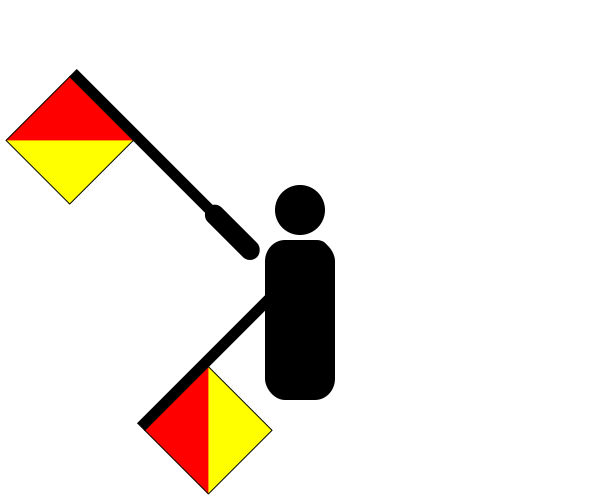
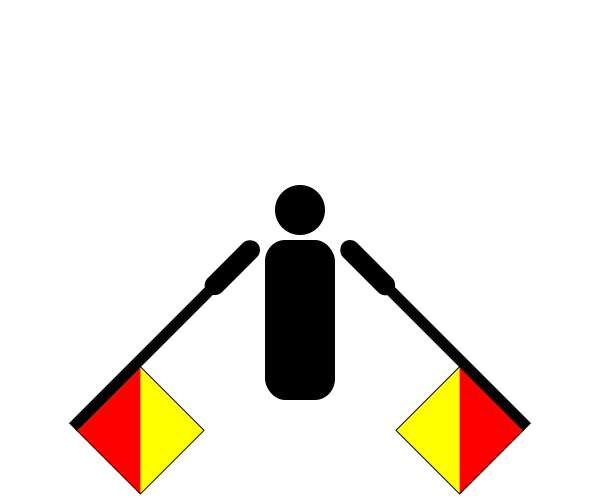
Semaphore



There are approximately 244 people named Linch in the UK. That makes it one of Britain's least common surnames. Only around four in a million people in Britain are named Linch.
Origin: English
Region of origin: British Isles
Country of origin: England
Religion of origin: Christian
Language of origin: English
