LEVIS
Levis is a surname with a multifaceted origin that intertwines linguistic, religious, and migratory histories. The name is rooted in both French and Hebrew traditions, reflecting its presence across Europe and the wider diaspora.
The first layer of its etymology arises from the Hebrew name Levi, meaning *joined* or *attached*. In biblical tradition, Levi is recorded as the third son of Jacob and Leah, and the term has long been associated with the priestly class. The Englishised form Levis is one of several variants that evolved from this religious root, alongside names such as Levy, Levian and Levitas.
Parallel to the Hebrew derivation is a distinctly French trajectory. The name is linked to the Latin personal name Livius, and to the Gallo‑Roman element Laevius, itself derived from the Latin word *laevus* meaning *left*. In some branches the surname is associated with the French locality Levy‑Saint‑Nom in Seine‑et‑Oise, and with the estate of Mirepoix in Arr\u00edere that was granted to a noble family following the Albigensian crusade. The earliest documentary evidence appears in the Eynsham Cartulary of Oxfordshire, where a Thomas Leui is recorded in 1228, during the reign of Henry I.
Following the Norman Conquest of 1066, the surname was introduced into England and later saw a significant influx of bearers who were French Huguenots fleeing religious persecution after the Revocation of the Edict of Nantes in 1685. Many of these refugees settled in Ireland, where the name became established in West Cork during the seventeenth century. Recordable occurrences include the 1813 marriage of Samuel Levis to Ann Vickery in Cork, the 1860 birth of Michael Levis at Ballydehob, and the 1861 marriage of Elias Levis to Ellen Allen at Kilmoe.
Variants of the surname recorded in historical and contemporary sources include Levy, Levie, Levias, Levitan, Levitin, Levine, Levysohn, Levyssohn, Levitsky and Levitz. These forms, while retaining the core meaning associated with joining or belonging, display regional adaptations across English, Irish, German, and Ashkenazi Jewish contexts.
In the modern era, the surname remains most common in France, especially within the Franche‑Comté region where it is the tenth most frequent surname; it is also represented in the United States (notably Michigan, Illinois, New Jersey, New York and Pennsylvania), Canada (primarily Quebec), and in Latin American nations such as Argentina, Brazil and Venezuela that received French immigrants.
Overall, the Levis surname is an old and historically rich name that encapsulates a lineage stretching from biblical ancestry through medieval Norman migration, through Huguenot dispersion, up to contemporary global settlements. Its varied spellings and persistent usage across cultures underscore both its adaptability and its enduring historical significance.
Typical given names associated with the Levis surname
Male
- Andrew
- Brian
- David
- Gary
- John
- Mark
- Peter
- Philip
- Richard
- Robert
- William
Female
- Arline
- Caroline
- Christine
- Edith
- Elizabeth
- Emily
- Emma
- Jean
- Patricia
- Pauline
- Rachel
- Rosemary
- Ruth
- Sue
- Susan
Similar and related surnames
Related and similar names are generated algorithmically based on the spelling, and may not necessarily share an etymology.
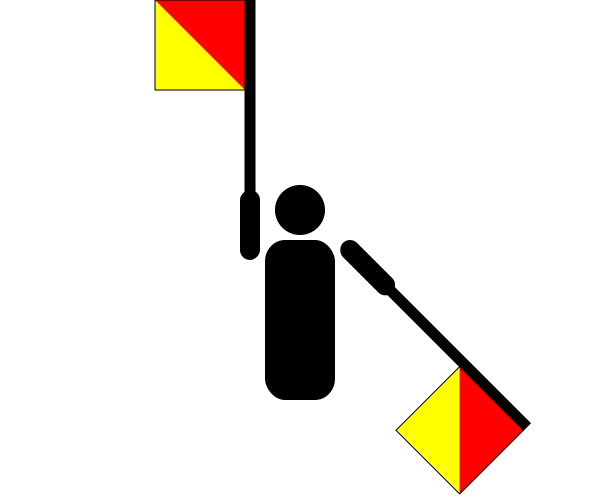
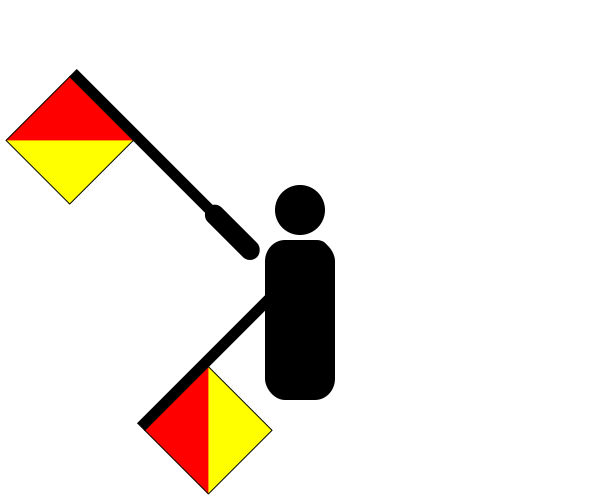
How to communicate the surname Levis in...
Braille
⠇⠑⠧⠊⠎
Morse
.-......-.....
Semaphore



There are approximately 280 people named Levis in the UK. That makes it one of Britain's least common surnames. Only around four in a million people in Britain are named Levis.
Origin: English
Region of origin: British Isles
Country of origin: England
Religion of origin: Christian
Language of origin: English
