KURTH
Kurth is a German surname of Germanic origin, whose earliest attestations can be traced to the medieval period in Central Europe. The name is a patronymic derivative of the personal name Kurt, a shortened form of Konrad. In Proto‑Germanic the element kuoni denotes bold or brave, while rad means counsel or advice; consequently, the name is traditionally interpreted as “bold counsel” or “brave advice”.
The surname appears in a wide variety of spellings across Europe, reflecting regional pronunciation and orthographic conventions. In German, Austrian and Swiss records the forms Conrad, Konrad, Kohrt, Kordt, Kunrad and Kuhndert are common, as are the diminutive variants Kienzle, Kunc, Kunz and the patronymic constructions Kurten, Coners and Kondratovich. The name is also recorded in Slavic contexts as Konkart or Kondrat, and in Italian as Corradi.
Historical documents attest to the use of the name in the late fourteenth century. The charters of the German town of Elsabe, dated 1297, contain the entry Conrad Conradi, which may be read as “Conrad, son of little Conrad”. A further example, from 1337 in the Swiss city of Ulm, records the name Rudolf Kunzelman as a variation linked to the Kurth lineage.
Scholars also recognise an earlier occupational or descriptive origin linked to the Old High German word kurtis, meaning short or small. This element, which may be related to kurz (also translating as short or quick), suggests that the name could have been applied to a person of diminutive stature or to someone associated with a short dwelling or establishment. Over time the personal‑name interpretation became dominant, and the surname was adopted as a hereditary patronymic.
In terms of geographical distribution, Kurth remains most frequent in Germany, particularly in the eastern and northeastern states of Saxony, Thuringia, Brandenburg, Berlin and Mecklenburg‑Vorpommern. Austria and Switzerland also record substantial numbers of bearers, reflecting historic migration and settlement patterns. In the United States, the name is principally found in Pennsylvania and Wisconsin, with notable concentrations in Texas, Ohio, and Iowa. The spread mirrors the broader dispersal of German immigrants from the late eighteenth and nineteenth centuries.
Besides the core Germanic variants, the surname has been adapted into several other linguistic contexts. In the Netherlands the form Kort is frequently associated with Kurth; in French the name may appear as Lacourt or LaCour, and in English it can be anglicised to Cort, Court or Curt. Variants such as Kurtz, Kurty and Cortes also occur in diaspora communities.
Contemporary bearers of the surname often regard it as a link to a resilient, forthright heritage characterised by strength of mind and body. While the name’s roots are firmly planted in Germanic linguistic and cultural soil, its modern bearers across Europe and the Americas continue to contribute to the societies in which they reside, maintaining a proud awareness of their historic lineage.
Similar and related surnames
Related and similar names are generated algorithmically based on the spelling, and may not necessarily share an etymology.
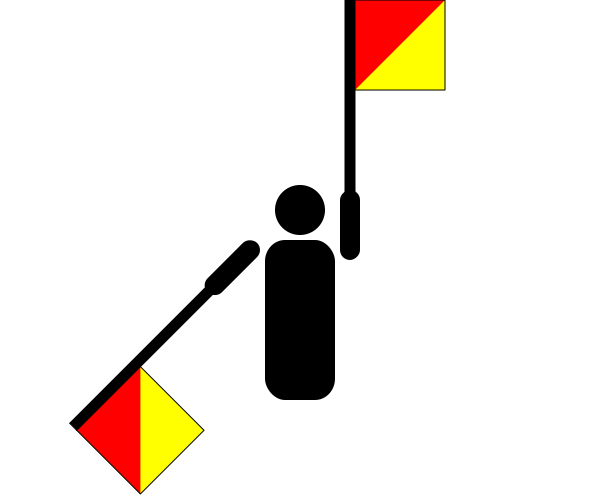
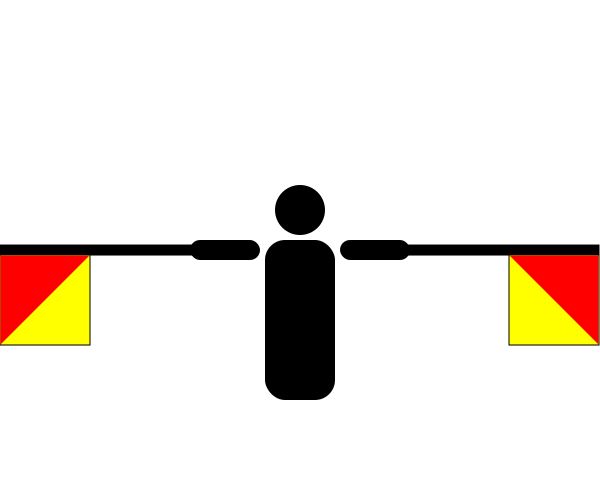
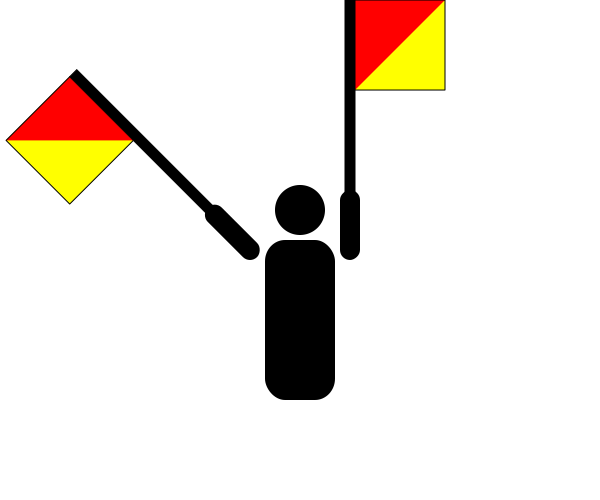
How to communicate the surname Kurth in...
Braille
⠅⠥⠗⠞⠓
Morse
-.-..-.-.-....
Semaphore


There are approximately 87 people named Kurth in the UK. That makes it one of Britain's least common surnames. Only around one in a million people in Britain are named Kurth.
