KURT
Kurt is a surname that has a dual origin in two distinct linguistic traditions. In the Turkish speaking world it denotes the word kurt, the name given to the noble and courageous wild animal commonly known as the wolf. As a surname it is widespread throughout Turkey and is also frequently adopted as a masculine given name. The symbolic association with the wolf brings to the name qualities of strength, courage and independence, attributes that are frequently highlighted in Turkish culture.
The surname Kurt also appears as a heritage of Germanic derivation. It can be traced back to the Middle-High German personal name Conrad or the Latin Curtius. From Conrad the meaning is generally rendered as “bold counsel”. The etymological roots lie in an ancient compound called Kuoni-rad, a phrase that roughly translates to “brave counsel”. In the Germanic linguistic tradition the name was commonly given to children of noble families or to members of the ruling elite during the Middle Ages. The surname carries connotations of perseverance, courage and intellectual strength.
Variations of the surname are extensive and can be found across Europe. In Austria, Germany and Switzerland the most common spelling is usually Kurt, although the alternative Kurtz also remains popular. Other recognised variants released through migration and regional spelling differences include Kurthe, Kurth, Korth, Kurten, Conradt and Conrad. Forms related through paternal or diminutive usage appear as Kunz, Kuntz and Kunzmann. Finnish, Russian, Czech, Italian, Hungarian and Dutch renditions are also evident; examples include Koenraad, Kondrat, Corradi, Kunradi and Cor(d)es. In the United States many families adopted spellings such as Kurts, Kurzweil or Kurtz through the process of naturalisation and Anglicisation.
In modern times the name continues to be used as both a first name and a family name in German-speaking regions. It remains a common baby name in Switzerland, ranking at number 89 in 2020, and it held the position of 30 in Germany in 2019 and number 33 in 2020. Austria recorded a rise to the 52 position within the same year. In the United States the name entered Popular Baby Names lists in 1924, maintaining a presence through the mid-20th century, and in 2020 held the rank of 601. Correspondent ranking data show a presence, though infrequent, in countries such as the Netherlands, Sweden and Norway.
The combination of meanings from both Turkish and German associations gives the surname Kurt a particularly strong symbolic resonance. Individuals who bear the name are often considered to exhibit a determined and powerful character. They are seen as optimistic, ambitious and intelligent, with a disposition towards a promising future. The surname therefore remains a source of pride for many families worldwide, symbolising both courage and wisdom.
Typical given names associated with the Kurt surname
Male
- Ali
- Andrew
- Cem
- Hasan
- Huseyin
- Ibrahim
- Ilker
- Mehmet
- Osman
- Veli
- Yusuf
Female
- Chrystelle
- Dilek
- Emine
- Hilary
- Ilhan
- Meryem
- Samantha
- Serpil
- Susan
- Yasemin
Similar and related surnames
- Cart
- Cort
- Court
- Courte
- Courts
- Crate
- Creed
- Croad
- Croud
- Crute
- Curd
- Curt
- Curte
- Curts
- Gard
- Garde
- Garrad
- Garrett
- Garrido
- Garrod
- Garrood
- Goard
- Gourd
- Greed
- Greet
- Grote
- Karet
- Kart
- Kartes
- Karti
- Kartz
- Kaut
- Kaute
- Kautz
- Keart
- Kert
- Kerts
- Kertz
- Kirt
- Kirti
- Kirts
- Kordt
- Kort
- Korta
- Korte
- Korts
- Kortz
- Kourt
- Krut
- Kur
- Kura
- Kurd
- Kurr
- Kurta
- Kurter
- Kurth
- Kurtha
- Kurti
- Kurtis
- Kurts
- Kurtt
- Kurty
- Kurtz
- Kurtze
Related and similar names are generated algorithmically based on the spelling, and may not necessarily share an etymology.
How to communicate the surname Kurt in...
Braille
⠅⠥⠗⠞
Morse
-.-..-.-.-
Semaphore
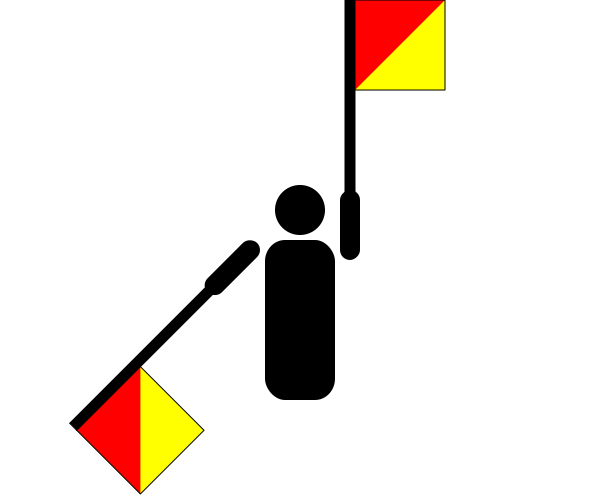

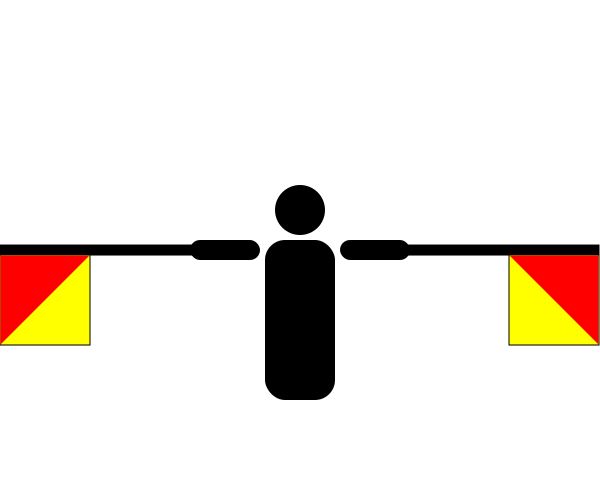
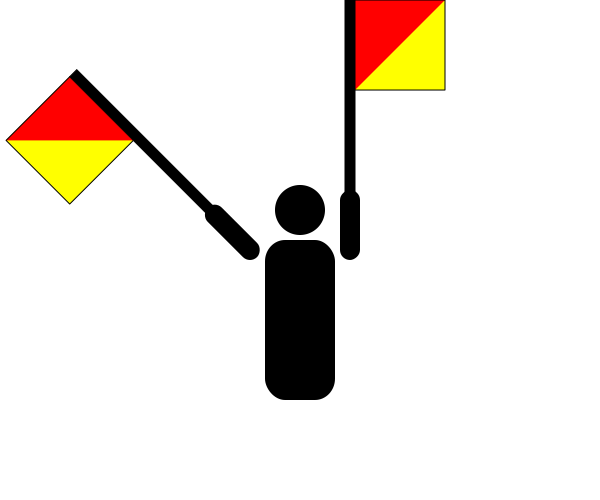
There are approximately 451 people named Kurt in the UK. That makes it one of Britain's least common surnames. Only around seven in a million people in Britain are named Kurt.
