KINDALL
The surname Kindall is of English provenance and has been documented since the early thirteenth century. Its linguistic roots are intertwined with both Anglo‑Saxon and Old Norse traditions, reflecting the complex history of settlement and language change in medieval England.
One derivation treats Kindall as a patronymic, stemming from the Old English personal name Cyneheard. The element Cyne means “royal” and heard denotes “hardy” or “bold ruler”. Thus the earliest bearers of the name were likely identified as the descendants of a person called Cyneheard, a naming convention that was common in early medieval societies.
A second and widely accepted origin is locational. The name is closely associated with the town of Kendal in Westmorland (now part of Cumbria) and with Kendale in Yorkshire. The placename Kendal derived from “Kirkby Kendal” and appears in the Domesday Book of 1086 as Cherchebi. Its meaning is “the valley of the River Kent”, a synthesis of the pre‑Roman river name Cunetio and the Old English dael for valley. Kendale in Yorkshire, on the other hand, is etymologically linked to the Old Norse words kelda (spring) and dalr (valley). Consequently, the surname Kindall can be interpreted simply as “the valley of the spring.”
Historical records from London church registers in the sixteenth century provide early examples of the surname and its variants. For instance, the christening of Chrystover, son of Thomas Kendall, was recorded on 12 August 1544 at St. Mary Bothaw, and the marriage of Edward Kendall and Agnes Deuton was documented on 12 April 1572 at St. Botolph's, Bishopsgate. The earliest documented spelling that is recognised today is that of John de Kendale, dated 1332 in the Lancashire Subsidy Rolls. Over subsequent centuries, the name has evolved into a number of orthographic variants, including Kendall, Kendal, Kendell, Kendle, Kindell, Kindle and Kyndal, each reflecting regional pronunciation and spelling practices.
In addition to its concentration in North East England, particularly Yorkshire, the surname is also recorded in Cornwall in appreciable numbers, illustrating the spread of the family beyond its original locality. Its presence in the United States, Canada and Australia has been noted, although it remains relatively uncommon on a global scale and its exact distribution remains difficult to quantify because of the multiple spelling variations.
Overall, the surname Kindall encapsulates a rich linguistic heritage, merging personal patronymic origins with a descriptive locational meaning linked to the hills and springs of northern England. Its survival through the centuries, alongside a suite of related variants, demonstrates the dynamic nature of English surnames and their capacity to reflect both individual lineage and geographical identity.
Typical given names associated with the Kindall surname
Male
Female
Similar and related surnames
Related and similar names are generated algorithmically based on the spelling, and may not necessarily share an etymology.
How to communicate the surname Kindall in...
Braille
⠅⠊⠝⠙⠁⠇⠇
Morse
-.-..-.-...-.-...-..
Semaphore
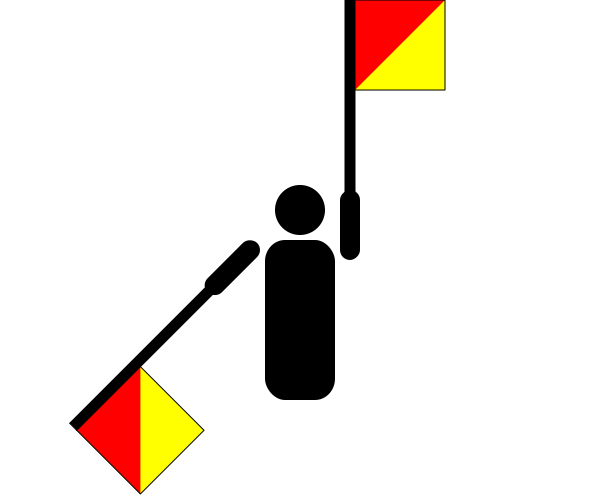
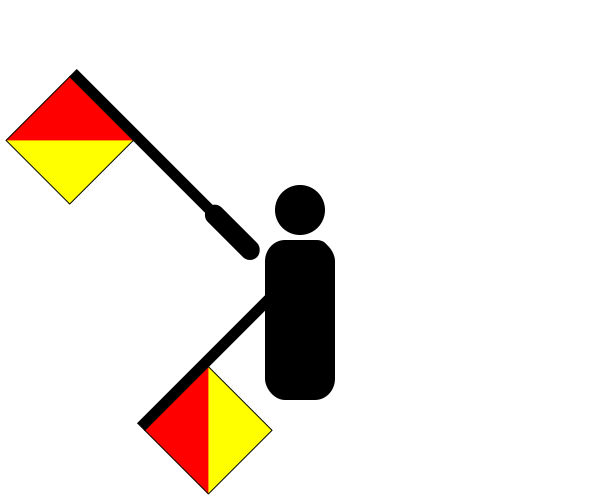
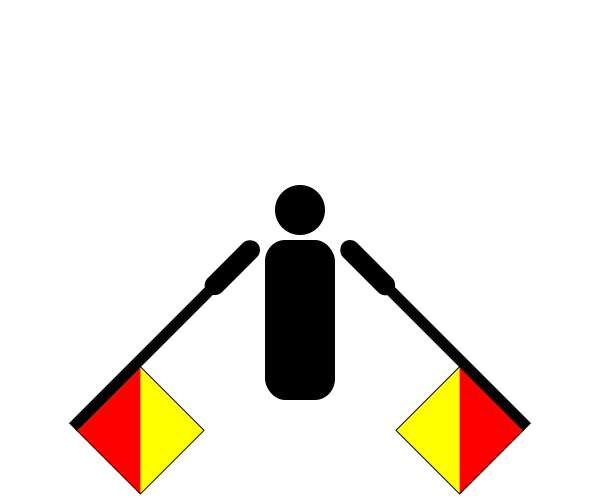


There are approximately 19 people named Kindall in the UK. That makes it one of Britain's least common surnames. Fewer than one in a million people in Britain are named Kindall.
