HUEBNER
Huebner is a surname that originates from Germany and is firmly rooted in the linguistic heritage of the Middle High German period. The name is derived from the term hube, which referred to a specific measure of land. In that era the word hube denoted a plot roughly equivalent to a hide – an English unit of land in the range of about one hundred twenty acres. Consequently, Huebner originally functioned as an occupational label for those who measured or managed such parcels of land, including land surveyors and smallholders.
The surname also appears in connections with the German word Hübner, meaning a steward or manager. In the old German dialects, a hübner or huber was generally understood to be a small farmer or landowner. Thus, the name could signify a person who not only measured land but also farmed or oversaw the cultivation of it, tying the surname to the agricultural sector of medieval society.
Early records in England place the name on the maps of the early eighteenth century, when it was first documented as Hubner. The name appears among several variants – Huebner, Hebner and Hibner – all of which are variations that arose during migration and linguistic adaptation. The earliest registered Christening listed in the annals is that of John Hebner on the 2nd April 1658 at St. Mary's, Whitechapel, London. A later record shows the first documented spelling of the family name as that of Benjamin Hubner, christened on 15th September 1728 at St. Mary's, Marylebone, London, during the reign of King George II, who is often referred to as the Last Warrior King for the period 1727-1760.
Heraldic records indicate that the name Hubner was borne by families in seven of the former principalities of Germany and also in Austria. Such documentation confirms that the name had established prominence and social standing within the Germanic realms well before migration to English-speaking lands.
The distribution of the surname has since expanded widely. Owing to the migration of German-speaking peoples, it can now be found in North and South America, Australia, and other parts of the world where German emigration took place. Within Germany itself, the frequency of the name is especially high in Bavaria and Saxony. In addition, a range of spelling variants such as Hübner, Hubner, Hiebner and Hueber reflect regional dialects and the adjustments made when the name entered languages lacking the umlaut.
Across its numerous orthographic variations, the core etymology of the surname remains clear. It is rooted in the agricultural practice of land cultivation and the measurement of property in medieval Germany, which positioned those bearing the name as essential contributors to the agrarian economy. As such, the surname Huebner carries an enduring historical significance that links modern bearers to the land‑measuring and smallholding traditions of the past.
Similar and related surnames
Related and similar names are generated algorithmically based on the spelling, and may not necessarily share an etymology.
How to communicate the surname Huebner in...
Braille
⠓⠥⠑⠃⠝⠑⠗
Morse
......-.-...-...-.
Semaphore


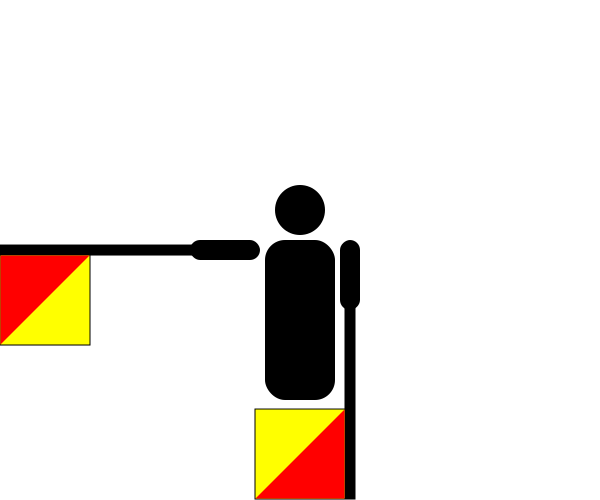
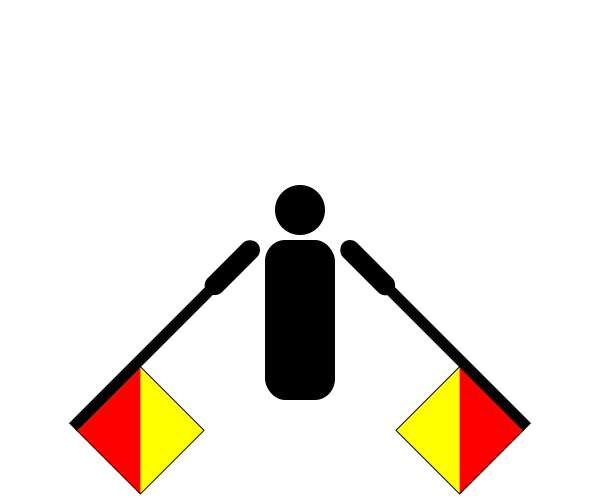
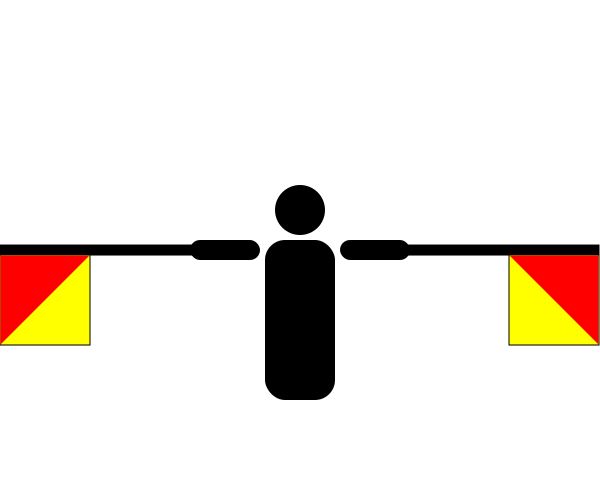
There are approximately 49 people named Huebner in the UK. That makes it one of Britain's least common surnames. Only around one in a million people in Britain are named Huebner.
Region of origin: Europe
Country of origin: Germany
Language of origin: German
